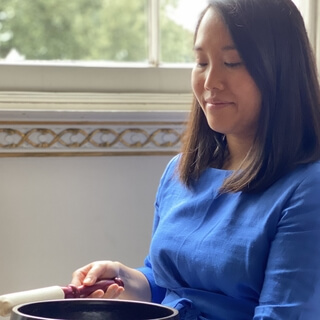
So there may be moments during a session where I invite the bell and then that's our invitation to pause and come back into our bodies or to really notice ourselves in our bodies.
And the other thing that you may sometimes see me do is bow and you don't need to bow back.
This sometimes is a gesture of gratitude in particular cultures just to say thank you for your attention.
It's also in the Plum Village tradition one hand is supposed to present the body and one hand is the mind and it's this sense of okay I'm here and I'm present.
So that's kind of what the bow means in that tradition.
Okay so let's begin this session together and yeah as we begin to explore this territory working with emotions it feels also important to name just the significance of the times that we're living in and the amount of suffering that we're witnessing maybe in our personal lives but definitely on a societal on a global scale as well.
And yeah really just to name that that piece to name that piece because we might notice yeah even in this moment how the body heart and mind how they are impacted as we recognize we recognize that piece what we are kind of collectively meeting during these times.
And yeah I'm particularly interested in engaged Buddhism or yeah practice where we can engage with the outside as well.
And I would say it's especially important to be able to look after emotions take care of emotions if we want to live in a skillful skillfully engaged way because I could care or I care but sometimes if I'm engaging in a way where it's just fueled with reactivity sometimes I will act in a way that can't be received or heard or won't be so skillful even though there's care there even though there's care there.
And as part of that also recognizing at least for my practice around tapering the dose just the volume of input we're receiving you know many of us receive through news or unfiltered content is much higher than what I believe that the mind has capacity for in that one moment.
And also the importance of taking time to step away to come on retreat to really learn how to take care of our bodies hearts and minds.
There's such an important piece to be taking this time to do that.
And yeah also to say that sometimes we might believe that we can just work with an emotion on the cushion through meditation and that's all that's needed.
But there will be times in our lives where actually these feelings these needs will need to be expressed to someone else in a dynamic of a relationship.
That emotions or this realm needs to be worked out on a relational level.
Relational level.
But once again what we're going to be exploring this week is so supportive because if we can really take care of our reactivity that will allow us to engage with others in the most skillful way in the most skillful way.
And yeah just a heads up our anchor practice for this week will be this acronym this page that I've put on this handout.
You might have heard of Tara Brack.
She's a Buddhist teacher.
She described this practice of RAIN.
And yeah many of my fellow practitioners and I we call it grain to include grounding grounding and inviting grounding in space before engaging with this practice.
And we'll be exploring each of these stages over the course of the retreat in more depth.
But really to say for some of us it's just a helpful acronym because the invitation is for us to pause on retreat outside of these sessions.
And for some of us it will just be a helpful reminder as to what practice we're doing.
But really to say trust your intuition because there might be particular areas of this practice you naturally resonate with and you intuitively move towards those places and others which maybe don't feel so relevant.
And over time you'll each kind of find your own own way with it.
So it doesn't have to look in this kind of prescriptive manner.
It's just a helpful reminder essentially.
But what we're going to be remembering today or reminding ourselves of today is this foundational practice of mindfulness.
Because when a strong emotion arises we really depend on the depth of the mindfulness that co-arises and can meet that emotion.
If our mindfulness is too unstable it can be very easy for that emotion to feel overwhelming.
But if the strength of the mindfulness is really strong and steady there's a sense that that mindfulness has a really vast capacity to meet whatever's here.
This also means that if there is a strong emotion that arises and we can tell that our mindfulness doesn't feel strong enough yet it's really okay to say to this emotion you know I see you and I want to learn how to take care of you.
For now this is a bit overwhelming so I need to go back to my mindfulness practice to strengthen that and know that that will support the relationship later.
But this this is an important dynamic for us to understand.
The word for mindfulness in the Buddhist teachings,
The kind of language of Pali,
The language of the early Buddhist texts,
The word for mindfulness is isati.
It's got this overseeing quality to it and a couple of aspects is that it offers a steady presence to be with whatever's here.
So it's able to see how this present moment experience is and how is it unfolding and it sees how thoughts emotions and sensations are interacting with each other and feeding each other in that moment.
So it's got this kind of overseeing quality to it.
And yeah we could say that the quality of mindfulness is at peace with whatever is arising.
This can sometimes be a misunderstanding because if you maybe search mindfulness online you will get a lot of images of people looking very peaceful on a beach or somewhere and so there can be a misunderstanding that we have to feel peaceful to be mindful.
But just to actually shift that understanding that mindfulness is being at peace with whatever's here even if the emotion is for example anxiety.
So mindfulness is the awareness that sees the anxiety and holds it with care without being anxious in itself.
So it's this sense of being alongside the emotion that that we're feeling.
One of my students she yeah allowed me to to share this story she suffers a lot with anxiety and often panic attacks at night time and yeah we were working together and she just shared one day well there was one night and I yeah I noticed that familiar anxious feeling felt like it was gonna go into a panic attack and then there was just this sense that I was alongside the anxiety just seeing it for what it what it is.
The feelings were still there this kind of bubbling this churning in the throat and in the chest but just got a little bit of space to be alongside it and she didn't need that emotion to go away.
So we could say that there was you know she was at peace with the anxiety there the mindfulness was at peace with the anxiety there.
So maybe we can be at peace with agitation or at peace with sadness.
Sometimes I say that yeah I'm peacefully agitated the agitation is there but it's not causing distress it's okay it's okay to be there.
And then the second aspect of mindfulness the root Pali word is sati and it's directly translated into you know it means to remember and in a moment when we're bringing our mindfulness to an emotion we also remember maybe previous ways we've practiced with this emotion previous ways we've learnt about the Buddhist teachings the Dharma that's the word for the Buddhist teachings and in that moment that can come to support us in the present moment.
So say for example yeah say for example anxiety comes and previously in my practice I've recognized oh it's really helpful when anxiety comes to feel the feet on the ground and then with time that becomes a natural response because it's kind of a learnt way that that's a skillful response to that emotion arising.
Okay so the question is how do we strengthen our mindfulness and really mindfulness is not a special activity it's not something that we solely do as a meditation but it's a quality of presence that we can bring to whatever we're doing whatever we're doing and as some of you have mentioned already that's the beauty of being here to be able to bring that quality of presence to whatever we're doing here on retreat and you've already noticed for yourself how supportive that is.
It can be supportive you know the invitation is to experience the present moment through the body because the body is always here with us in the present moment so through the senses any of the senses or through sensations that are felt in the body.
So say for example we are washing the dishes here all of us will be washing dishes at some point and maybe there's kind of thinking ahead what's coming next but actually the invitation is can I drop into maybe the feeling sensations of the warm water against my skin.
You know we can just stay with those sensations and it's just a way for us to anchor to the present.
So some helpful ways for us to access this quality of presence the first is to take moments to pause so maybe we can do that now we can just listen to another sound of the bell and pause together.
You can notice how you feel after that pause.
Often we're caught in a flow of we could say habitual reactivity or autopilot and pausing just allows us to unhook from that to offer ourselves some some space around that and yeah when we pause we're just looking inward and we're checking in how is this body this heart and this mind in this moment how am i how am i and yeah we might even sense that there might be an emotion present it might feel very localized it might feel more nebulous we can begin to sense in this way.
In one of the monasteries that I lived at there is a chiming clock in a communal area and it chimes every quarter of an hour and part of our practice is whoever is in the vicinity and can hear that chime no matter what we're doing we might be cleaning doing tasks we might be talking to someone but all of us when we hear that chime we just pause and we come back to our bodies we just feel our breath in in the bodies can just be a really helpful way to unhook from that from that flow.
The second thing is is to keep it simple so hopefully no one will be multitasking here whilst whilst we're here but also you know if we're washing the dishes it might be easier just to stay with the sensations as opposed to the sensations plus the sounds plus the eyes you know just choosing keeping it really simple as a way to anchor ourselves Taking it slower can be helpful.
We're not forcing the body or the mind to stop but it's almost like there's a little spinning top and we're not adding any more spin or say in life we have like a little snow globe and life kind of shakes it up you know and our habitual energy might be to keep shaking after a while we've kind of built a momentum and we're just slowly slowly beginning to put it down just allowing things to settle to settle.
We don't need to force ourselves to go slower than what feels comfortable but yeah just notice what is it like to really kind of take your time not to rush we notice what it feels like in our body to rush and we kind of really give ourselves permission to take our time.
We could say that the aim when we remember it's okay if we forget is to kind of stay anchored in the body and yeah particularly the silent times can be really helpful to practice this because we're more likely to remember but say after this session ends we'll be in silence and all of us at some point will need to walk to our rooms so we could say how can we anchor ourselves in the body as we make that transition as part of our practice so we could feel the footsteps on the ground as we do that.
You know we can just say okay for this moment from here to the room i'm gonna try my best to stay with the sensations in my feet and the mind will naturally probably jump ahead and then each time we notice that we come back to the sensations of the feet on the ground.
When we get to our room maybe we change it up and we're gonna say okay gonna stay with the sensations in my hand as I open the door.
Maybe when we're brushing our teeth we're gonna stay with the sensations of the toothbrush against the teeth.
We don't need to hold this tightly you know just what feels easeful or interesting to try out.
Yeah for me one of my favorite practices on retreat is to mindfully open and close doors and yeah I really like this precept that Viren was talking about this quality of gentleness.
It's like for me a really beautiful practice where I can practice gentleness.
How can I kind of just gently open the door and gently close it you know and recognizing that it's like an act of kindness as well to anyone with sensitive ears but like for me that's an enjoyable way to practice for you it might be it might be something else.
And yeah really to say that the mind wandering is an important part of the practice because the the bit where we're learning to strengthen our mindfulness is that when we notice the mind has wandered we're just gently bringing it back.
So it's a really vital part of the practice and it's also really important because we might notice ways that we we react to ourselves when maybe we don't like that the mind has wandered.
You know we might notice we're a little bit judgmental towards ourselves or we're impatient with ourselves and in those moments is a really beautiful opportunity you know how would it be like to just allow you know notice that the mind has wandered and allow myself to be human.
You know it's okay we practice that self-kindness that we practice that patience for ourselves.
A really beautiful way for us to start cultivating these qualities.
Yeah the last thing I wanted to mention is around also noticing what feels pleasant and resourcing whilst we're here.
You know can we allow ourselves to be touched by life while rather than you know withdrawing until we feel happy enough to experience life.
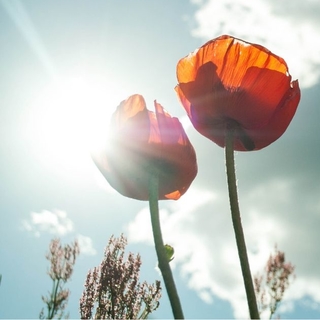
I went on a short walk earlier and I was just really enjoying the oxeye daisies and then I passed the chickens and they were so curious.
I was just really enjoying how they were kind of walking up to the gate to see who it was and these little moments can we really allow them in allow them in and some of you might be thinking you know there's just so much going on with my life.
One beautiful flower is not gonna cut it you know one chicken is not gonna cut it and you're right you know one flower is not gonna kind of you're really going through a challenging time it's not gonna be enough.
But I'm reminded of a story from the Buddhist times in ancient India there was a woman who had to travel to another village and yeah in those times you know you had to walk and it was a very far distance sometimes took a day or longer and she made her way and the sun was really beating down on her there was no shade she was getting really dehydrated and she realized she needed some water so she started looking out for water and there there wasn't any any to be found.
And then she eventually came to a crossroads and she saw a little hoof print from an animal and in that hoof print there was just the smallest amount of water and she couldn't use her hands to scoop it up it would just muddy the water so she had to actually get down on her hands and knees and just gently gently put her lips on that puddle and just took one sip.
Yeah and I'm really touched partly by the humility of this story but also you know sometimes we're really thirsty and all we have access to is one sip but can we allow ourselves to drink that?
You know it's like a drop coming into a bucket that maybe one drop isn't enough but over time we continue to allow ourselves to receive those drops it will begin to fill so really allowing ourselves to lean into those moments of beauty or gratitude or quiet joy or connection you know these these moments.
Okay it can just be helpful sometimes particularly when we're experiencing a more challenging emotion things can kind of become a bit myopic just really we can feel quite isolated so this practice of allowing ourselves to be touched by beauty it allows ourselves to feel more this sense of interconnectedness more this sense of being part of the web or flow of life.
A Zen master said once I practice so that I can see the small flowers growing in the pavement so maybe that's our invitation okay.