So taking a couple of moments to make yourself as comfortable as possible.
So it's a bit of a balancing act.
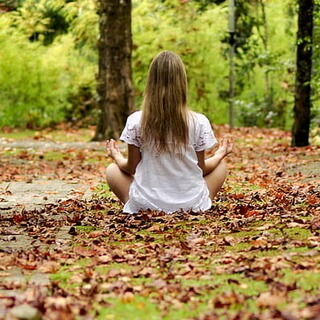
You'd like a posture that's restful and that's where your body is at ease,
But you also want a posture that's dignified and awake.
So the spine plays an important role.
So sometimes it can be very helpful to have the spine free from the chair,
So it's freestanding,
But you may prefer to take the support of the chair.
So whichever you feel will be most supportive for you.
So this mindfulness practice is where you'll be invited to connect with your experiences as they are happening.
So such as sensations in the body,
The flow of the breath,
Thoughts,
Emotions.
But for any kind of practice,
It's always helpful to have an anchor or a home base that you can come back to at any time during the practice.
So it could be the soles of the feet,
The feeling of the soles of the feet on the floor,
Or maybe the breath as it flows in and out of the body.
Or another anchor could be simply noticing sounds around you.
So it's nice to have that in your back pocket that you can go to at any point during this practice.
So you're always taking care of yourself during your mindfulness practices.
So we're going to start with the body.
Just being aware of the body as it is right now.
The head,
The neck,
The torso,
The arms and the hands,
The hips,
The legs,
And the feet.
And then sensing the body as one unit,
As a whole sitting here.
The fullness of the body,
The space that it's occupying in the room,
The connection with the chair or sofa,
The front of the body,
The back of the body,
And the sides.
So for this part of the practice,
We're placing our attention on our body into the foreground.
And everything else that's going to happen during a practice like this could just be gently playing out in the background.
So you might notice thoughts,
Sensations,
Noises.
They can all be gently happening in the background,
But the majority of the attention now can rest on the body.
Without too much effort.
This body sitting here,
Sitting here,
In this space,
In this moment,
Not having to do anything right now.
Then we can move to another part of our experience,
And that's the breath.
So just being aware of the breathing in the body.
And the invitation here is to allow the breathing to happen in whatever way it's flowing right now.
We're just gently bringing our attention towards the breathing.
We're bringing the breath now into the foreground.
It's our focus of our attention.
The in-breath and the out-breath.
And it can be interesting to see where you can feel the breath most easily in the body right now.
So checking it out for yourself.
It could be in the belly,
Maybe the chest,
Or maybe the touch of the air as it enters your mouth or your nose.
Just resting your attention for a few moments on the area in the body where you can feel the breath quite easily right now.
Not having to change or fix anything.
Trusting that the body knows how to breathe.
And then we're going to allow the attention,
Or the focus of our attention on the breathing to move a little bit now into the background.
And I'm going to invite you to just notice any sensations,
Any physical sensations in the body that might be present right now.
And not having to seek too hard,
Just noticing if there's anything there.
Pleasant or unpleasant,
Dominant or subtle.
You could notice the feeling of clothing against the skin,
The contact of the body with the chair beneath you,
The temperature of the body,
Maybe feelings of warmth or coolness.
And what's also interesting when a sensation makes itself known is to see if there's any reaction to it.
So if it's a feeling of discomfort in the body,
There might be a urge to resist it,
Or a judgment in the mind around it.
It's all part of this experience.
This is what's ever happening in the moment.
And sometimes when we notice areas of discomfort,
It's a real opportunity to see what it would be like to explore that area of discomfort,
Or bring a sense of allowing of,
Oh yeah,
This is here right now.
Or bring a sense of allowing of,
Oh yeah,
This is here right now.
What's it like?
Where am I feeling it in the body?
What are the sensations within it or around it?
Can I make space for it?
But all the while knowing you can come back to the home base that we talked about earlier in the practice for a moment or two.
And then if you feel comfortable,
You can come back to the sensations again.
And then maybe on the next breath,
You can allow the focus of sensations to gently drift into the background.
And we can now invite ourselves to be open to sounds,
The world of sounds.
So a very different focus of attention.
So we don't have to make any effort with this part of the practice.
We're just simply being open to noticing any sounds as they arise and fall away.
It could be sounds in the body,
Sounds in the room,
Through the device,
Or further in the distance.
All this life happening within us and around us through the world of sound.
And if the mind wanders off,
Gets lost in thought,
You can very gently just bring it back.
And then we're going to move to the next part of this practice where you're invited now to focus on thoughts.
Bring the thinking mind into the foreground,
The world of thoughts.
If you could imagine that you're lying in a field and there is a blue sky with maybe various different clouds and the thoughts are like clouds coming and going across the sky.
And you're just watching them.
It could be dark and heavy.
They could be light or fleeting.
They might linger.
They might be fragmented.
Just seeing the nature of your mind right now as these mental events play out in the mind.
And instead of necessarily getting caught up in the story of the thoughts,
It can be helpful just to maybe label them as there's the mind thinking,
Thinking.
Or you could say maybe it's planning or judging.
So the opportunity here is just to get to know the pattern of the mind in this moment,
Not having to change or fix anything.
And if you find that this part of the practice is a little bit tricky,
You could simply come back to the anchor,
Your home base,
And then just notice thoughts as they come and go.
And when we practice mindfulness,
We very often notice that thoughts can be wrapped up with emotions.
So I'd like to invite you now to bring emotions into the foreground of your attention.
And the invitation here is just to notice if there are any emotions present for you right now.
They could be strong emotions like impatience or restlessness,
Irritation,
Excitement,
Or they could be more subtle,
Feeling peaceful,
Feeling bored,
Feeling sleepy,
Or they might be more vague.
Maybe it's just a general feeling tone.
Could be even a sound associated with them like a hmm,
Or maybe a color,
If there's no particular label emerging right now.
The question here is what am I noticing?
What's my inner landscape like right now as I sit here?
How am I feeling within myself right now?
What's the mood like?
What a warm sense of curiosity and allowing,
Making space for anything that might be present.
So on this short journey,
We've covered the body,
The breath,
Physical sensations,
Sounds,
Thoughts,
And emotions.
So now for the final part of the practice,
We don't have to focus on anything in particular.
We can call this choiceless awareness.
So just seeing where your awareness goes to now for this last part of the practice.
It's almost like your awareness can be your guide.
Awareness of the thinking mind,
Awareness of the body.
You bring in a relaxed and open presence to this part of the practice.
Just for this final minute or so.
And to end,
I want to invite you to sit down for a minute or so.
And to help us to prepare to close the practice now,
I'd like to invite you to take three breaths in whatever way you choose.
And I'm going to close the practice now with the bell.