You've arrived at Pretty Spiritual Podcast,
Where we share our spiritual journeys to empower yours.
Come on in.
Yeah,
Okay.
No,
Seriously,
Come in.
Hello,
Welcome.
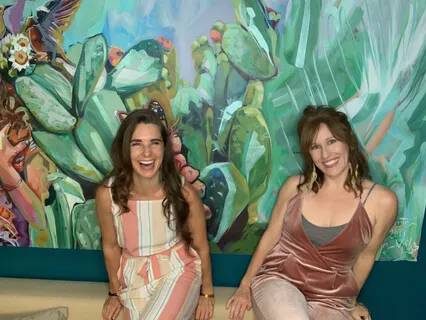
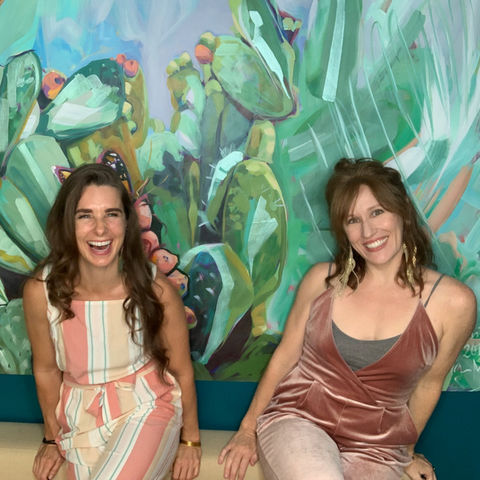
I am Annie.
This is the marvelous Lindsay Poney.
Hello.
We are Pretty Spiritual Podcast.
This is a live podcast episode.
And we are just kind of getting settled in.
So you'll hear our plants rustling as they come to cohabitate with us and our papers and our knees and stuff.
So yeah,
We brought in natural foliage.
If you hear a wild jungle cat in the background,
That is Lindsay Poney's very beautiful kitty that is untamable and will not be stopped from.
.
.
I tried to kick him out.
I'm sorry.
He's like,
I'm here for the party.
I'm a sensitive creature too,
I need to be in on this.
I'm so sensitive.
I have to be here.
So today our episode is about being a sensitive person and we titled it Tools and Resources for Empaths and Highly Sensitive People.
And however you identify across that spectrum,
And Lindsay did a lot of research and probably has more insight into that too.
I just know that I have always been really sensitive and things impact me,
Whether it's sensory experiences,
Or emotions,
Or my energy levels,
It just is different than it is for other people.
And so we have been talking about how do we navigate this world that is just full of social media and noises,
And beeps and cars and all this sensory overload happening all the time and then these constantly raising expectations of what we should be able to meet and perform and produce at and how that's kind of considered what our value is.
There's just a lot happening too in my personal life.
My mom is very sick right now with late stage cancer and all this sensitivity feels extra tender.
And we thought this episode would be really sweet,
Probably for everyone as we're all emerging in this post COVID world or semi post COVID world of coming back into this place of not wearing masks,
Being in bigger groups,
And how can we resource ourselves so we don't get overrun.
That's what we're talking about today.
I'll have Lindsay just share about what's it like for you?
What's been happening?
What's up on this topic?
Okay.
Hi,
Everyone.
Thank you so much for joining us.
Annie,
Thank you for coming and being with us.
I was very busy getting all of our sound and everything together.
So I realized I was like,
Oh,
It's starting.
I didn't say a little prayer and I didn't really check in with myself.
So I'm just taking this moment to kind of feel all of these very excited energies that are going through my body and to kind of take the moment to get settled and to be with whatever is here.
So that's kind of what I'm doing right now.
And I just want to say hi everyone that's on line right now for this Insight Live.
It's so great to be in community and to be able to get to learn about myself and maybe some of ourselves and identify and relate.
So yeah.
So it's okay to take a moment.
I just took a deep breath when you said that.
I was like,
Okay,
Yeah,
I can calm down.
It's always allowed to take a moment and be here with what is and with myself.
And so for me,
This topic was so amazing and inspiring and,
You know,
Empath is a word that's kind of new and hot.
It actually didn't come on the scene until 1908.
So it's really interesting.
It started with science fiction.
And so now that it's more in this real world that we have,
It's interesting to look at and then to go and actually define it and learn about what empathy and being empathic and all of that can actually mean and then how to take the time to really sit with it and see what it means for me.
Is this in my life?
How does this,
In what ways does this affect my life and my being on a level and my conscious of it?
And how can I use it as a superpower really is how I've tried to reframe this.
For me as a younger person,
I was very sensitive.
I know I've shared about it before where my siblings called me Agnes Tenderbones.
And,
Well,
You know,
I was shamed for my sensitivity.
There really wasn't space for it.
And I learned to harden my heart and dismiss my really sensitive nature.
And I've carried that habit into adulthood.
And so getting to learn about this topic and getting closer to when I needed to go on a gentleness tour because I've just been so hard.
I've just hardened off my heart and it's been in my defenses so that I could protect myself.
And so now that I am able to put down the shaming,
Because I found out that I was shaming myself for my own sensitivity and blocking it off.
And now it's been really exciting to kind of go back to my younger part of myself and see myself as like Agnes Tenderbones and the loving person that I am and how I feel so much and I feel so deeply with people.
And the way that I live life is like,
I'm really here and present with it and I'm feeling all of the feelings and it's resonating on a really deep level.
And I can honor that today.
You know,
I can really be with that today when I would shame myself and push it away and be like,
It's not there.
It kind of would get all like,
You know,
Misaligned and then would come out in other ways.
Oftentimes for me,
Then I became a very like aggressive person,
Uh,
Just to the opposite end of the spectrum.
Instead of being like this wholehearted sense of being,
I was like,
And,
Um,
And so I really like to look at the different ends of the spectrum of how I go when I'm not being able to be with these authentic vibrations and energies that are inside of me.
And another thing just to touch on is for me getting to learn about my sensitive nature,
How I feel fully and how the intensities go from one end to the spectrum to the other is what's been helping me to really be able to hone in on my authentic nature and what's been here,
What I've been blocking off so that I can get closer to it and to be more available with it so that I can actually use it in ways of my benefit instead of it getting misaligned and then working out kind of haywire.
Like sometimes my empathic nature ends up leading me into codependency,
Perfectionism,
Like a lot of other virtues and values that I aren't where I want to be pointing towards.
And it's so amazing that to think that if I can honor myself and this sensitivity and who I am,
Then I actually get to be more in line and in tune with the directions that I want to go.
So that's just been like mind blowing for me to see that like,
Oh right,
Like getting in this flow state of who I am and how I am and the truth of my nature can actually get me more where I want to be.
Anyway,
I'm just learning all about this.
So thanks for coming on this journey as I explore my insides and yeah,
I would love to hear about what's this topic been like for you?
I was sensitive to the plant's needs.
Yeah,
And isn't it so wonderful that she's okay.
So if you are new to our podcast,
This is what we do is we kind of share about our own experiences real time of what's happening for us with this topic.
And then the second half of the episode,
We talk about the tools and the resources that we're using to try to navigate it.
And we always like to make it clear that we're not experts.
This is just us sharing our journey as we go.
I mean,
Pony is an expert.
No,
We are experts in our own experience.
I highlighted it for us because Annie was reminding me when we were like workshopping things that we're working on,
Like,
Oh yeah,
We are experts in our own experience.
And that's what we're doing.
We're sharing very honestly and truthfully and vulnerably of like these other sides of ourselves and we're experts in that area for ourselves.
And you maybe listening could get enlivened or inspired to become the expert or the scientist of your own life,
Your own internal ways of being so that you can take that information and be able to use it for yourself in the world,
Essentially.
Yeah.
And tell us what's working for you too.
We love the tool share.
Yeah,
We need all the tools and we need to share.
Yeah,
We got to share because we learned all these from other people.
Yes,
We did.
For me with this topic,
I have,
Like I said in the intro,
I've always known that I was sensitive,
But I really,
Like Pony said too,
I made fun of myself for it.
Like I had no room for it and I thought it was a fault because I noticed that I was so responsive and reactive to how like teasing or things like this.
I didn't have any tolerance for that being the truth about me and nor did I have any tools.
And so I just pretended it wasn't happening and would kind of shove that stuff inside.
So there's the part of me that's really emotionally sensitive to being teased and this stuff.
But then there's this part of me that's very in tune with how other people are feeling.
And I,
For so long,
Had no idea about boundaries,
Energetic boundaries,
Internal boundaries,
Personal boundaries,
The things that other people were feeling or expressing,
I would pick up on them and I would absorb them,
Get waterlogged in other people's stuff.
And I described this on the podcast and with Pony and I joke about it,
But it was like I thought of myself like this cosmic jellyfish and I would just like wiggle over into other people's experience.
And I didn't want to be there necessarily.
I'm like,
Oh my gosh,
She's going through this and it's so horrible.
And then this is happening.
And it was almost like I was inside another person's body or brain and feeling what they're feeling.
And it's very stressful and draining,
But also it kind of felt like a responsibility.
Like I had to feel if I didn't let myself feel what somebody else is feeling,
Maybe that's not kind of me.
And like I said,
I didn't know anything about boundaries in that regard.
And then I'm also sensitive to environmental stimulation,
Noises,
Lights,
Music,
Sound,
Like sometimes it's fine and sometimes my wife's in bed listening,
Watching stuff on Instagram and I'm like,
Oh,
The noise,
I can't tolerate it.
She's like,
Oh my God,
My wife.
Starting to notice and acknowledge that my nervous system operates different,
Not than everybody's,
But then the mainstream nervous system and that it's very sensitive.
Part of this is just how I'm wired.
Part of this is to do with my ADHD diagnosis.
This just sensory stimulation is something that's real for me.
And I've also learned about something recently and it's very fascinating.
I'm just kind of at the tip of it,
But it's called rejection sensitivity dysmorphia.
If you're interested,
Look it up.
It's really fascinating,
But I've been learning a bit about it,
But it kind of speaks to that.
The over response I have to teasing or things like this and not knowing how to have tools in the past and then I kind of built up these tools that I use that weren't really great tools,
But they were like avoidance,
Avoiding things that I might not be great at.
And so that's a really interesting thing that I'm learning more about and as I do,
I'll share as I go.
Other things that this untamed sensitivity has resulted in is hypervigilance.
So if other people are feeling okay,
Then I'm going to feel okay.
So let me be super tuned in and I'm going to try to manage your emotions with my words,
My actions being like really nice and charming.
Then aren't we all really happy and charming too?
Everything's great.
So hypervigilance that turns into codependence for me.
All of these little things,
Essentially this last couple of years has just been learning,
Oh,
It's really okay to be a sensitive person.
There's other tools than these really kind of harmful tools that I have been using as a solution,
Which for example,
For a long time I used alcohol.
You know,
It's like dull stuff down great.
Turns out I don't like big parties.
I never knew.
So it's like I get to learn these things about myself,
Use different tools,
And then also these resources I'm going to share in our tool section,
I can actually bolster my sensitive side and tend to it.
And then there's room for it to come out in other places like creativity and in relationships that are safe and loving.
So speaking of tools.
Oh,
I do love some tools.
Oh,
Pony,
Tell us.
Thank you so much.
Right now talking about nervous systems and being really sensitive and then the world that can seem chaotic,
I don't know for you all,
But I know for me that I personally think that being alive and actually dealing with what is going on on a moment to moment basis,
Being really present with all of the emotions and the truth of life coupled with like the 24 hour news,
The truth.
I just don't,
I'm not as diluted anymore or like I'm getting older and I'm seeing how all of these causes and conditions come together.
What I'm going to do is I'm going to talk about tools right here because I have so many tools,
But I think the most important takeaway for me is that it's been really important for me to stop shaming myself and to stop hating myself,
Thinking that if I shame and hate these parts of myself,
Then that will give me the energy and the activation that I need to become a better person.
That has been this unwritten contract that's like constantly going on that took me a long time to be able to recognize and see and then get into action around that.
So that's still a really important part of my day,
Really getting in tune with myself and honoring and loving this part of myself and my true nature.
And that takes a lot of being with myself and accepting.
And also I like to call it time traveling where I go back and I look at my historical context,
Meaning what were,
How was I raised a lot of research that I was looking at was really interesting to talk about in ways that people are empathic and the ways that they,
So you can show up like skillfully and understand emotion contagion and that when we get together and how we're social creatures,
That other people's emotions,
That's why when there's a big emergency,
The first thing that everyone says is to stay calm because we have these emotions and they're contagious and then we can all start freaking out.
It's the same way with like what a baby does when one baby's crying.
I don't know if you've had a couple,
But they'll just like turn it on.
And we're still the same way only as we age and mature,
We can bring in a bigger skillset.
So with that in mind,
Some of the things that I thought was interesting was about how some people show up once we've learned these skills and like know how to be like,
Okay,
I see that you're having these issues and that I'm becoming this jellyfish or I have this semi-permeable membrane and I'm just letting all these things come in and then I'm off on a ride with you and then that's when I often will like,
You know,
I go into fix,
Solve,
Do,
Enable,
Like whatever it takes and then their issue becomes my issue and then I'm unable to have my own life in a real way for some time if I don't pay attention and watch this.
So this is all very human and it's in our DNA and it's the way that we were raised.
So going back and checking and being with this nuanced ways that you were raised and how things were handled has been really monumental and me being able to tug at strings to see what this nod is.
Okay,
So now practical,
Tangible tools.
Let's get into it.
My most important one,
I wrote the oldest tool in that I've ever had is a hankie.
So when you do your historical context and you need to cry.
So that's my number one favorite one.
I don't know.
I'm sure I've shared about that,
But anyway.
What brings hankies when we're going to have a hard topic?
A personal one for me that's been very helpful in this is to notice my intensity.
Again,
When just harkening back,
I'm usually on the spectrum,
Whether I'm more aggressive because that's just my type of how I was raised.
We were very intense family and would yell.
So you have to get to know yourself and see your little markers so that you can have the signposts of what your internal environment is like so that instead of just an automatic reaction,
You can pause and respond.
So when I start to notice my intensity somatically,
What that feels like in my body,
I get really tight and I'm not breathing fully.
And then I'm just like really fast thinking.
I mean so fast that there isn't a time.
That's also when I know that I'm in my survival brain,
Right?
Because what happens is if we were actually being chased by a lion,
Everything gets directed to being able to run just to get out.
So that's what we're talking about with nervous systems.
So nervous systems are nervous.
Okay.
That's always a cue for me that I try to remind myself.
It's very quick to be like,
Gah,
What's happening?
Where is it?
And I'm also very like hypervigilant person.
I'm very,
I'm always kind of waiting for that.
So these are,
This is information about myself that I've gained that I can use.
The more I get to know about myself and honor myself and listen to myself,
Hold myself,
Grieve for the things that needed to be grieved,
The more that I can have this really full,
Wholehearted experience with myself.
My intensity and noticing my intensity and before again with like,
I was,
I have a lot of shame around like my natural energy and who I am.
It's always been,
It's always,
You know,
I've,
I've had to evolve with it and understand it.
And so it's a big indicator for me and I can use it to help myself to see,
Okay,
Is this a moment where I can see that my nervous system is really triggered right now?
I also wanted to talk a little bit about triggering because what I recognized in my situation,
Learning about my sensitive self is that I have been confusing my sensitivity and I've been confusing it with the state of being triggered.
So what has happened is I get triggered often.
I'm doing a lot of really intense therapy and in my life I haven't realized the moments that I've gotten triggered and in a triggered state.
And when I'm in a triggered state,
I can't function.
I can't think properly,
But myself doesn't know that.
Myself is in a triggered state and I'm like,
Okay,
I got to figure this out.
So I'm going to like just get into the mode of fixing,
Solving,
Whatever it is.
And I'm in such a heightened state that then it sends me into this tailspin where I can't take care of myself.
So noticing my intensity and recognizing when I'm actually triggered and not just writing it off as I'm a sensitive person,
This is too much,
I should be different.
How do I get into action so that I can be a different person right now when what I really need to do is I need to,
Number one,
Recognize that I'm triggered.
I've been triggered.
My nervous system is triggered.
This is not the time for me to be able to problem solve.
So I recognize that I'm triggered and I take a moment and then I realize,
Okay,
My nervous system is flipped into survival mode.
Okay.
What are my tools?
What are my tools?
Okay.
Go back to tools.
So for this one,
It's bilateral is what they call it.
So bilateral stimulation,
Like I was talking about before,
When we get into fight or flight,
All of our mental energy is going to get us to get out and to just be able to survive.
So we want to be able to calm ourselves down.
So what we do is you can take any object,
Whatever is around.
Right now I have a pen.
I'm going to take some paper tape.
So you take some tape and you're going to just move it and you're going to completely follow it with your eyes.
So you're getting the full stimulation of your brain to come back online.
And this helps you to be able to go from that fight or flight,
Very small part of your brain into the bigger part of your brain that's going to move you more into relaxing.
And so what I will do is I will get some bilateral stimulation.
There's so many nervous system tools.
So this is just one of them.
I can even feel like how a different part of my brain starts to come on.
Then I'm going to do a quick breathing exercise.
There's so many,
I love breathing exercises.
And right now the one that I really,
Really like is you take two pressurized inhales and then a long exhale.
So I'm going to do it a couple of times for you.
So it's going to be a hard,
Fast inhale two times through the nose and then a longer exhale and just take your time with it.
So it's going to go.
So again,
It's a very,
I feel all floaty now.
That's why I love some breath work.
So I've gone from a very triggered state into a much more in pretty quickly.
But again,
For me,
I just wanted to say that I forget that I am triggered and my brain is so in survival mode that I really have been taking time on a daily basis to remind myself that I actually am triggered a lot in my daily life.
And that is okay.
I have tools and I can have agency to help flip my nervous system to get myself back online and there will be time to problem solve and figure it out and understand why all of this is here,
But coming back to like really getting myself into the safest place,
Which is my body,
Myself right here.
And it's a much slower,
Less intense environment.
And so getting to gauge the two sometimes when I'm triggered,
What's really nice for reality testing is to write down all the ways that I feel when I'm triggered.
So for you,
It's going to be very personal.
It can be completely different.
I don't know what it's going to look like for you,
But it has to do with your body and ways that you're holding it,
The mind racing perhaps.
And then I also take a snapshot of immediately after you do some bilateral stimulation and then you do a quick breathing exercise,
Then take the temperature of like,
Oh my gosh,
You know,
Like,
Wow,
I felt muscles in my body that I didn't even know were tense,
Relaxed.
And then I also had like a floaty,
Amazing feeling.
That's really what keeps me coming back.
I have to be honest,
I love cash and prizes and I love to feel good.
So those are my tools for now.
I have so many more and I would love to talk so much more about this.
Thank you,
Pony.
I felt myself relaxed,
Especially after the breathing one.
That's so helpful.
Yeah.
The first tool I want to share is one that I learned from a very special woman named Wendy and it's called neutral separations.
And someone taught it to her and she taught it to me.
And it's an energy tool,
An energy containment tool.
And it's to help with that cosmic jellyfish when I'm obsessively in someone else's experience.
And so essentially it's creating this energetic boundary inside of me mentally,
Physically,
Spiritually.
So I know that I'm contained and then I'm actually separate from other people because sometimes that gets hazy for me.
And so I'm going to do an example of it with Pony.
So she'll just sit there.
She doesn't know I'm doing this.
Isn't that great?
I'm over at my house in San Francisco thinking,
Is she okay?
Is this happening?
She didn't text me back.
Is she mad at me?
You know,
That's just an,
That's not actually our relationship,
But that's an example.
And so I can notice I'm doing this obsessive thinking or I think I'm in someone's experience.
And then I state five things,
But I'll just do two for time's sake of facts about us.
So be sure not to say things that are those sneaky opinions,
Right?
Like Pony is so much smarter than me.
Like those aren't the different types of things we're looking for.
Just facts.
Pony lives in Oakland.
I live in San Francisco.
Pony is separate from me.
I am separate from Pony.
I release any energy of Ponies that I'm holding and I take back any of my energy that Pony has.
And so I'll just kind of picture myself as this contained person in my house in San Francisco,
Pony in her house in Oakland.
And I'll say,
Pony has blue eyes and I have hazel eyes.
Pony is separate from me and I am separate from Pony.
I release any of her energy and I call back any of my own energy from her.
And so I just go through that just stating facts that are not any kind of biased facts.
They're just simple things.
And at the end of it,
It's really soothing to me and it's been very helpful.
The example I used of the text message was very silly,
But there's been times when I have been emotionally sick,
Caught up in other people's stuff.
And that is a tool that really kind of helps me come back into my body.
So that's my first tool.
My second tool is,
I've been using this a lot,
Especially now that my mom has been sick,
But also just we moved.
Life is so life and everybody here has their life happening and they know exactly what I mean when you're overwhelmed and there's stuff happening and it just feels like holy bananas,
What else?
And so I was encouraged by someone to set a timer on my phone every hour that says take five breaths.
Because I do what Pony does is when I get overstimulated,
I run faster.
I'm like,
Let me have another cup of caffeine.
I'm going to run away from all this overstimulation by running more.
This was suggested to me and I was like,
That's a terrible idea.
No one has time to sit down for five breaths.
What?
Every hour?
What am I,
A maniac?
And I've been doing it and I have to force myself to sit down,
Force myself and then just take five breaths.
It takes maybe 20 seconds and it always slows me down a little bit.
So that is another tool,
Both of those tools are about me coming back into my body because when I am overstimulated as a sensitive person,
I kind of dissociate from my body.
I just start to ignore my body cues.
I start to smash them down with caffeine,
More stimulation,
All these things.
So I just,
I needed just,
Here I am,
I'm right here.
It's okay.
And then when I kind of come back into my body,
I might even like do a little baby cry.
There's this like little,
That comes out and then it's gone.
But that's the thing I was running away from in the first place.
So for me,
A huge part of this is getting tools for addressing my codependency,
Which for me is this compulsive behavior.
And so spending time with other people who are also working on recovering from codependency has been game changing for me as far as understanding that I'm very sensitive to other people,
To the world,
And that that doesn't make me bad or weak.
But also I have come up with these strategies that are no longer serving me,
Which are like hypervigilance and lack of boundaries and ignoring myself and saying yes when I shouldn't say yes and all the things.
And I'm happy to provide more insight on how to find resources on recovery from codependency.
People can reach out on our social media platforms and I'm happy to provide resources for that.
Insight Timer is an amazing resource for empaths and highly sensitive people.
There are tons of talks on here about- I listen to so many.
They're so good.
Like what is empath versus a highly sensitive person?
There's meditations,
There's visualizations.
I have two- so in the morning I have a routine that I do to prepare myself for the day.
I'll usually journal,
Say some prayers,
And then I'll listen to some guided meditations.
And I've usually been listening to two.
One that's kind of about my spiritual path and then the other is about being an empath or a highly sensitive person and preparing yourself for the day.
And it just gets my brain on board.
So there's a couple that I have highlighted.
One is Meditation for Empaths by Suzanne Robichaud.
And it's really cool because she does this visualization in the beginning where she walks you through energy containment and kind of control of your energy.
And it's so helpful because it's like,
Oh yeah,
This is not just a thing I make up in my head that I'm sensitive and I can feel my energy.
Other people do this and they have active tools and they are available for me to use.
And another one I've been listening to a lot is called Empowering Empath Meditation.
And it's by Mariam Sosa.
And this has another visualization about putting this cloak on around you.
So you kind of envision putting on a cloak for the day and not in a way of hiding from the world but more of,
Again,
This kind of protection and containment because otherwise I just kind of seep out everywhere.
And then my last tool is Affirmations.
So like Pony said,
I use the shame tool hardcore.
I'm too sensitive,
What a baby,
Get the hell over it.
I have been saying I am lovable just as I am.
I also really practice on saying,
Oh,
I'm comparing myself to my wife.
My wife is the most high executive function person.
She's just clicking like this at 120% all the time and I'm not her.
My nervous system is different.
My executive function is different.
I don't operate like that.
And when I compare myself to her,
I am a failure in my mind.
So I have my affirmations.
I say,
I love you Annie.
Oh,
I love you Annie.
And then I say,
Oh,
You're doing great.
So it's like Annie was talking about figuring out the bringing her energy back.
A really good question to help bring this in is,
Is this mine?
Like what is going on?
These emotions,
Are these mine?
What do I stand to lose?
What is going to happen with me?
Are these mine?
And I just learned about that one.
And that has really,
Really helped me with my empathetic walls.
And if they've soaked up other states that I'm confusing as my own.
So like what's at stake here?
Is my safety at stake?
Because a lot of times when I get triggered,
I think that my safety and my wellbeing is in jeopardy.
So asking,
Is this mine?
What am I going to lose?
What's the worst that could happen here?
Helps kind of bring me back and reframe what's going on.
And that was really just playing off on Annie and her amazing tools of being like having the person side by side so that you can separate yourselves.
So that's one of the great questions.
And then another mantra that I learned in yin yoga that I loved so much is my sensitivity is my superpower.
And it's a mantra.
So instead of,
Again,
With like the shame for so long,
We have these habits of shaming that our truth about ourselves is actually realizing that my sensitivity is my superpower.
I can hone it.
I can listen to it and it can tell me the things that I'm needing to hear,
Acknowledge and be with.
I honor it.
I recognize the truth of feeling deeply and resonating with others around me.
It's an amazing thing.
And a really trust me,
I big part of my job is I am people even have told me this,
Like I,
My I'm an ESL,
I'm an emotional support Lindsay,
Cause my name's Lindsay pony.
And like it is a real tool being able to show up and be there to be able to show up and be there in these types of waiver.
People is a skill.
It is emotional labor.
It is exhausting.
And being able to recognize it as a superpower that is there for yourself first is really,
Really important.
So I gather and protect my energy.
I use it for myself because we are,
It's okay cause I forget that I can get well and take self care time and take care of myself.
I am worthy of that.
And when I do that first for me,
Other people will be taken care of because I have a tendency to help everyone else.
And then just let myself go to the wayside as I'm sure other people can kind of relate to.
I think you called out that be showing up for people emotionally takes energy and it's emotional labor.
Yes.
And then also part of this acknowledgement and understanding and knowing my body cues and knowing what my energy levels are at.
Then when I'm not able to show up,
I can not answer the phone if I'm not able to do that right at that time.
And so all those little things,
As I start to understand and take care of myself,
I can say,
Oh,
You know,
I'm going to read this text later because I know that it's going to take some juice.
So I'll look at this later.
I'll answer this email later.
I will make plans a week from now with this person when I have a bit of time to rest.
And it's like,
I didn't have the capacity to do any of those things before because I didn't even acknowledge that it was real for me.
So we're all here.
We're doing it right.
We're just doing these baby steps and trying new stuff and being gentle with ourselves and like you said,
Bony,
As we do that,
I actually can give so much more because it's coming from this really resource place,
Not me kind of constantly running on empty.
Right.
Yeah,
Definitely.
We're so glad that you joined us.
We're so happy and we're just kind of wrapping up here.
And before we got on,
I was doing lion's breath and then I was doing ocean breath.
And after going through all of this,
People are talking about being triggered.
In the comments,
I just want to be really honest and clear.
It's true.
When we go in and we talk about these really real things that are here,
Not only can it be triggering or a big upheaval or it's a lot,
This type of insight work is a lot.
And it's why people stay deluded and in denial.
And we all have a healthy layer of it because it's how we operate and go on this planet.
And so just really taking time and being with yourself and calming yourself down and doing some breathing.
Do the bilateral.
Always love some of that.
Get that going.
Hug a cat.
Yeah.
Highly recommend.
Yeah.
Just getting the lion's breath and the ocean breath and taking this time to be with yourself.
And we're proud of you.
Yeah.
Because this work is really,
Really worthwhile.
It's hard.
It takes bravery and courage and it takes a group of people in a community and you all are our community.
We're so glad that you're here.
If you are able to donate,
We would love that.
It helps us so much.
And we are going to do this every month.
We'll have a live podcast episode and we're also audio recording it.
So then it will be up streaming on platforms.
All the platforms.
So we're really excited.
It's so fun to have this interactive and see you all here.
It's so great that we get to show up and share tools and learn together because without each other,
I need someone.
.
.
We show up and we prop ourselves up and we learn these tools and we do what we can.
And also we rely on our net in a healthy way in our community.
And Insight Timer is so amazing to be able to do that.
There's so much here for all of us.
It's the best.
And find us on social media.
We won't call out any specific names,
But that's where it's easiest to chat with us.
And if there's tools that work for you as far as navigating this world as a tender person,
We want to know.
We love hearing them.
This is how we learn and grow is by sharing.
That's right.
We learn and grow together better for sure.
I wanted to also just call out Katie C.
If she's on here,
She reached out because her mother is very sick and it sounds like our mothers are in similar situations and it was just perfect timing.
And so again,
With the community and shared experiences is very helpful.
So sending love to you,
Katie C.
Yeah.
Sending love to all the moms.
We have a couple of questions on here.
So Erin first with what's your thought on trauma therapy?
I live in it.
I'm doing so much trauma therapy right now.
I do brain spotting currently.
So I'm in somatic therapy and we do where when you get into some sticky trauma spots that you've been going over,
Your eyes will look in a specific way.
And then you kind of go in through that channel and use that ocular nerve to get into some places that you might not have been able to.
And it has been monumental in my recovery.
There's nothing more important than investing in your mental health.
It will go on ad infinitum.
And so when I think about that,
There's just,
I will do whatever it takes to be able to do that.
I do somatic therapy for,
I was going through PTSD and my therapist is a somatic therapist and it was very helpful because it was less about digging into specific memories or experiences.
And it was more about working to release trapped emotion and experience in my body.
So a lot of teaching me body cues,
Teaching me how to understand what was happening in my body because I had kind of dissociated from it for so long and then giving me tools to get into my body safely as well as having talk therapy.
So I could talk about experiences as they came up,
But it really was less about like reenactment or coming like confronting and more just making room for when it came.
Emotional is such a huge part of so many people's lives and so we are sending love to everyone working on that right now.
Someone asked what our favorite colors is.
Green,
Gold and purple?
All colors,
Rainbow.
I need all colors,
All patterns,
All the time.
Love that question.
Thank you.
Pony,
Someone asked about the bilateral movement.
Can you just tell people what to look up maybe if they want to learn about it?
If you look up nervous system regulating tools,
There's so many and bilateral stimulation,
There's so many.
I mean even flossing your teeth counts.
So it's really cool to look for those types of tools and riding a bicycle because you get your legs.
It's really about getting your whole brain involved.
That's why I call my bicycle my spiritual machine because I read all the big things come to me on my bicycle.
I'm just like,
Oh my God,
So highly,
Highly recommend.
The vagus nerve,
Very important and there's lots of ways that you can lay down and breathe to get your vagus nerve,
Which is the longest nerve in your body that really can change things for you somatically and with your nervous system from what I've researched.
Of course,
Do your own research.
Sarah asked what do you guys think about massage therapy?
Pony and her partner,
Justin,
Do a lot of massage and body work.
Yeah,
I think it's really,
Really,
Really important.
My most favorite is actually contrast baths.
I think that it is a spiritual experience that takes you to another level for me.
No matter what,
The last 10 seconds of my shower minimum is freezing cold.
So a contrast bath,
This is also like Wim Hof.
It's a type of breathing and when you get very,
Very hot in a sauna and then you take it all the way down like freezing cold all the way up for at least 30 seconds and do that back and forth and back and forth.
And it has helped me to be able to get over some really big blockages inside of my body,
Mind and heart.
And I do it at least once a month.
The pandemic,
It's been harder.
So I really think that there's a lot there.
If your doctor thinks it's okay.
I'm not a doctor.
I don't know what anyone needs.
What kind of therapy practice would you suggest to pull stuff down memories?
That's such a great question,
Carly.
And I don't know if I have the specific answer to that.
Pony has some insights.
I think it would be really important to make sure that you have a really wide net when exploring PTSD.
A lot of times the reason why our memories are gone is because it was something that we could not process,
Handle or did not have the tools at the time or the support.
So I really encourage making sure that you have some type of support.
Personally,
For me,
There are some groups that meet and they have a lot of ways that they bring up the past type of time traveling.
So there's a lot of writing and ways that you can essentially go back into your historical context with the right type of questions.
You can message us on the social medias with the photos.
If you message us on what she said with the photos,
Direct message us and I will send you all of the things that I have done that have been some cues where we meet in groups and we actually go through this type of stuff.
So hearing other people's memories,
Oftentimes for me,
Has been a time capsule that has jarred something that has taken me back to some areas that work on to me.
And like I said,
This is something that you should have a therapist and some type of support,
Whether it be spiritual friends,
People that know you're doing this type of work.
Training professionals.
Yeah.
And because it's labor,
It is really intense labor.
And when I was especially in the thick of working,
Like my PTSD was coming up,
It didn't come up until I was eight years into my sobriety journey and I had been working with a therapist and it was like all of a sudden this key unlocked in my brain.
That my body wasn't safe enough to have those things come up until that point and had I rooted around and kind of forced them out,
My system wasn't,
Like speaking of sensitivity,
It was too sensitive to manage all of those things that I had worked really hard to keep locked inside.
So like Pony said,
I really,
Really encourage you to have as much support and to go with the guidance of a mental health professional who's informed in trauma as you go on your journey and we love you and we believe in you.
Yeah.
We're rooting for you.
You're on the path.
Keep going.
Gently.
Yeah.
Awesome.
Well,
We're so grateful for all these amazing questions and for everyone to participate and just be with us.
It is so special.
It really is.
Thank you so much for showing up for yourself and being here with us and we hope you take the time to love yourself today.
Yeah.
Bye.
See you next time.