Welcome to the Mindfulness Meditation podcast.
I'm your host,
Dawn Eshelman.
Every Wednesday at the Rubin Museum of Art in Chelsea,
We present a meditation session led by a prominent meditation teacher from the New York area.
This podcast is a recording of our weekly practice.
If you would like to join us in person,
Please visit our website at rubinmuseum.
Org slash meditation.
We are proud to be partnering with Sharon Salzberg and teachers from the New York Insight Meditation Center.
The series is supported in part by the Hemera Foundation.
In the description for each episode,
You will find information about the theme for that week's session,
Including an image of a related artwork chosen from the Rubin Museum's permanent collection.
And now,
Please enjoy your practice.
Good afternoon.
Welcome to the Rubin Museum of Art and to our weekly mindfulness meditation practice.
My name is Dawn Eshelman.
I'm head of programs here.
The future is fluid.
At least that is how we are talking about it.
Here at the Rubin Museum this entire year and this month,
Here in our meditation practice,
We are examining this idea,
This concept of fluidity and how it shows up in our collection here at the Rubin,
But also how it's helpful and useful to us as we think about the future,
Our place in the past,
The present,
And the future,
And of course,
In our practice,
In our meditation practice.
And each week we team with our teacher of the week to select an artwork from our collection that illustrates this idea.
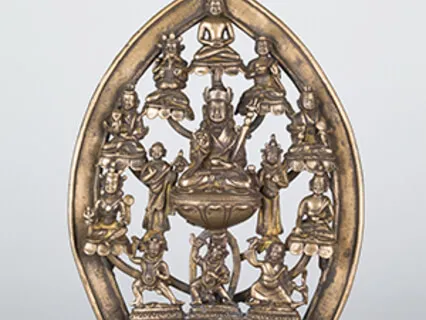
And so that brings us to the object you're looking at behind me here.
This is a beautiful sculpture from the 16th century,
Copper alloy.
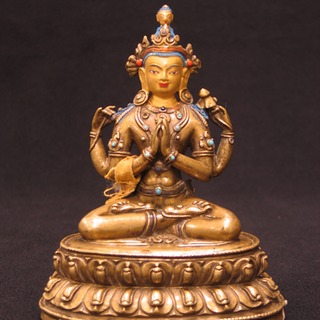
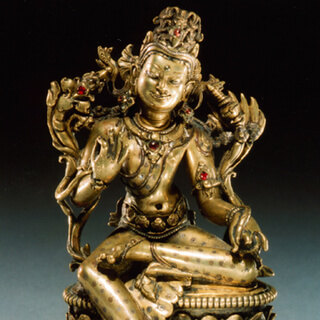
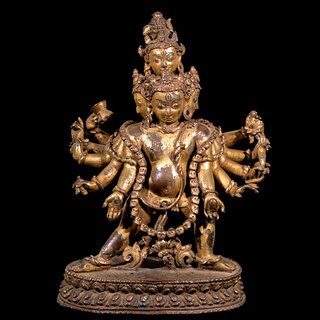
This is the eight emanations of Padmasambhava.
And if you've been here throughout the month,
You've been hearing us talk quite a bit about Padmasambhava,
Who was an extremely important figure in Tibetan Buddhism and elsewhere as well,
But is known as the second Buddha,
Is known for bringing Buddhism to Tibet.
And you can learn all about him up on the sixth floor.
There is an exhibition all about him called The Second Buddha,
A Master of Time.
And in fact,
He could time travel.
He could actually understand the past,
Present,
And future all as one.
And his powers were many.
He in fact could appear in his many different forms,
Eight different emanations.
And that is what the sculpture behind me is showing us right now.
So you may have counted these figures and noticed that there are more than eight,
In fact.
So Padmasambhava is perhaps obviously in the very center here,
This historical figure that we've come to know.
And directly above him is the Buddha,
Samantrabhadra.
And directly below him is a protector deity,
One of those wrathful protectors that we've talked about many times.
And then flanking him directly on either side are these two figures that were really important to the success of him bringing Buddhism to Tibet.
And that is the monk,
Shantarakshita,
And his consort,
Yeshe Tziyogo.
So surrounding Padmasambhava are his eight emanations.
And you can learn more about those if you'd like to take a little bit more time and go on the tour after meditation today.
It's free,
Of course,
With your ticket.
Jeremy will meet you right outside and bring you up to the sixth floor and tell you all about the eight emanations.
For our purposes here today,
I think it's useful to just think about the fact that Padmasambhava is powerful not only in his human form,
But in all of these other forms as well.
And that his power is really part of it rests in this ability to kind of shape shift,
To be who he needs to be for a particular purpose.
And that that is probably something that we can all relate to,
That we all have different parts of our identity that we exercise at different moments during a day or that develop throughout our lifetime.
And perhaps that's something that we get to know in our practice.
But this idea of fluidity,
Of course,
Is something that we can practice as we let go of each particular moment and focus on our breaths in our mindfulness practice itself.
So we'll hear more about this idea from our wonderful teacher,
Sharon Salzberg,
Who's back with us after lots of travels.
Welcome back,
Sharon.
Always great to have you back.
She's the co-founder of the Insight Meditation Society in Barre,
Massachusetts.
She is a beloved teacher and author,
And many of her wonderful books are found up at the shop.
And her latest book is Real Love.
Please welcome her back,
Sharon Salzberg.
Hello there.
Hi.
Nice to see you all.
Is it still winter?
I'm not sure.
I have a cold.
But I guess last week was actually canceled because of the snow.
It's like intense.
I wasn't here.
I was stuck in Charlottesville,
Where in the most psychic event of my life,
I'd had my boots mailed.
Because I was in California before then.
And I thought,
I'm not bringing my boots to California.
That's crazy.
By the time I come back to these coasts,
It won't be winter anymore.
That was not the psychic event.
That was the opposite.
But sometime while I was in California,
I thought,
You know what?
I should get someone to mail my boots to Charlottesville.
And they did.
So I was really happy about that.
So fluidity.
I even like the word.
I think it's such a precious kind of word.
And it brings up everything as these terms,
These concepts actually do.
Change,
Movement,
Flow,
Beginning again,
Resilience,
All the ways that we get stuck,
That we sort of defy that reality or attempt to defy that reality.
There's so many associations with it.
I even thought of,
I remember at the time I was teaching with my friend Mark Epstein,
Who's a psychiatrist here in town.
He's written several books on Buddhism or meditation and psychotherapy.
And that's how he defined trauma was frozen,
Being frozen,
The lack of fluidity.
So I keep imagining a river which encompasses everything,
Shallow points and deep turbulent points and schmutz that's flowing around in the river and clear parts and just flowing,
Always flowing and thinking about our lives in that way and the ways that we kind of defy that or we get stuck or we start to close down around something and freeze.
And how one of the reasons that's experienced by us as being traumatic is that it's counter to how things actually are.
It's like everything is trying to move.
It's trying to continue to flow and to burst out of that confine.
And we're somehow closed down.
So that's the struggle.
And realizing that and being able to kind of release that sense of struggle is part of our practice.
So that means inclusion.
One of the things I really love about this image is how many parts of his being are being manifested.
And it reminded me of when I first went to India,
Which was a long time ago,
And I'd seen the pantheon of Hindu gods and goddesses and sometimes they were the same person.
But I'd say,
Who's Durga?
Durga is like the mother in the most kind of conventionally maternal guise,
Like making you cookies and hugging you and saying,
How was your trip?
Did you have enough tea?
Things like that.
Like that over there.
And then like,
Who's Kali who looks totally different?
Kali is the same as Durga.
But Kali is the wrathful,
Intense manifestation of that same essence.
And it was my first beginning of thinking,
Oh,
That same essence might manifest in lots of different ways.
It's like the core part of our being might come out in certain circumstances as a sort of gentle,
Nourishing,
Caring aspect.
And other times it might come out as a fierce,
Intense,
Demanding aspect,
But it's still the same essence.
And so here we have the many manifestations of Pabasambhava,
Which is really kind of the same thing.
Like when we discover our essence,
It's not just one thing in terms of its manifestation.
We meet life as is being demanded in the moment to the best of our discernment and intelligence and awareness,
And we show up for it in that form.
But who we are within is really that same sense of knowing who we are,
Presence,
Balance,
Love,
Compassion,
And so on.
So flowing,
Moving,
Changing.
Every time we try to stop that,
We're in trouble.
I did a webinar,
I guess you'd call it,
Yesterday with his friend,
George Mumford,
Who's a sports psychologist.
He's worked with a lot of,
Well,
He's not only sports,
He's worked with a lot of teams,
Which is what he's mostly known for.
And he kept talking about flow,
Just that concept of flow where you're not like over determining something and saying,
Well,
If I move my fingers,
You know,
Three quarters of an inch over here,
Then I'll get a better basket or something.
But you're in a certain state where all these factors are coming together and it's almost like you and the goal are one and you're just moving.
And it's a very different state of being.
And in some ways it resembles some of what we experience at times in meditation with,
You know,
When we remove like a lot of self-consciousness and we feel mostly in touch and we're very aware,
We're very mindful,
And we're discerning.
We understand that certain forces are arising within us that we actually want to be letting go of.
Like maybe that voice that says,
Can never do it right.
That's worth letting go of.
But because we see it and we're in more of this fluid state,
We're not seeing it and seizing it.
Like,
I knew that was true.
You know,
I've suspected that all along.
So-and-so told me that long ago and it's really true.
And why do I even try?
You know,
So not only do we have the thought that arises,
But we seize it.
We take it to heart.
We build on it.
We create a self-image around it.
We freeze,
Right?
We tighten.
We're not even breathing most likely at that time,
Right?
We're just holding down.
And as one of my teachers,
A Tibetan teacher,
Sakyamrata Rinpoche once said,
It's not the thought that's the problem,
It's the glue,
Right?
So we practice meditation.
We experience this kind of fluidity in many,
Many ways.
One,
As Don said,
You realize it's maybe been quite some time since you last felt a breath,
Which is like the home base for our awareness.
We practice letting go.
We practice beginning again.
It's like a major component right in that moment.
And also in how we relate to all the various things that come and go and come and go and come and go.
It's like,
Oh,
That's the peaceful,
Nurturing manifestation.
That's the angry,
Wrathful manifestation.
That's the fierce manifestation.
That's the gentle manifestation.
We're just watching without seizing,
Right?
As much as possible without the glue.
Because in the end,
We emerge with a whole huge new vision of who we are and what we contain and what it's okay to feel and what we can meet with.
Oh,
Poor thing.
I know,
Boring.
With presence,
With balance,
With love,
All of those things.
Yeah,
That's better.
Okay.
And we hear that voice inside us plenty of times.
I certainly do.
Okay.
So when we practice,
Largely in those two ways,
We'll be looking for that sense of fluidity,
How fluidly we can let go and begin again,
Or do we get stuck right there and a whole lot of judgment about ourselves and how bad we are,
Right?
Letting go and starting over.
And also how we meet just these various things that come and go and come and go and come and go and think of that river that's containing everything.
And our consciousness is like that river.
And we're just letting whatever comes up to come up,
To pass away.
We don't have to mess with it.
We don't have to be freaked out about it.
It's just like,
Oh,
There's that.
There's that.
Back to the breath.
Okay?
So let's sit together.
You can sit comfortably.
See if you can close your eyes or not.
However you feel most at ease.
And we'll start by listening to sound,
Which may be repeated throughout,
Which is a wonderful way of just relaxing deep inside and allowing your experience to come and go.
We can't control the sound.
We can simply meet it as it arises and passes away.
So let the sound wash through you.
And bring your attention to the feeling of your body sitting,
Whatever sensations you've discovered.
Bring your attention to your hands and see if you can make the shift from the more conceptual understanding like hands,
Fingers,
And bring your attention to the direct sensations,
Pulsing,
Throbbing,
Pressure,
Warmth,
Coolness,
Whatever you may be feeling.
You don't have to be naming those things,
But feel them.
That's where we rest our attention.
And bring your attention to the feeling of your breath.
Just the normal natural breath,
Wherever you feel it most distinctly,
The nostrils,
The chest,
Or the abdomen.
Find that place,
Bring your attention there and rest.
Same level sensations.
You may get an image of the breath,
You may hear the breath,
But we're aiming our attention toward feeling the breath,
One breath at a time.
And the sounds or images or sensations or emotions might arise,
But they're not very strong.
You can stay connected to the feeling of the breath.
Just let them flow on by.
You're breathing.
Just one breath.
If something comes by and it is quite strong,
It just pulls you away.
You get lost in thought,
Lost in fantasy,
Or you fall asleep.
Truly don't worry about it.
We say the most important moment is the next moment after you've been gone,
After you've been disconnected.
Will we realize that?
Practice letting go,
Practice beginning again.
If you have to let go and begin again,
Countless times in the next few minutes,
It's totally fine.
Great.
.
.
.
.
.
.
.
.
.
.
.
.
.
.
.