Welcome to the mindfulness meditation podcast presented by the Rubin Museum of Art.
We are a museum in Chelsea,
New York City that connects visitors to the art and ideas of the Himalayas and serves as a space for reflection and personal transformation.
I'm your host,
Dawn Eshelman.
Every Monday we present a meditation session inspired by a different artwork from the Rubin Museum's collection and led by a prominent meditation teacher from the New York area.
This podcast is a recording of our weekly practice currently held virtually.
In the description for each episode,
You will find information about the theme for that week's session,
Including an image of the related artwork.
Our mindfulness meditation podcast is presented in partnership with Sharon Salzberg and teachers from the New York Insight Meditation Center,
The Interdependence Project,
And Parabola Magazine.
And now,
Please enjoy your practice.
Welcome to mindfulness meditation online with the Rubin Museum of Art.
I'm Dawn Eshelman,
Great to be here with you.
And for those of you who are new,
The Rubin is a museum of Himalayan art and ideas in New York City.
And it's great to be here with you and to practice together for our weekly session where we combine art and meditation online.
As many of you know,
Our practice here is to take a look at a work of art together and to hear a brief talk from our teacher,
Who today is the wonderful Sharon Salzberg.
And then we'll sit together for a short sit,
15 to 20 minutes,
Guided by Sharon.
Let's take a look at this work of art together.
We're talking this month about this idea of facing chaos.
And this theme comes to us from the beginning section of an exhibition we're just about to open.
It's called Awaken,
A Tibetan Buddhist journey towards enlightenment.
So it explores the steps in the journey of self-knowledge and transformation from chaos to awakening and everything in between.
So for the next couple of months,
We wanted to explore some broader themes from that exhibition.
So here we are starting with facing chaos.
So let's see here.
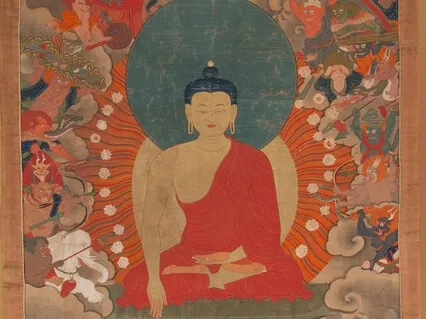
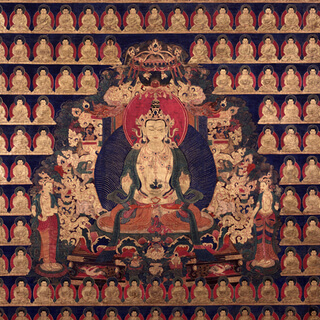
This epitomizes a very important moment in the life story of the Buddha.
And this is perhaps a familiar image to many of you.
This is the Shakyamuni Buddha,
The historical Buddha.
And this image here shows us with the Buddha.
And I'll just talk mainly about the main figure here.
We'll get into what's going on a little bit around him.
But he's seated in a meditative position,
His legs crossed and one hand on his lap.
And the other hand,
His right hand is reaching down toward the earth.
And in fact,
This is a gesture that we often see the Buddha depicted as using.
But here it points to this very specific moment in time,
The moment of his enlightenment,
The moment,
You know,
After many,
Many moments of grappling with chaos,
With obstacles.
And here in this moment,
Despite all of these obstacles in his way,
This army that is surrounding him and really,
Really trying to get him here with all kinds of different weapons.
This is the army that Mara has created and imposed upon the Buddha to distract him.
But here in this moment,
He is touching the earth,
Right?
He is simply reaching down and asking that the earth witness him.
And in doing so,
This is his moment of enlightenment,
This moment of complete awareness,
This moment of recognizing that all of these distractions are simply that.
And in fact,
You can see that the weapons themselves and the arrows that are being kind of darted towards him here are being turned into flowers,
Into blossoms.
And you know,
Reminding us that these are all constructs,
Right?
And so the Buddha has kind of transformed them into something else through that awareness.
So we'll bring on our teacher,
Sharon Salzberg.
Sharon Salzberg is the co-founder of the Insight Meditation Society in Barre,
Massachusetts,
And has guided meditation retreats worldwide for many years.
She just celebrated her wonderful anniversary.
I think we spoke about it last time,
Right?
50 years of practice.
And Sharon's latest book is Real Change,
Mindfulness to Heal Ourselves and the World.
She's the author of several other books,
Including Real Happiness and many more,
Which you can purchase in many different locations,
Including the Rubin's shop and online.
And she's been a regular participant in many of our onstage conversations and just such an important presence and teacher here for us at the Rubin.
You can find out more about her at SharonSalzberg.
Com.
Welcome Sharon.
Thank you so much.
Great to have you.
We were just talking about it.
It's been about a year since we've seen each other.
It's been about a year.
And I was saying that the last place I had lunch with another human being was in the Rubin Cafe on March 9th.
Hopefully we'll be there again soon.
It's actually the last place I taught physically with a group of people.
So yes,
I'm looking forward to it.
It's great.
It's great to have you here with us this week too.
So thank you for teaching today.
Thank you so much.
And I absolutely love that depiction of the Buddha.
It's meant a lot to me for many,
Many years.
And whether it's more of a Tibetan description or Burmese description,
Which is what I heard first,
It is a very pivotal moment and it means a lot,
I think,
For each of us.
So in the Burmese tradition,
At any rate,
The life of the Buddha went,
As we know,
From one extreme to another,
Then known as the Bodhisattva or being aiming toward enlightenment.
He spent quite a number of years in his youth in complete self-indulgence.
Then he went off and practiced,
As was somewhat common in that time,
These very strict austerities and practices of self-mortification.
And after six years of that,
Decided,
Well,
That's not the way either.
He came upon this idea of the middle way,
Which is neither self-indulgent nor hating in that way,
That sort of modification of the body at any rate.
And one might extrapolate from that to the kind of psychological abuse we may fall into.
So it was a middle way that avoided both extremes.
It wasn't like,
Sometimes we think of the middle and it's more like a little bit from that extreme and a little bit from that extreme and we mush them together,
But it's really not like that.
It's avoiding it altogether.
And that brings us just about up to the moment in time that's depicted with the Bodhisattva reaching his hand over his knee.
So he ate something,
Which he had not done in quite a long time,
And then went to sit under this tree known as the Bodhi tree,
In what is now a town,
Bodh Gaya,
But then was in a forest,
On a riverbank.
He sat down with the determination that he actually was not going to get up until he truly understood life,
Happiness,
Suffering,
Till he was free from conditioning until he'd known boundless love and kindness.
It was,
It was this aspiration he'd held for a long time that sent him through those years.
And he just determined he wasn't going to get up until it became real.
And there's a legendary figure in the teachings known as Mara.
Mara is,
It's kind of like the satanic figure in Buddhist teachings where Mara is actually in these legends,
He's talked about as a heavenly being that felt that since the Buddha or Bodhisattva is always depicted as a human being,
That as a heavenly being,
A celestial being,
Mara had some dominion over the Bodhisattva because he was only a human being.
And so he didn't want to lose that.
And he knew that if the Bodhisattva became a Buddha,
Became enlightened,
That he would lose it,
That he would no longer have that sense of superiority of birth.
So he decided he was going to get the Bodhisattva to give up.
So there Siddhartha got some of the Bodhisattvas sitting under this tree with this determination and Mara appears with an army.
So here's the chaos.
It was just like one thing after another,
After another,
After another,
With the goal to have the Bodhisattva give up.
And Mara appeared as these very sensually enticing images,
Thinking that desire would get the Bodhisattva to give up and throughout it,
The Bodhisattva just sat.
He had some calm.
He had the clarity of his vision of what was possible for him,
That he wasn't going to give up.
He had the ability to not kind of suck in and completely absorb the feelings,
The enticements,
The situation,
So that he had some centeredness and some space and therefore an ability more to allow these things,
Including the feelings,
Whatever they were,
To come and go.
And then Mara tried fear and he had like these hell storms and rainstorms and ghoulish sounds and horrible visions and all kinds of things.
And still the Bodhisattva sat composed.
And in all those images,
I never get the sense of like coercion or kind of violence against oneself or forcing himself.
It was like,
Okay,
I'm here.
And I think about just that quality of presence and determination,
But also ease that it implies for me.
And Mara appeared as all kinds of things and just,
It didn't work.
And then the last attack of Mara is basically self-doubt.
Mara more or less says,
Who do you think you are?
Like how dare you imagine you could actually be that free,
That you can break through the bonds of conditioning,
That you can have that radical knowledge of the ways of the world and how the world actually works.
What makes you think you can have that kind of boundless love and compassion?
Get up.
And it's in response to that taunt and that assault of self-doubt that the Bodhisattva reaches his hand over his knee and just as Dawn described,
Calls upon the earth to bear witness.
Calls upon the earth to bear witness to the many lifetimes as they describe,
Where the Bodhisattva practiced generosity and ethics and patience and kindness and equanimity and all of these virtues,
All of these valuable qualities,
He practiced them for lifetimes.
And that's what had brought him to that moment in time,
To that scene with that determination.
And the earth recognizing that shook in bearing witness to those lifetimes.
Mara realized that he was vanquished and he fled into the night.
And the Bodhisattva went on to achieve enlightenment.
And so I think of that moment,
Especially the kind of chaos and undermining feeling of that sort of self-doubt where it's so easy to believe that what our aspiration is in terms of,
You could say spiritual growth or understanding or compassion,
Whatever it is that really that's way theoretical.
You know,
That might be real for others,
But it's not real for us.
And yet it is real.
And so whatever helps us in effect,
Do that same gesture,
Reach a hand over the knee and touch the earth,
Recognizing that yes,
We have a right to be here.
We have a right to imagine,
Like dare to imagine,
You know,
A really radical degree of happiness.
And that's hard to believe both because of past experience,
The state of the world,
What we've been taught,
What we've been led to believe about ourselves.
And yet there's this thread that we look at an image like the Bodhisattva reaching a hand over a knee.
And it's not meant to be distant,
You know,
Like that happened.
You know,
If you take the myth as a happening,
It happened 2,
600 years ago.
Nice for him,
But it really is more like we look at an image of the Buddha or a great saint or we listen to the music somebody has created that is evocative of those states of possibility and whatever the experience is,
It's not,
It's about us.
You know,
We look at the Buddha to see ourselves,
To see our own potential,
Which is considered very real.
We read the words of somebody or we listen to that music or we hear that poem or whatever it is.
And it's also about us.
It's not just about the kind of distant or more abstract accomplishment of somebody else.
So here we are with that possibility in any moment to just kind of lean a hand over the knee and remember that we can follow a path and that,
Uh,
We are capable of really a lot.
Okay,
So let's sit together.
Can sit comfortably.
See if your back can be straight without being strained or over arched.
You can close your eyes or not.
Let's start by listening to sound,
Whether it's the sounds of my voice or other sounds.
It's a way of relaxing deep inside,
Experiencing greater spaciousness.
Of course we like some sounds and we don't like others,
But see if you can allow them to come and go without rushing to hold on or push away.
Bring your attention to the feeling of your body sitting,
Whatever sensations you discover.
See if you can feel the earth supporting you.
That earth that's just waiting to bear witness.
It's right there.
Feel space touching you.
Usually when we do think about touching space,
We think about like picking up our finger and poking it in the air,
But space is already touching us.
It's always touching us.
Bring your attention to your hands and see if you can move from the more conceptual level,
Fingers to the direct experience of sensation.
Picking up,
Pulsing,
Throbbing,
Warmth,
Coolness,
Whatever it might be.
You don't have to name the sensation,
But feel it.
And on that same level of feeling sensation,
You bring your attention to the feeling of the breath.
Just a normal,
Natural breath in this system.
You don't have to make it deeper or different,
Just however it's appearing.
Feel maybe that's the nostrils.
Maybe it's the chest.
Maybe it's the abdomen.
You can find that place.
Bring your attention there and just rest.
See if you can feel one breath without concern for what's already gone by without leaning forward for even the very next breath,
Just this one.
And for some people it's true.
The breath just doesn't work for all kinds of different reasons.
It's fine.
You can just rest your attention on some sensation happening in your body.
Anyway,
Maybe your hands touching something like that.
This becomes the home base.
The important thing is that quality of rest.
If you're with the breath,
You might want to use a quiet mental notation like in out or rising,
Falling to help support the awareness of the breath,
But very quiet if you do it so that it's really just a support for feeling the breath.
And if images or sounds or sensations or emotions should arise,
But they're not very strong.
If you can stay connected to the feeling of the breath,
Just let them flow on by your breathing.
Just one breath.
If something comes up,
It whirls you away.
You get lost in thought,
Spun out on a fence or you fall asleep.
Truly,
Don't worry about it.
You can recognize you've left the breath or the primary object.
See if you can gently let go and simply return.
It's okay.
No matter how many times it happens,
You don't have to lose confidence.
We're practicing actually letting go and beginning again.
No matter how many times it happens,
It's okay.
No matter how many times it happens,
It's okay.
No matter how many times it happens,
It's okay.
No matter how many times it happens,
It's okay.
No matter how many times it happens,
It's okay.
No matter how many times it happens,
It's okay.
No matter how many times it happens,
It's okay.
No matter how many times it happens,
It's okay.
No matter how many times it happens,
It's okay.
No matter how many times it happens,
It's okay.