Welcome to the Mindfulness Meditation Podcast presented by the Rubin Museum of Art.
We are a museum in Chelsea,
New York City that connects visitors to the art and ideas of the Himalayas and serves as a space for reflection and personal transformation.
I'm your host,
Tashi Chodron.
Every Thursday,
We present a meditation session inspired by a different artwork from the Rubin Museum's collection and led by a prominent meditation teacher from the New York area.
This podcast is a recording of our weekly in-person practice.
In the description for each episode,
You will find information about the theme for that week's session,
Including an image of the related artwork.
Our Mindfulness Meditation Podcast is presented in partnership with Sharon Salzberg and teachers from the New York Insight Meditation Center,
The Interdependence Project and Parabola magazine and supported by the Frederic P.
Lenz Foundation for American Buddhism.
And now,
Please enjoy your practice.
Everybody,
Tashi Delek and good afternoon.
Wow,
So courageous.
I thought I just said that just yesterday,
But I guess it was last Thursday.
It was raining as well.
So welcome.
Welcome to our weekly Mindfulness Meditation at the Rubin Museum of Art.
I'm Tashi Chodron,
Himalayan Programs and Communities Ambassador,
And I'm delighted to be your host today.
So I'm kind of curious to know how many of you have been attending this on a regular basis?
Okay,
Wonderful.
And how many of you are first time?
Wow,
Many.
Thank you.
And in between?
All right.
So it looks like pretty much even.
And those of you who are new,
We are a global hub for Himalayan art with a home base in New York City,
And we are so glad to have all of you join us for this weekly program where we combine art and meditation.
Inspired by our collection,
We will first take a look at work of art.
We will then hear a brief talk from our teacher,
Sharon Salzberg,
Who is joining us virtually.
Actually,
That's the camera.
She can see us.
And then we will have a short sit,
15 to 20 minutes for the meditation guided by her.
So this month is the month of March.
We have been exploring on the theme of reawaken,
And this month is also Women's History Month.
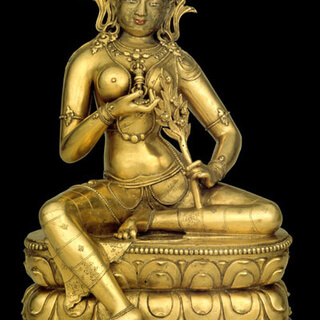
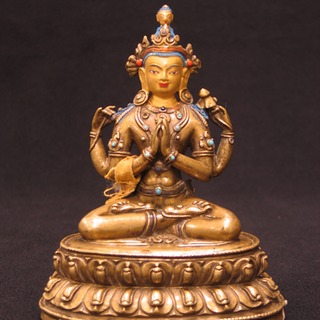
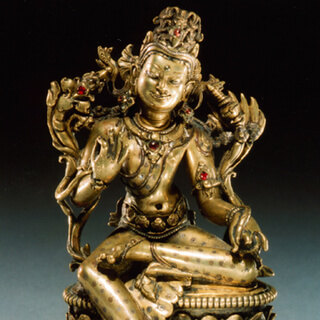
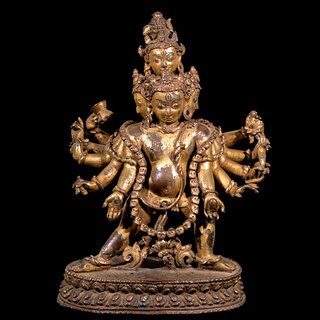
So we have this beautiful goddess or female deity,
Prathisara.
She is known as Prathisara,
And in Tibetan,
Sosor Thangma,
Or Nangla.
She's one of the five protector goddesses,
Origin Central Tibet,
Possibly from Densartel Monastery.
And this is dated from 14th to 15th century,
Beautiful gil copper alloy,
And the size is about 11 3 4 into 9 3 4 into 7 inches,
And a beautiful sculpture.
The connection to the theme is March being the Women's History Month,
And so hoping that Prathisara reawaken us to be forces of the protection in this world,
Which is so needed.
And the description for the Prathisara,
Addressed as Nangla,
One of the five deities,
The goddesses,
Known as Pancha Raksha,
The five protector.
And Prathisara is one of the main amongst the five protector,
And it says that the oldest of the texts dates from the 4th century of the Common Era,
And they are also each embody a Buddhist mantra.
So each of the five deities bestows protection from the turbulence of this world.
They are associated with preventing and surviving natural disasters,
Curing snake bites,
And averting pestilence and epidemics.
They also promote sustenance and happiness.
Prathisara is specifically associated with protecting pregnant women.
As you see here,
She appears in four faces,
Forehead,
And they appear in multiple color.
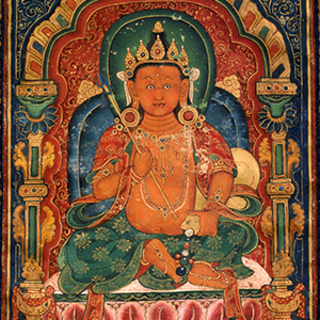
If you look in the painting,
Then you can see the colors in white,
Red,
Yellow,
And bluish green,
I think.
And then,
As you see here,
In eight arms,
Four arms on each side,
Of course.
She holds a sword,
As you see here,
And then vajra,
And bows,
And the dharma wheel,
Chakras,
And so forth.
And so all of this are to protect us from all the defilements.
The inner word is the afflictive emotions,
But the outer benefit is from all the diseases and natural disaster.
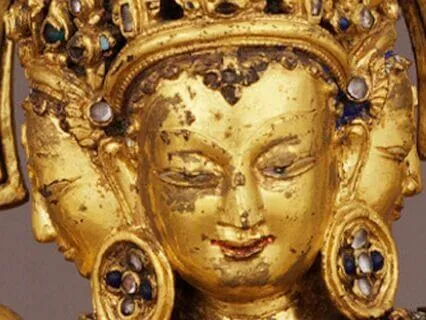
Now here is a closer look,
Beautiful inlays of semi-precious stones.
And now you see here,
These two symbols here,
This symbolizes the moon,
Sun and the moon.
And so here is the full image of Prathisara,
Deity goddess,
Sitting on the lotus throne.
So let's bring on our teacher for today.
Our teacher is Sharon Salzberg.
Sharon Salzberg,
Co-founder of the Insight Meditation Society in Barre,
Massachusetts,
Has guided meditation retreats worldwide since 1974.
Her latest book is Real Change,
Mindfulness to Heal Ourselves and the World.
Sharon also the author of several publications,
Including the New York Times bestseller,
Real Happiness,
The Power of Meditation,
Faith,
Trusting Your Own Deepest Experience,
Loving Kindness,
The Revolutionary Art of Happiness,
And Real Love,
The Art of Mindful Connection.
While running her own podcast,
The Metta Hour,
And interviewing 100 and plus influential voices in meditation and mindfulness movements,
Sharon has regularly contributed to many on-stage conversations here at the Rubin Museum.
Please help me in welcoming Sharon Salzberg.
Hello.
It's so nice to see you all gathered there.
How wonderful.
I miss being there in so many ways.
And thank you for that beautiful description of the protectress and for the introduction.
I will say,
Though,
That I've had two books come out since Real Change.
It's not actually my latest book.
I had two books come out last year,
One called Real Life,
One called Finding Your Way.
So I keep moving on.
It's a world like that.
And I think,
You know,
Hearing that beautiful description of the protectress,
The main message that came to me was that as we pursue a path of goodheartedness and clarity and trying to understand our lives in a deeper way,
We're actually not so alone,
That whether or not you believe in,
You know,
Pestilence and things being watered off by alignment with these forces,
The underlying idea is that there are forces of good in this world.
And as we commit ourselves to growing clarity and loving kindness and mindfulness and all these qualities,
We can remember that and align ourselves with those forces so that we don't feel so alone and adrift.
It's akin to taking refuge,
That we are joining a stream of beings,
Seen and unseen,
Who have themselves committed to this kind of path and or a path,
You know,
Of of growth and clarity and understanding.
It doesn't have to be this precise path that you may be on,
But it is aligned in those ways.
When I think of reawakening,
I actually think of in the Theravada tradition and in,
Like,
Say,
Burmese schools of Buddhism,
The word that is translated that we translate as meditation is actually Bhavana,
B-H-A-V-A-N-A,
Which means cultivation.
So it's a little bit like cultivating the ground,
Growing a garden.
You're creating the conditions for what you want to see emerge.
And that always makes me think of my friend Joseph Goldstein,
Who talks about growing his first and perhaps I think it was his only garden.
He's about nine years old and he said he got so impatient and excited.
When the little green fluffy stuff is growing on top of the carrots that he'd yank them up to help them grow faster.
So needless to say,
He didn't have much of a harvest,
Which is why I think it was maybe his only garden.
So we cultivate the ground so that the things we want to see,
Insight,
Love,
And so on,
Can emerge.
We can't hurry the process.
We're doing what we need to do,
Which is cultivating the ground,
Helping create the conditions.
And in some schools of Tibetan Buddhism,
That same word,
The translation meditation is this phrase I find really cute,
Which is getting used to it or getting familiar with it.
And this brings up the sense of reawakening for me.
So what is it that we're getting used to in the process of meditating?
That seems to be a belief that as human beings,
We human life,
We have had moments of profound connection and clarity and love and understanding,
But we don't tend to be awfully used to it.
We don't tend to live there.
You know,
So maybe we have an experience for a whole variety of different reasons,
Even great suffering sometimes brings us there because so much falls away in those times.
Or we're in love or we're inspired or art or music or poetry.
So many moments,
Friendship can bring us there.
And then sometimes we have this kind of experience,
This opening,
And then.
We think,
What was that,
You know?
I don't think I'll tell anyone about that or maybe I'll tell everyone about that,
But most fundamentally is I don't know how to get back there.
Right,
I don't know how to abide there,
To dwell there more often.
And so we practice meditation,
Some method or technique or another,
In order to make a home out of the deepest places we have known.
And with both these examples.
I think of reawakening because it's not like a desperate process,
It's not like coming from nothing.
And somehow trying to attain the seemingly unattainable.
We're either cultivating the ground or we're getting used to familiar with the place we have already been.
So the whole kind of vibrational element of it is very different.
We can have more composure,
We can have more patience,
We can have more of a sense of experimentation and trying things out and persevering through the ups and downs that inevitably come on a path as we get used to dwelling in kind of a reawakening of our greatest potential.
So let's do some practice together now.
If you want to sit comfortably,
See if your back can be straight without being strained or overarched.
You want some energy in your body,
But not like so much.
If you want to be really stiff and uptight,
You just want to be relaxed and at ease,
But not so much at ease that your waist slumped over so you can feel your way into what feels like a balanced posture to you.
And close your eyes or not,
However you feel most comfortable.
And if your eyes are closed and you get really sleepy,
You can always open them and continue on.
Sometimes we start just by listening to sounds.
It could be the sound of my voice or other sounds.
It's a way of relaxing deep inside,
Allowing our experience to come and go.
Of course,
We like certain sounds and we don't like others,
But you don't have to chase after them to hold on or push away.
See if you can have the sounds just wash through you.
Bring your attention to the feeling of your body sitting,
Whatever sensations you discover.
See if you can feel the earth supporting you.
Feel space touching you.
Usually we think about touching space.
We think about picking up a finger and poking it in the air,
But space is already touching us.
It's always touching us.
We just have to receive it.
Bring your attention to your hands.
See if you can make the shift from the more conceptual level,
Like go fingers,
To the worlds of direct sensation,
Picking up pressure,
Wavering,
Heat,
Cold,
Whatever it might be.
You don't have to name these things,
But feel them.
And on that same level of feeling sensations,
See if you can bring your attention to the feeling of the breath,
Just the normal natural breath.
You don't have to try to make it deeper or different,
And see if you can find the place where the breath is strongest for you or clearest for you.
Maybe that's the nostrils or the chest or the abdomen.
Find that place,
Bring your attention there,
And just rest.
The image is used like a butterfly resting on a flower,
Just so lightly.
Feel the breath.
Sometimes we think if we get like a stranglehold on the breath,
Our minds won't wander,
And they'll really wander more,
Just rest.
It's just one breath.
You don't have to worry about what's just gone by.
You don't have to lean forward for even the very next breath,
Just this one.
And if you like,
You can use a quiet mental notation like in,
Out,
Or rising,
Falling to help support the awareness of the breath,
But very quiet.
So your attention is really going to feeling the breath,
One breath at a time.
And if images or sounds or sensations or emotions should arise,
But they're not very strong,
If you can stay connected to the feeling of the breath,
Just let them flow on by,
You're breathing,
It's just one breath.
They are strong and they pull you away.
See if you can just notice what's happening in the moment.
There's thinking,
There's joy,
There's sorrow,
Whatever it might be.
Recognize it without judgment.
See if you can gently let go,
Bring your attention back to the feeling of the breath.
And for all those perhaps many times you're just gone,
You fall asleep,
You're way lost in thought,
Don't worry about it.
We say the most important moment is actually the next moment when you realize,
Oh,
Quite some time since I last felt a breath.
That's the critical moment because that's a place where we can have some kindness to ourselves,
Practice letting go,
And simply return to the feeling of the breath.
If you have to let go and start over,
Over and over again,
It's totally fine.
When you feel ready,
You can open your eyes or lift your gaze and we'll end the meditation.
So thank you for that.
Thank you so much.
Thank you.
Thank you so much for that,
Sharon.
Thank you.
Thank you very much,
Everyone.
That concludes this week's practice.
To support the Rubin and this meditation series,
We invite you to become a member at rubinmuseum.
Org slash membership.
And to stay up to date with the Rubin Museum's virtual and in-person offerings,
Sign up for a monthly newsletter at rubinmuseum.
Org slash e-news.
I am Tashi Chodron.
Thank you so much for listening.
Have a mindful day.