Hi,
Thank you to be here with me for this practice.
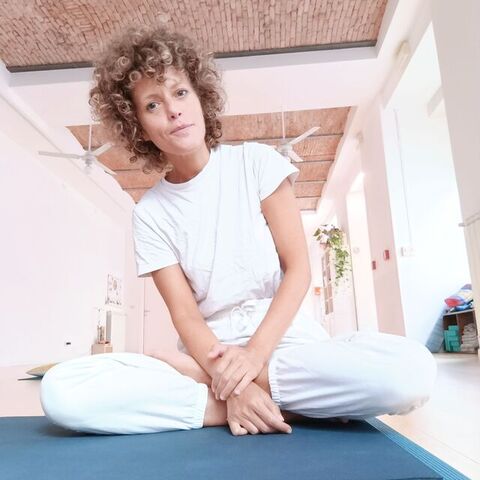
When we talk about the art of sitting we refer to the ability to remain in a seated position for an extended period of time,
Comfortably enough to keep the spine straight.
The practice of simply sitting in somehow a comfortable position is the secret treasure in yoga.
All the asanas we practice daily primarily aim to bring us to a seated position that does not cause discomfort and allow us to focus solely on breathing practice or meditation.
The traditional seated position is on the ground with cross legs or in various other forms.
But in this short tutorial I would like to focus not only on the position on the ground but also on sitting on a chair,
Provided that the back is not leaning against the backrest of the chair.
So you can choose a stool or a chair where the feet are placed on the floor and lying under the knees with the soles well grounded and if possible without shoes.
So whether you are sitting on the floor or in a chair I hope this short practice will help you become aware of how spacious sitting can become.
And whatever in the seated position on the floor with all its countless variation,
We'll try to choose a cushion of a high suitable for our hips.
It's important to always remember that to sit comfortably on the floor our hips must be higher than our knees.
Therefore choosing support in the form of a cushion,
Blocks or a zafu that lifts the seat adequately from the floor,
Allowing the knees to rest on the ground and distributing the weight properly.
In that way whenever we are seated on the floor or in the chair we will follow the instruction.
When we are ready to sit and close our eyes the starting point of our awareness is allowing our breath to enter and exit naturally without effort.
And then we begin by bringing our attention to the base of support of our body in the sitting position.
This is a solid base that we can feel through the weight falling on our sitting bones,
Especially the way we can feel over our ischial bones,
The bones located directly beneath the sitting bones.
We can touch them briefly with our hands if we can't feel them otherwise.
Feeling the sitting bones is very important because they give us the direction and position of our pelvis that is not going to be pushed too far forward,
But most importantly not tilted backward,
Which can cause that uncomfortable feeling of a curved back.
So let's try to feel for a moment where our ischial bones are and how the rest of our body aligns above this support point,
Both right and left side.
We will make small movements in all direction very slowly,
Listening to the perception of the weight,
And then we will try to find out our point of balance.
Maybe it's not the perfect point,
But it's the place where our awareness stops today,
So that we can find a comfortable and neutral position of our pelvis,
And in that way we can be sure that we completely abandon the weight of our legs to the ground,
If we are sitting on the floor,
And that we have comfortably placed our feet on the floor if we're sitting on a chair.
From this foundation,
From this strong base of our sitting posture,
We now focus on perceiving our abdomen.
When sitting,
The abdomen maintains a slight contraction,
And when I say slight I mean a contraction that is not strong,
But it's just enough to keep the spine upright from its base,
Without too much effort,
And above all,
Without limiting the natural flow of breathing.
Sometimes,
Due to postural reasons,
We struggle to extend our spine,
And the secret lies precisely in this core of the abdomen that supports us and invites us to extend the spine upwards.
As soon as the abdomen is slightly contracted,
We will feel the chest blue and the shoulders fall.
Now let's try inhaling slowly and exhaling slowly a few times,
Emphasizing the inhalation phase and the possibility of creating space,
Expanding the volumes and filling the chest open,
The heart center opening to the breath.
A simple experience of just sitting with the abdomen slightly contracted,
The chest open,
So that we can now take care of our shoulders.
We want to loosen this armor a bit,
And by resting our hands on our thighs or knees,
We can feel that we can release the weight of this armor.
First into the arms,
Then into the hands,
And finally into the legs,
So that we can release all the weight to the ground.
So we no longer need to hold ourself up with our shoulders,
But instead support ourself from the abdomen at the base of the spine.
So let's take a moment to integrate these first parts of the art of sitting,
Bringing our awareness again to the foundation of the sitting bones,
The position and the balance of our pelvis,
The contraction of the abdomen,
The blooming of the chest,
And the soft relaxed shoulders.
Remember to allow your elbows to be soft and relaxed as well,
Resting close to the ribs.
We will try to inhabit this space of calm and silence,
Breathing normally without effort,
But aware that in the seated position,
It is primarily our chest that opens and closes with each breath.
And then we will spend a little time for the position of the head.
This is a heavy structure,
That much like the pelvis,
Needs to find its own balance,
And our posture can affect the position of the head.
So now that we are seated with eyes closed,
While we are breathing,
Let's try to use our inner gaze.
With the eyes closed,
Imagine looking at the horizon in front of you.
Avoid letting the head fall forward,
Or lifting the chin too much,
Straining the cervical spine.
And once we've found a comfortable position for our head,
We remember to relax our face,
Slightly separating the teeth,
And maybe try gently to lifting the corners of the mouth to bring a bit of peace to our facial expression.
We are here,
Seated,
Breathing,
As if each inhalation and exhalation entering and exiting the body has something new to tell us.
We are very curious about our breath and about our sensation.
We accompany ourself with the gentle rhythm of the breath.
We want to be open to welcoming each breath.
Continuing to be curious witnesses to the simple breath entering and exiting the body.
And we'll try to carry this with us for a moment,
Even after my voice say goodbye.
But your practice may continue.
Take a moment to say thank you to yourself,
For being here,
For giving time to the practice.
And I thank you to be here with me.
I hope to see you soon.