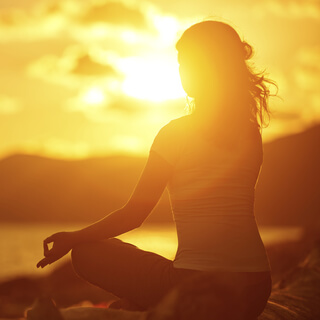
So we start by closing our eyes very gently.
Closing our eyes in the same way we would close them to go to sleep.
Not squeezing our eyes closed,
Just letting our upper and lower eyelashes touch gently together.
And to relax our body,
We start by taking a few deep breaths to ourselves.
Breathing in to the full volume of our lungs,
And then breathing slowly and smoothly out again.
Once again,
We breathe the cool refreshing air from around us.
And when we breathe out,
We may imagine that we are letting go of any of the worries and concerns normally filling our mind.
Meditation is mostly about our mind.
But to create the conditions that allow us to work effectively with the mind,
We need to attend to the relaxation of our body first of all.
And we do this by what's known as a body scan,
Which means scanning down through the whole of our body,
Relaxing each and every muscle as we go.
So starting at our forehead,
We relax any tension in the muscles there.
We relax our eyebrows and our eyelids,
Checking once again the way we've closed our eyes is as gentle as possible.
We let the muscles of our face become soft.
We relax our jaw,
Taking special care that we've not clenched our teeth together.
And we move down to our neck and let our shoulders drop to their natural height.
From there we relax our arms,
Our forearms,
And then our hands and fingers,
So that our hands are resting only very gently in our lap.
Continuing on downwards,
We relax the whole of our torso,
Chest,
Trunk,
And our abdomen,
Especially the muscles across our belly,
Before moving on down to relax our legs,
All the way down to our feet and our toes.
Until there's no remaining part of our body with any sort of stress or tension anymore.
If we notice knots of tension remaining anywhere in our body,
We do our best to relax them as far as possible,
Almost to the point that our whole body seems to disappear or melt away into the atmosphere around us,
Allowing us to turn our attention inward to the feeling inside us,
That sense of warmth and wellbeing,
And of inner space.
Something which by any other name we could call our state of mind.
And even our mind needs a little bit of mood setting to ensure the success of the meditation ahead.
The way to do that is to put aside any worries or concerns that are weighing on your mind,
Any regrets from your past,
Any plans for the future,
Leaving nothing but the present moment,
Nothing but the here and now,
And bringing our awareness back within the space of our body to a safe place,
A safe haven for the mind.
Some people have described it as being like a bunker that protects the mind,
Because for as long as our mind is located on the inside,
It is somehow shielded against the impacts of the outside world.
And inside ourselves we conjure up a sense of happiness and joy in the mind.
If happiness and joy don't come automatically to mind,
You might cast your mind back to a time in your life when you felt truly happy.
Thinking not so much about the place or the situation,
But thinking about the feeling it brought you on the inside,
That warm fuzzy feeling,
And conjuring up the same feeling within yourself now,
Almost as if it were tiny particles of happiness and joy growing and spreading inside of yourself,
Until it fills the whole of your body and mind,
Leaving no space inside yourself for any other sort of thought.
And when you feel relaxed and refreshed,
Both in body and in mind,
Very gently and using no effort at all,
You can imagine that inside your body is just an empty space,
A hollow cavity,
With no organs or tissues,
Muscles or bones.
As if your whole body has been transformed into a sort of transparent bubble with nothing on the inside.
Within this empty space of your body and mind,
You can call to mind a picture of something like a bright shining sun,
Or alternatively a full moon,
A star,
Or perhaps a sparkling diamond.
But this time we are relocating that imaginary picture to bring it within the space of our own body.
We don't worry too much if the actual picture is not very clear,
Even if it's vague we accept it anyway.
And bear in mind that for about half the people who meditate,
It's going to be more of a feeling than a picture,
In which case we can guide that object down within the space of our body by how it feels,
The warmth or the shape and texture of the object.
We bring that object slowly downwards within the space of our body,
Almost as if we were slowly breathing the object down to the deepest point of our breath,
Or as if we were gently swallowing the object down within ourselves to reach the very deepest point of our stomach.
Once it reaches that point,
Or a point that feels comfortable for us,
Down inside ourselves,
We gently maintain that inner object at the centre of ourselves,
As continuously as we can,
For as long as we can,
Not letting our attention slip away anywhere else if we can help it.
If we find our attention wandering away,
Then it's not the end of the world,
We just bring our attention back again to the inner object,
And if the inner object disappears,
Then we just think of a new one.
As for the possible problem of there being thoughts in the mind,
If the thoughts are at a low level,
Then often we can just ignore those thoughts,
Treat them like unwanted guests,
To the point that they will eventually die down into silence all by themselves,
Almost like guests that go away if you starve them of attention.
They will eventually go away even without a confrontation.
If you're one of those people who tend to have a lot of thoughts going on in the mind,
Then it may be the case that you need to make use of that traditional mantra,
The words Sama-Arahang or the equivalent,
Not saying the words out loud,
But hearing them silently coming up from the centre of your body,
As if that were the source of the sound.
The same place that you see or feel the inner object is the place where the sound comes from.
Sama-Arahang,
Sama-Arahang,
Sama-Arahang,
Over and over again,
Lightly,
Gently,
Continuously,
Leading the mind deeper at the centre of the body,
While at the same time freeing the mind of any extraneous thoughts,
Until the mind comes closer and closer to an approximation of silence within.
In the beginning it may seem like there are a lot of thoughts with a few gaps in between.
Later the gaps will become longer until the thoughts are less numerous than the gaps themselves,
And you start to discern a sense of connection with the centre of yourself.
As some people observe,
If they observe very gently,
Not trying to force anything,
Not trying to hurry anything along,
Observing with a very light and gentle attention,
It may be possible for the inner object to start to change and transform on its own,
In which case you just follow the experience,
Follow the way it evolves without interfering,
Without changing it back to what it was before,
Always focusing at the centre of whatever you can see or feel within yourself.
And the by-product of that inner transformation will be a mind that gradually becomes calmer,
That will gradually shed any negativity,
Giving rise to a sense of inner knowledge,
A sense of mastery,
A sense of clarity from within,
Which seems to cleanse us from the inside.
And these changes for the good will stay with us long after the meditation itself.
So for now we focus gently at the centre of ourselves,
Focusing with the same lightness of a feather floating down to touch on the surface of some water,
Or with the same care that we might use to thread a needle,
No hurry,
No force,
Just a sense of lightness that will be rewarded by an increasing sense of joy from within.
Copyright © 2020 Mooji Media Ltd.
All Rights Reserved.
No part of this recording may be reproduced without Mooji Media Ltd.
's express consent.
Copyright © 2020 Mooji Media Ltd.
All Rights Reserved.
No part of this recording may be reproduced without Mooji Media Ltd.
's express consent.
Meditation practice makes perfect.
It is something we need to work at,
Just as we might work at a new language or a sporting skill.
It's the things that we do regularly that we become adept at.
For some things like physical exercise two or three times a week will be enough to keep you fit.
But for those who can see that meditation is doing them good,
A little meditation every day is the best way forward.
If we can find a period of just twenty minutes per day to sit down and meditate,
Maybe early in the morning,
Maybe last thing at night,
Relax our body,
Relax our mind,
Focus gently at our centre and clear the mind of thoughts at a time of the day when our energy levels are not too low and when we're unlikely to be interrupted by other things.
If we can manage to do a little each day,
Then we'll see some sort of improvement in the ease with which we can meditate.
We'll find we're able to go further in the same length of time and achieve a greater sense of peace.
There'll be a gradual accumulation of peacefulness within ourselves,
Especially towards the end of the practice.
There'll be a sense of well-being that builds up inside ourselves,
A sense of calm that seems to be fostered within the mind.
And it's a sense of calm that stays with us even as we get up from our meditation to do other things.
We still feel calm from our meditation as if it's something we carry around with us.
When we're new to meditation,
Sometimes the sense of calm will wear off after a while,
Especially when we come across things in our lives that are irritating or annoying to us.
But as we become more adept in meditation,
The sense of calm will be more robust,
More resilient.
It will stay with us in spite of the challenges we encounter in life,
Until eventually there will be a seamless connection both inside and outside our practice.
While we've got our eyes closed,
Then it's called meditation practice.
But while we've got our eyes open doing other things,
Maintaining that sense of calm is known as mindfulness.
So meditation and mindfulness hand in hand can help us maintain well-being throughout our day.
And this is what we're aiming for,
By upholding a regular meditation practice within our lives.
So for now,
We continue keeping our mind on track at the centre of ourselves,
Lightly and gently,
Using only the very lightest of touch to keep the mind in place.
Each to your own practice now,
In silence for a few more moments,
Until we come to the appropriate time.