Hello friends,
My name is Stella Billory.
I'm a Senior Mental Health Occupational Therapist and I have a private practice coaching friends who have ADHD.
ADHD is a neurodevelopmental condition and it affects all manner of areas of our everyday lives.
One thing that you may or may not know about ADHD is that friends who have ADHD experience the world differently.
So our sensory systems work differently to neurotypical friends.
So what is the sensory system?
So you're probably very familiar with the first five senses,
So our sense of taste,
Our sense of smell,
Our sight,
Our hearing and tactile touch.
And you may or may not be familiar with the further three senses.
So we have interoception,
Which is how we sense the body inside.
And an example of that might be knowing if you need to go to the bathroom or knowing if you're hungry.
And we have the vestibular system,
Which is located in the canal of the ear.
And if you've ever gotten onto a lift and you felt a little bit woozy or you've been on a boat and you felt seasick,
That's your vestibular system.
And the vestibular system communicates to the body,
To the nervous system,
Where the head is in relation to the earth.
And so it cultivates a sense of groundedness.
And finally,
We have proprioception.
And proprioception is what we're going to be focusing on in today's practice.
Proprioceptors are located in the skin,
In the muscles and in the ligaments.
And when proprioceptors are activated,
Either through movement or tactile touch,
It communicates to the body,
To the nervous system,
Where the body is in relation to the things around it.
And so proprioception is having a sense of our body in the moment and increases our sense of body awareness,
Embodiment and also balance.
And balance can be thought of as physical balance and also emotional balance.
So stimulating proprioception is a very,
Very useful tool to have in your toolkit if you're a neurodivergent person.
And so in today's practice,
We're going to be working with some gentle movement.
I'm really asking you to consider if this movement is appropriate for you.
So what we're going to be working through is a series of tapping exercises.
So tapping using the fingers,
The knuckles or the palms of the hands across the body.
And you might do this practice standing up,
You might do it seated.
But I'm really asking you to consider,
Is this practice appropriate for you?
And some examples might be,
If you have an injury,
Tapping that injury may not be appropriate.
If you were pregnant,
Tapping the torso may not be appropriate.
And if in any way you're unsure if this practice is appropriate for you,
I really recommend you speaking to your doctor before you participate.
And you're going to need a little bit of space to do this practice.
So perhaps considering that as well.
And so we'll make a start.
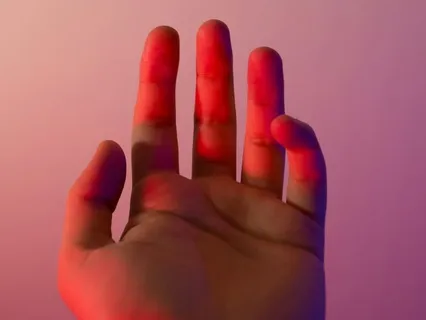
The invitation is to bring the hands that the palms are touching and to start to rub the palms together.
And as you rub the hands,
You'll hear the sound of the hands rubbing,
And you might start to feel that heat generated through the palms.
So just continuing to rub the hands.
So we're activating the proprioception in our hands,
And also in the arms through the muscular effort that's required.
Okay.
And now the invitation is to part the hands.
So imagine that you're holding on to an imaginary balloon or ball,
The palms shining towards each other.
So relaxing the shoulders and feeling that warmth,
The space between the hands,
Kinetic energy.
And so now you're invited to let go of that imaginary ball and find in front of you an imaginary piano.
And spread the fingers out wide and start to play this imaginary piano.
So twinkling the fingers like you're touching the keys of the piano and letting the hands and the wrists become involved in the movements.
And maybe the hands move from side to side to just waking up the wrists.
Good.
And now you're invited to bring those hands just to the left of your breastbone underneath the collarbone.
And we're going to continue with this twinkling fingers sensation.
So starting to tap the chest with the fingertips,
Twinkling fingers,
Tapping,
Lovely.
And now taking the fingertips away from the body and closing the fingers.
So you kind of have a half closed fist.
And now we're going to bring the knuckles of the hands onto the chest.
So starting to tap with the knuckles.
For some of you,
It might be a little bit more difficult to tap with the knuckles of the hands.
But if you can tap with the knuckles of the hands,
With the knuckles,
Slightly more proprioception as we come to the knuckles and just noticing how that feels.
Is that too much?
Does it feel better than the twinkling fingers?
And then separating the hands from the chest once again.
And now you're invited to spread the fingers out wide so the palms are flat.
And now we're going to bring the flat palms to the left of the chest.
So starting to tap with the whole of the hands,
One or two hands.
So again,
More proprioception input as we increase the surface area.
Good.
And then just releasing the hands down by the side of the body.
And let's take a long,
Slow breath in.
And a clearing breath out.
I'm just taking a moment to see how you feel.
And if you're with me,
We will continue.
So deciding if you want to use raindrop fingers or the knuckles or the flat palms as we bring the hands back to the left of the chest.
So we're staying on the left side of the body.
And we'll continue tapping on the left side of the body.
Tapping below the collarbone.
And continuing with that right hand,
Letting the left hand fall.
And we'll bring the right hand to the left shoulder.
And we're tapping around the shoulder and the top of the left arm.
Working our way down the arms,
So the top of the arm to the elbow.
And the forearm and the wrist.
And that left hand,
Front and back.
And then working your way back up that left arm.
So seeing if you can touch as many parts of that arm as possible.
When you get back to the shoulder,
We come back to the top of the left chest.
And now the left arm's going to reach up into the sky and you can do this seated or standing.
And we're going to take a little side bend towards the right hand side.
And the right hand now taps underneath the left armpit.
And we're going to tap all the way down the left side body.
So sides of the ribs,
All the way down to the hip.
And coming up to stand up or sit up straight.
And we continue and both hands can get involved now.
So we're tapping around the left hip and the left glutes.
And if you don't have blood pressure issues and you're okay to forward bend,
We're going to continue down that left leg.
And we're going to tap all the way down the left leg.
So the top of the thigh,
The front and back of the thigh.
Tapping gently around the knees.
And we can tap a little bit more firmly when we get to the calf and the shin,
All the way down to the ankle.
And if you can access the top of the feet,
Tapping the top of the feet as well.
And then just like we did with the arm,
We're working our way back up.
So coming back up the leg all the way up to the hip.
And then just releasing the arms and sitting up or standing up straight and full.
Just taking a moment to take a long slow breath in through the nose.
And out through the mouth and inviting you just to notice the sensory feedback on the left side of the body.
So how does it feel to breathe into that left lung after a little bit of tapping?
And noticing any other sensory feedback,
How does it feel to stand on that left foot?
How's the left shoulder feeling?
Another long slow breath in and clearing breath out.
And then we'll do the same thing on the other side.
So again bringing the palms so that they're touching and we'll start to rub the hands.
Rubbing,
Rubbing,
Rubbing,
Putting some heat and also some curiosity in those palms.
And again parting the hands so we imagine that we're holding onto an imaginary balloon,
The shoulders relax,
Feeling the warmth between the palms.
And there's an imaginary piano in front of us and we start to play the keys on this imaginary piano and the wrists become involved and the arms start to sway from side to side.
And then bringing those twinkling fingertips this time to the right of the breastbone,
Just below the right collarbone and we start to tap there with the fingertips.
And you might have a sense of where we're going and closing the hands into fists and tapping just below the right collarbone with the knuckles.
And then finally extending the fingers and coming into flat palms,
Tapping just to the right of the collarbone.
And knowing that you can move between the raindrop fingers that we used on the piano or the knuckles or the flat palms as we explore the right hand side.
So as you're ready to we start to tap left hand moving to right shoulder.
And you make that journey down the right arm,
Trying to make contact with the right shoulder.
Once you finish the length of the arm,
You just travel back up the way you came,
So travelling back up to that right shoulder.
And this time the right arm reaches up towards the sky and we take a little side bend,
Seated or standing over towards the right shoulder and we start to tap to the right of the right arm.
And this time the right arm reaches up towards the sky and we take a little side bend,
Seated or standing over towards the left hand side.
And this time the left hand comes to the space underneath the right armpit and we're tapping down that right side body all the way to the hip.
Once we get to the hip,
The spine comes up straight and both hands become involved.
So we start tapping around that right hip and glutes.
And again,
If there are no blood pressure issues,
We start to forward fold,
Bending the knees,
Tapping the front and the back of the right leg,
Past the knee,
The calf,
The shin,
Top of the foot.
And then we simply work our way back up the leg.
Once we get back to that right hip,
There's no rush to get there if you're still exploring.
Just let go of the practice and you may want to come to a seated position,
You may be happy standing.
And again,
We just notice,
So how was that experience on the right hand side?
How does it feel to take a long,
Slow breath in through the nose and out through the mouth?
Just noticing how it is to wait there,
Either through the right foot or through the right seat.
How does the right side of the body experience the breath?
How's the right shoulder sitting?
We'll take another long,
Slow breath in.
And a clearing breath out,
Really trying to relax the shoulders and the space between the eyebrows.
So this practice can be utilised whenever you need to transition between tasks,
When you're starting to feel emotionally overwhelmed.
When you're having difficulty managing your time and your scheduling and you need to take a structured break.
Anytime that you need more awareness and more balance,
You can call upon this practice.
Thank you so much for joining me,
Beautiful people.
Wishing you a peaceful and productive day.