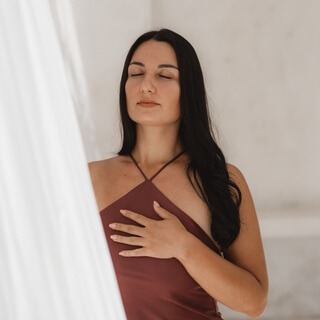
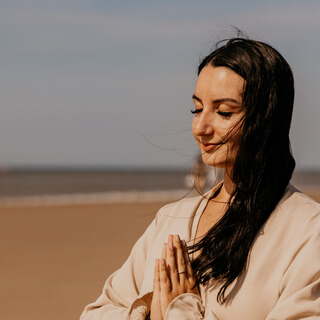
We will be exploring the nervous system and creating safety within ourselves.
This is something that has helped me tremendously and changed the game for me.
And I know it will for you too.
So let's dive in.
First,
Let me explain you about the nervous system and how it works and what aspects are relevant and important to know about when we are talking about anxiety.
So the nervous system consists of two major parts.
We have the sympathetic nervous system and the parasympathetic nervous system.
Sympathetic nervous system is also known as fight or flight.
This is the state we are in when we experience anxiety.
Your brain,
Your nervous system,
Your body signals a threat and therefore it activates your survival mechanism,
Your fight or flight response in order to help you deal with this threat,
With this problem in your life.
Now specifically anxiety,
We can link that to the flight response.
When you are in flight,
You might experience panic,
Fear,
Worry,
Anxiety.
When you are in fight,
You might notice anger,
Frustration,
Irritation.
Now when our body recognizes that fight or flight are not going to help you or when it's too overwhelmed by the situation,
It will shift into freeze,
Fight,
Flight,
Freeze.
In the freeze state your body pulls the emergency brake and goes through a shutdown.
You might feel numbness,
Depression,
Low energy,
You might be unable to move.
This is freeze.
You will dissociate from your body.
So the parasympathetic nervous system on the other hand is our state of safety.
This is also called rest,
Digest and heal state of our bodies.
When we are in this state,
Your body is not pulling any brakes,
In fact it is pulling one brake which is called the vagal brake.
The vagal brake is your body pulling a brake,
Shifting from the gas pedal,
Shifting from fight,
Flight or freeze and putting it's foot on the brake,
Giving you a brake,
Giving you safety,
Giving you peace.
So in this state of safety we feel at peace,
Present,
In joy,
In flow.
Most importantly we are open to connecting with people.
This state is also called the social engagement and safety state.
These two go hand in hand.
One very important thing I want you to remember is the longest nerve in your body,
Called the vagus nerve.
The vagus nerve runs from your brain all the way down to the base of your spine.
It connects your brain to the organs in your body.
Essentially your vagus nerve is your mind-body connection.
When you activate or stimulate this nerve,
You activate the parasympathetic part.
So we want to stimulate the vagus nerve.
This is what it's all about.
This is how we shift from fight,
Flight to safety.
This is how we shift from even freeze,
The shut down,
The dorsal vagal state to safety.
Now you don't have to remember these terms,
I just want you to remember that there are two sides and that the bridge between those is your vagus nerve,
A really long nerve in your body,
The longest in fact.
So today I'm going to share with you some practices and we'll do a breathing exercise together to help activate your vagus nerve and with that the parasympathetic part of your nervous system.
You can do these practices anywhere,
Anytime.
I use them daily and they work like a charm.
So before we breathe together,
I want to share some practical things you can do by yourself.
Anything that has to do with activating the throat will activate the vagus nerve.
Because it runs from your brain down to your organs,
It is also deeply connected to your throat and neck.
So some examples of how you can do this is by singing or humming.
You can make the voo sound.
Take a deep breath in.
Voooooo.
You can also make the sound of a bumblebee.
Take a deep breath in.
Keep your mouth closed.
What you can also do is gargle water.
After you brush your teeth and scrape your tongue.
If you're not tongue scraping yet,
I highly recommend you to start doing it.
It has incredible benefits for your health.
Tongue scraping.
So after you brush your teeth and scrape your tongue,
Take some water and gargle it in your mouth for as long as possible.
You can repeat this gargling or the bumblebee sound or the voo sound for as many times as you like.
Besides doing those things,
You can also massage your throat.
Massage basically any part of your body and you will activate the vagus nerve and you will feel more relaxed.
I think we can all agree that after a massage,
We feel a lot more relaxed.
So now let's practice breathing together.
What's important to notice when it comes to the breath,
In terms of activating your vagus nerve,
Your parasympathetic nervous system,
Is that your exhales should be longer than your inhales.
You are releasing more air,
More energy than you inhaled.
So let's practice breathing in the pattern of 4 seconds inhale,
8 seconds exhale and then we'll shift to 4 seconds inhale,
7 seconds hold,
8 seconds exhale.
This hold,
You will feel the benefit of it almost immediately.
It's like an extra space,
An extra moment of peace in your body.
So let's begin.
I will do the counting.
All you have to do is get comfortable,
Breathe deeply through your belly.
When I say inhale,
Inhale.
When I say exhale,
Exhale.
So now let's all fully exhale.
Now inhale,
2,
3,
4 and exhale,
2,
3,
4,
5,
6,
7,
8.
Inhale,
Exhale,
Inhale,
Exhale,
Inhale,
Exhale,
Inhale,
Exhale.
Inhale,
Exhale,
Inhale,
Exhale,
Inhale,
Exhale,
Inhale,
Exhale,
Inhale,
Exhale,
Inhale,
Exhale.
Hold your breath and exhale.
Inhale,
Hold,
Exhale,
Inhale,
Hold and exhale,
Inhale,
Exhale,
Inhale,
Hold and exhale,
Inhale,
Hold and exhale.
One last time,
Take a deep breath in for 2,
3,
4,
Hold your breath for 2,
3,
5,
6,
7 and exhale for 2,
3,
4,
5,
6,
7,
8.
Allow your breath to return back to a normal rhythm.
This is what safety feels like,
Letting go,
Surrendering.
Keep breathing in this pattern for as long as you like to.
This is also a great practice to do before bed,
Before falling asleep.
If you struggle with anxiety before you go to bed,
Keep counting your breaths 4,
7,
8 until you fall asleep.
Thank you so so much for being here.
I wish you all the safety and social connection in your life.
Another tip.
The next time you have a conversation with somebody,
Look them in the eye.
Your nervous system loves that.
It automatically triggers a social engagement and safety state.
Try that and let me know how it works.