Eva,
If that's okay,
Just to eliminate as much background noise as possible.
So here we go.
So really warm welcome to this day retreat on patience and forgiveness,
Which are themes that are very close to my heart,
But we haven't really talked that much about before,
Especially forgiveness.
When I was thinking about that as a topic,
I realized how enormous it is and how important to freeing up our mind.
So both of these qualities are very beautiful,
Indispensable qualities,
Both for our daily life,
You know,
For our relationships,
For our work life,
But also for our practice.
And the Buddha actually said that patience is the highest spiritual quality,
Which I'll go into more during the day.
But equally,
Forgiveness is just one of the most important values in our life,
You know,
That we can have in our hearts,
People who hold on to resentment,
Who hold on to hurt,
You know,
Basically dragging all the pain of the past along with them into the present moment,
And the present moment can never really be free.
So,
In a sense,
You could think of patience and forgiveness as aspects of the right intention,
The second factor of the Eightfold Noble Path,
Samma Sankapa.
And those three right intentions are basically letting go,
Nekama,
Renunciation,
Giving up,
If you like.
So you can see how that already relates to forgiveness,
Because with forgiveness,
We're letting go of past resentments,
Recrimination,
Any thoughts of revenge,
You know,
Or just kind of churning up that past again and again.
So we're trying to make peace with the past,
Put it down,
Let it go.
And then the second intention is avyabh pada,
Which means basically loving kindness.
That's the second right motivation in the Eightfold Path.
And of course with forgiveness,
You know,
We overcome resentment through the practice of loving kindness.
With patience,
We learn to open up to the moment with loving kindness,
Rather than trying to push it away or get onto something better,
Or get over what we don't enjoy about the present,
We actually learned to open to it with a really wide,
Soft,
Embracing kind of attitude,
A wide open heart to whatever arises in this present,
You know,
To our bodies,
To our minds.
And then the last of these three right intentions is called avihimsa ka sankapa,
And that means the right intention of non-violence,
But it also means gentleness,
Like not harming oneself,
Not harming another.
And I think this is where patience comes in,
Because patience is really an aspect of gentleness,
Being gentle with the moment,
Not forcing the moment,
Not forcing your practice,
You know,
Not forcing your mind onto the breath or into the present,
But just gently allowing it to settle into that moment.
You know,
So we're making our minds gentle,
We're making them soft,
So that our experience can be received.
And in a sense,
It's like when the mind is soft,
The breath or the body sensations or thoughts of loving kindness,
Whatever your main object of practice is,
They can soak into the mind.
When the mind is kind of hard and tight and it's not gentle,
It's demanding,
Then these objects kind of,
They come to the mind and they just bounce off,
Right?
Sometimes you might have noticed when you're practicing with the breath,
You go to it too soon or you're trying to force it and it just,
It won't stay.
It'll come in and it'll just bounce off.
It's like trying to put something inside a very hard stone.
But when the mind becomes soft and with gentleness,
It's like a sponge.
It can absorb the breath and the breath starts to fill up the mind.
So we're working with these right attitudes and strengthening those right attitudes.
And for that,
An understanding of causality is really key.
Because when we understand that everything that we experience in this present moment is basically,
If you like,
A result of everything that went before.
Everything you've done in your life or the conditioning of your past,
You know,
Even right down to what you ate for breakfast today,
That all manifests now in this here and now.
And there's little we can do about it,
Right?
There's very little we can actually do to change it.
But what we can influence is the way we respond,
The way we relate.
So we're always looking for ways to relate to this present moment that lead to a release of suffering.
They lead to letting go of suffering,
Actually moving in the direction of peace.
And so,
Yeah,
Patience really helps us to foster peace in that present moment by overcoming the craving,
Overcoming like this tendency to lean forward,
To lean with expectation towards something better.
So it helps us to just simply arrive in the present.
And through understanding this causality,
You know,
We learn not to blame ourselves.
We know not to blame the situations we're in.
But we develop this sense that a sense of non-judgment,
Understanding things have arisen due to causes.
And what I can do is just see how I'm reacting to that right now.
This is where I can make,
If you like,
New good karma.
Right.
Because karma really means intention.
It is also an action.
And we can always make good karma with whatever we're experiencing now.
So I like to ask myself,
You know,
No matter what's arising,
Like,
What is the kindest thing I can do with this moment?
And of course,
That includes patience and forgiveness,
Being patient with it,
Being forgiving.
It might not be quite what you want to arise in this moment,
But we can forgive the moment's imperfections.
And in that way,
We become more open to seeing it as it really is,
Rather than pushing it away or trying to make it different.
So what is patience and how does the Buddha define it?
We're going to patience a little bit this morning.
This afternoon,
We'll go a bit more into forgiveness.
Of course,
The two overlap.
But patience,
As I said,
Is an aspect of non-harm.
It's an aspect of being gentle with the moment.
And the Buddha said,
Kanti paramam tapotitika,
Which means patience is the highest of the spiritual qualities.
And I think it's important to say that patience doesn't mean tolerance.
It doesn't mean endurance.
You know,
Gritting your teeth and kind of,
You know,
Just trying to withstand whatever affliction or difficulty has arisen.
And it's certainly not enjoying things in the hope that they'll change.
You know,
I'll do this meditation so long as I feel better by the end of the day.
Or I'll give this Dharma talk so long as people give donations at the end.
That's not patience.
That's not giving,
Actually.
That's expecting something in return.
So we don't stay with things to endure them in the hope that they'll change.
But patience is more like actually approving of the moment.
In the ordination procedure,
When a bhikkhu or a bhikkhuni take the full ordination,
They enter into the sangha,
The monastic sangha,
And the sangha actually receive them saying kamati.
It means the sangha consent or approve of the candidate.
And the word kamati is related to kanti,
Patience.
So it's something much more soft,
Much more gentle than endurance or even tolerance or even patience in a sense.
It's more like a consent and approval,
Even a welcoming.
Even a welcoming and not only of the perfect candidate,
But a welcoming no matter who you are.
And at the same time,
The teacher who ordains you has this immense patience and the wisdom to understand that,
You know,
They don't just ordain you and leave you to your own devices.
They're patient enough to allow the Dharma to work on you.
They don't push you to progress.
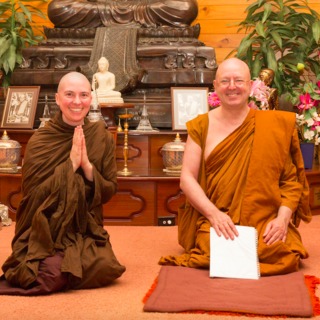
My own teacher,
Adrian Brown,
Has infinite patience.
You know,
One of the nice similes he uses is like a tree growing in the forest.
From day to day,
You don't think anything's happening,
Right?
You just look at the tree.
It's the same size.
Even the plants,
Sometimes you don't really see them growing,
Especially during the winter,
Because it's not the right time for them to grow.
But over time you start to notice that,
Gosh,
The trees really have grown and it might take 10 or 20 years.
I remember there was one time in Bodhinyana monastery in Perth where somebody,
I think the Sangha,
Or at least some people in that Sangha,
Decided they should cut down the acacia trees because Adrian Brown has really terrible hay fever and there were loads of acacia trees with a lot of heavy pollen in the spring.
So he'd be coughing all the way through his talks and always just really stuffed up during that hay fever season.
So they cut down all these beautiful,
Huge trees in the forest.
It was a little bit controversial.
And yeah,
It wasn't necessarily the right thing to do.
But I remember going in there one year for my Rainsbury tree and you'd come down the path that entered in and it was like you could see everywhere.
In the past you couldn't see the little paths that led to the cooties,
But you could see much more.
But over the years,
Going back again and again,
Bit by bit,
They're starting to grow back.
They planted loads of trees,
Of course,
Probably more trees,
To be honest,
Than were there before.
But over the years they start to grow and fill up the forest again and the forest starts to look really lush and really fresh.
But if you're looking day by day,
You'd never notice that.
There's another simile,
I think it's in the Anapanasati Sutta or the commentary to that,
I'm not sure.
There's this one simile where it says it's like a carpenter with the breath.
It's like a carpenter turning the lathe or something.
So it's like with precision,
You put your attention there in the breath and bit by bit it kind of it's like it carves a groove.
You could say it carves a groove in the mind.
But then there's this other simile where the Buddha likens progress on the path to the handle,
Say,
Of an axe or something.
You use this axe,
I don't know.
Cutting trees again,
This is terrible similes,
Isn't it?
OK,
Cutting vines,
Like Russian vines.
We've got some of those here,
Actually,
Russian vines that swamp and suffocate all the other plants.
And we're cutting those and we're using this axe and holding the handle.
And you think that the axe handle is going to remain in pristine condition,
But over the years it gradually gets worn away.
You can't see that day by day,
But over time it starts to get the imprint of your hand on the axe handle.
So you're not looking for that to happen,
But it's just a part of the process.
I was reading one of the verses of the early Buddhist nuns this morning.
I've got a really beautiful translation here.
Bhundu Sajjato and Jess Walton.
That's actually me and Jess on the front.
Jess was a bhikkhuni,
That's her.
And we were walking into Bandhanon,
Which is about,
I forget,
Maybe five miles or so from Santi Forest Monastery.
And in here there are the verses of the enlightened Buddhist nuns of the Buddha's day.
And you might think,
Because there's quite a lot of verses that talk about almost instantaneous enlightenment,
Right?
You might think,
Gosh,
Those women in those days and those bhikkhus also in those days,
Even lay people,
They used to get enlightened just like that.
We'd go and hear a Buddha's sermon and,
You know,
500 Arahats are born at the end of that sermon.
And that's one way to look at it.
But of course,
We never really know all the foundations and the groundwork that had gone before.
Most probably these people have been practicing for many,
Many years and perhaps even many eons,
If you believe,
Or even if you don't believe,
If you can just imagine that they may have been practicing for life after life.
So usually it's only that moment of the breakthrough that's recorded.
But there is one very nice little poem here,
Which I'll read,
Because it also gives me a sense of encouragement and hope.
Actually,
I've been practicing meditation for 25 years.
So this is very apt and I think Jiva too.
So here we go.
And this is by Sama.
So she's one of the bhikkhunis.
In the 25 years since I went forth,
I don't know that I've ever found serenity in my mind.
I'd failed to find peace of heart or any control over my mind.
But when I remembered the victor's instructions,
That's the Buddha,
I was struck with a sense of urgency.
Those subjects are so many painful things I have through my love of diligence,
Reached the end of craving and fulfilled the Buddha's instructions.
This is the seventh day since my craving dried up.
So you see,
Even with a Buddha present,
Even,
You know,
Those times in India,
25 years since going forth.
So I'm still OK.
I only went forth 14 years ago and I have had some peace of mind.
So we're all doing well.
If we can get some moments of peace,
Maybe some hours of peace.
But we don't ask for very much because we really don't know when this process is going to come to completion.
It's not up to us.
It's up to nature.
So what are some of the benefits of patience?
And of course,
One benefit is that it gives us a commitment to it gives us a commitment to whatever we're doing.
For example,
In my case with the project,
If I wasn't committed or if I was really impatient with this,
Then I would have already given up.
It's been five and a half years and we still don't have a monastery.
But that patience and that understanding of causality,
Having to put all the foundations,
The causes and conditions in place gives me an enormous amount of resilience and patience and equanimity.
And because of that,
There's some joy.
Some joy is going to be there.
If we're impatient,
Our mind becomes very brittle and dry and we can't enjoy what we already have.
We're always looking to improve it or to move on and beyond.
So it stops that sense of pushing too hard and consequently burning out.
I often work at my maximum capacity,
As I'm sure many people do,
You know,
And many of us have very busy lives,
Very demanding lives,
Whether within the family,
Looking after someone who's sick or even dying,
Or whether we have businesses or companies or,
You know,
We're teaching.
I know one of our community had to teach all her classes over Zoom during the pandemic,
Which I'm sure is not unusual.
And it sounded really tough.
She actually said that in some of the classes,
Everyone had their videos turned off.
So she's just teaching to this blank screen and not really being able to get any feedback or any sense of where they're at.
One person had their video on and she said that really helped.
But yeah,
You know,
This was making a lot more work,
Because then you would have,
Normally in a class,
You can address all their concerns,
Them and them,
But it was creating lots of work after the classes by email and all the other things.
So,
You know,
We really have a lot of work and I think modern society just becomes increasingly demanding and pressurised.
But this patience allows us to know that even if we work at our limit,
A lot of the time,
We have to take risks.
We also have times in our life where we just say,
OK,
I just stand back now and rest.
Without fear of losing the progress,
Losing the momentum,
But just understanding that when we're more resourced,
Things become much easier,
Much clearer.
We can see the way forward.
We can make decisions.
They're often decisions,
All the answers to questions just come in your mind when you're resourced.
So the mind becomes bigger and brighter.
We learn more.
We're open to more things that look like mistakes.
We can see them as opportunities,
Opportunities to grow,
Opportunities to learn.
And I think most importantly,
Just being open to the path in particular as this process,
Rather than something which is too goal oriented.
So instead of making enlightenment our goal,
We make our goal how to make peace with this present moment that's arising right now.
Our goal,
If you like,
Is to put the causes and conditions in place wisely with wisdom,
With discernment for the future,
For the effects that we'd like to see happening in the future.
And we can always test that by looking,
Does this lead to a release,
To a softening of suffering,
Or does this lead to more tension,
More stress?
You know,
The Buddha said,
That it's the Dhamma when it leads to disentanglement,
When it leads to putting things down,
When it leads to peace,
To disengagement,
And ultimately,
Of course,
To Nibbāna.
So I wanted to talk about two lovely things that Ajahn Brahm has coined,
And he's coined two types of patience.
This is really nice because I think it helps us to see where our patience is leaning into the future with expectation.
And the first one is waiting in the moment.
And this is the one we want to develop,
Right?
The kind of patience that is waiting in the moment.
So that kind of patience is like waiting with,
Waiting with whatever's arisen.
So again,
Not waiting for it to change,
But just being a companion to this present moment,
Right?
Staying present to it,
Staying present for it,
Even attending or tending to the moment.
Like a waiter in a restaurant would come and look after the people in the restaurant,
Looking out for their needs,
Looking out for what they can,
What they want,
Or when they're ready for the next course,
We tend to the moment.
What does this moment need right now?
How can I just relax into it and open up to whatever's arising with a soft and gentle patient heart?
And that kind of patience has no time limit,
Right?
We're not saying,
I'll be patient so that eventually.
So it has no time limit.
And I think when we're really,
Really with our experience in this present moment,
It's as though the present moment expands and becomes a really wide place and we start to move inside time.
As long as we're kind of being pulled into the past,
Especially through things that maybe we haven't yet forgiven,
Resentments or regrets.
Or we're being pulled into the future with a sense of,
You know,
It's going to get better later.
The future always looks brighter than this present moment,
But it's just a fantasy.
And as long as that's happening,
We can't really be present to what's happening now.
We miss a lot of the beauty,
A lot of the peace.
So when we're able to be with this present moment,
We move inside time,
Time disappears and hours can go by when you're meditating.
It's really a strange thing when time starts to become malleable and unfixed.
Sometimes in a meditation,
If you notice that craving gets involved or aversion gets involved,
You can be sitting for like 20 minutes and it seems like two hours,
Right?
You're just waiting for the bell.
I do have a bell,
So you won't be waiting indefinitely for bells.
But sometimes you think,
Oh,
The teacher's definitely forgotten to ring the bell.
And that's because you're not being patient with the moment,
You're thinking towards the future,
Even just one step ahead.
And other times when you are accepting this moment,
You are,
You know,
Peaceful,
Economist,
And you're making that your goal.
It's amazing,
Time can just fly and you think,
What happened?
It can't be the evening already.
I just sat down to meditate at like two o'clock and now it's getting dark.
That was sometimes my experience on my winter retreat.
I'd sit down at like two and suddenly it's like six o'clock.
I'm like,
Wow,
What happened?
And it was because I'd forgotten about goals.
I'd forgotten about getting anywhere.
I was just really settled in the present and enjoying each moment.
And those moments,
I mean,
It's not that really there are such things as moments,
But it's as if they kind of become just this one long moment,
Which are really timeless.
It's like the whole concept of the past and future just disappear.
And you enter a place of silence where there's much less of a sense of self,
Because really it's that craving and aversion constantly creating our past in our mind,
Because we're never remembering it accurately and creating our future in our mind.
We do it because it engenders a sense of self.
It makes us solid.
If we have nothing but this present moment,
Then who are we?
Where's our history?
Where are we trying to get to?
And that can be threatening.
That can be scary to the sense of self.
So in a sense,
That patience takes a lot of trust.
It takes a lot of courage to surrender to the process unfolding in its own time.
So then the opposite of that,
Of course,
Is waiting in the future.
So you think you're being patient,
You think you're at the moment,
But actually you've just leant a little bit forward into the next moment.
And it can be so subtle.
A nice simile for that actually is like when you have a camera lens and it might be one of those big cameras that you have to like twist to get it in focus.
And it's like you're sort of in the present,
But it's a bit blurred.
It's like the present moment becomes a bit sort of smudged into the future.
So you're sort of present,
But you're anticipating very subtly the next bit or you're like assessing where you are now based on the last moment.
And at that moment,
What we can do is like bring that camera more sharply into focus.
So you get a little bit closer to that present and everything just becomes in sharper relief.
You can see the colours more clearly.
You can see the beauty.
You can see all the nuances and subtleties in,
Say,
A beautiful flower.
And suddenly it just comes to you very,
Very beautifully when you're in the present.
So we can check,
You know,
To see if we're just lurching that little bit forward.
And it's really interesting because we don't always do that with craving.
We sometimes have expectations on the future of failure.
Like we sometimes think,
OK,
I'm not really a good meditator.
I'll be in this present moment,
But it won't develop.
It's not going to develop.
You know,
I'm not going to get into the breath or I'm not going to get into the beautiful breath.
The breath when the pity starts to arise,
The joy starts to arise because it hasn't happened before.
It won't happen today.
So we're leaning into the future again with expectation based on the past.
And in a way,
We're just putting limitations on ourselves.
We're carrying the past,
The past,
Say,
I don't know,
You can't even call it a lack of success,
Right?
It's just because you haven't had a certain experience so far,
You assume it's not going to happen later on.
And so you're not open to that.
So I do really like that phrase that comes from Zen,
That beginner's mind.
You know,
Thinking of the mind like an empty cup.
It's receptive.
You know,
It's just open.
It's ready and waiting to receive.
It's not full of all the old kind of stale water or the tea with dust on top.
It's actually empty and open to receive each moment as it arises.
So,
Yeah,
The other thing that we can do is like wait in the future,
Not waiting for something to happen,
But waiting so that something happens.
Right.
So this is even subtler.
This is like you've managed to learn to wait in the moment.
You're genuinely in the moment.
You're genuinely waiting with the moment,
Waiting in the moment,
The right kind of patience.
But you're waiting in the moment so that something happens.
You're not just unconditionally waiting in the moment because,
You know,
This is this is the past.
This is what the Buddha asked us to do.
And so sometimes people go on retreats and they had maybe a nice retreat.
Who knows?
But afterwards they say,
Oh,
It didn't work.
It didn't work.
You know,
I waited.
I was patient.
I was a quanimus.
I was full of matter.
But it didn't work.
So what does that mean?
Actually,
That means that you were kind of subtly bargaining with the practice,
Right?
You were subtly bargaining with the Buddha.
I'll do what you say as long as I get my sweet reward.
So even there,
There's this like little expectation.
And again,
You might think,
Well,
Surely there has to be some result.
I mean,
We have to see that there's a benefit to these practices.
But I do think that,
You know,
The results aren't always what we're necessarily looking for.
And there may be results that you just don't notice because you expected something else.
Or you may have lost track of the fact that the results are very slow,
Like those trees in the forest,
Like the forest growth.
You don't see it in one week,
Maybe not even in 12 months.
But after two or three years,
You start to see the forest was growing all along.
Right.
Quite recently,
I read something actually on a Facebook post that said something like,
Yeah,
I went on this retreat and it didn't work.
And I said to them,
How do you know that?
How do you actually know?
Because cause and effect is an instant,
Right?
The effects can come much later on.
And even when we're meditating for that moment,
You know that you're not committing wrong actions,
Right?
You're not committing wrong speech.
You're not doing anything to harm others.
So at least out of body,
Speech and mind,
You've got two thirds down.
You're purifying your body and your speech.
Of course,
Mental speech is another thing.
We have to then purify that as well,
The way we talk to ourselves.
But basically,
You're already making a lot of progress just by stopping the kind of gross cravings and aversions that arise in the mind.
So again,
I like to ask myself,
You know,
What would how would I relate to this moment if this moment was all I actually had?
If this was it,
If this moment was all I had,
Would I be able to see the beauty?
Would I be able to accept this moment?
You know,
Allow myself to open up to this moment just as it is.
It would make a difference,
Wouldn't it,
If this was the only moment we ever had.
And the thing is,
One day it will be the last moment.
We actually don't know when that last moment comes.
It could be,
You know,
In 20 years or 40 years.
It could be next week.
It could be today.
In five minutes.
The Buddha actually said that when we practice the recollection of death and dying,
It's not to scare our minds.
But he said that,
You know,
Even thinking that I could die tomorrow is not the right way of practice,
Because the fact is you could die within one breath.
This could be the very last breath.
Or he said,
You know,
This morsel of food you will be eating later.
Not now,
I'm afraid.
But this morsel of food that I'm eating now could be the last breath.
So we're not even thinking about the next morsel on our spoon.
How many times are you eating and like you're still chewing that morsel?
Or maybe you've just put that morsel into your mouth and you're already collecting the next one on your spoon.
I do it too when I'm like busy or in a rush.
And then I remember,
Wow,
OK,
I already have a morsel in my mouth.
Like,
Can I just chew that properly and and really appreciate the fact that I have this beautiful,
Nourishing,
Warm meal?
So all these different ways of being patient are so helpful on the path.
And the thing is,
You know,
You can think,
Well,
This moment will be the last moment.
This could be the last moment.
But in a sense,
It's always the only moment that we have.
Right.
Because the future can only be a reality when it comes into the present.
It only actually exists.
Anything only actually exists in this present.
The rest is just fantasy and memory,
Which is distorted.
I spoke to one of my best friends recently and we went to school together from the age of four.
And I'd remembered an incident at school where it was quite a kind of controversial incident,
Because I'd remember that there was a naughty person in the class who was always making trouble.
And the teacher at one point decided to put a box on his head,
Like a cardboard box,
Kind of to humiliate him,
I guess,
But also so he wouldn't speak and disturb the class.
And we all thought,
Of course,
It was hilarious.
And I was quite convinced it was our English language teacher who was quite an eccentric character.
Even though he's a very,
Very good man.
Right.
And I know this kind of thing nowadays would be quite controversial,
To say the least.
Maybe abuse.
Maybe you could see it as some kind of abuse.
But I was speaking with my best friend and she said,
No,
No,
No,
That's not what happened.
He couldn't have done that because that boy wasn't even in the class,
In his class.
Like he was teaching in senior school and this other incident happened in junior school.
And actually what happened in junior school was that once the teacher put some tape on this person's mouth,
I mean,
That's still a bit dodgy,
Right?
So this person had put some tape on his mouth.
But then something did happen with that English teacher.
But what had happened was that English teacher put a chair on his own head.
I don't know why.
Like I say,
He was eccentric.
He put a chair on his head once to make a creative point,
I guess.
So I matched the two things up.
The naughty boy with the sticky tape and this teacher with a chair on his head.
So in my memory,
It was this boy with a box on his head.
It's just a crazy example,
But I found it really quite telling,
You know,
Is how we can be so sure and actually have a lot of details,
Kind of very vague and then all mixed up.
And that's often what happens,
Isn't it?
And then we create all these stories and even resentments and grudges around things that actually never happened.
Maybe we're holding grudges towards people who never said what we think they did.
It was actually someone else who said it or did it.
Or it happened to someone else even.
Right.
In a sense,
It did happen to someone else because we're not that same person anymore.
They're not that same person anymore.
We're always changing.
We're just five candors.
The body and all the mental aggregates,
Perception,
Feeling,
Consciousness and will.
And all these things are arising and passing,
Changing all the time.
So how can we be angry with somebody else's consciousness or somebody else's perception that happened 20 years ago?
They don't have that perception now.
Maybe they never had that perception.
It was just your perception of their perception.
So it becomes kind of ridiculous to hold grudges and to feel ill will when we think in this way.
So we learn to wait in the moment rather than wait on the future.
And the way we can do this is,
Of course,
To start off the path with a very strong foundation of SELA.
Because by practicing ethics,
Ethical conduct,
You know,
Kindness,
Non-harm,
Patience,
Forgiveness in terms of our body,
Speech and mind,
We're eliminating future causes for regret,
For remorse.
We're eliminating the harm that is possible to perpetrate through body and speech particularly,
And the harm that we inflict on our mind with uncharitable thoughts or impatient thoughts,
Unforgiving thoughts towards ourself.
So this SELA becomes a foundation.
And then the Buddha says the first step in the practice is to establish mindfulness as a priority.
So we establish this sense of knowing this awareness in the present moment with a sense of patience,
Waiting in this moment,
Arriving in this moment and arriving with a good-comer attitude.
So we arrive in the moment,
But we arrive with loving kindness,
With non-ill will,
With a sense of letting go,
Making peace.
We arrive with an attitude of patience,
An attitude of forgiving,
Whatever faults we find in that present moment.
So we change our attitudes and perceptions of,
For example,
What it is we need to develop on the path.
Maybe you think you need a better body or better health.
Maybe you think that,
You know,
It's not going to work because this is your first meditation.
You needed to have been practicing many years ago.
It all came too late in your life.
These are just concepts.
You know what you,
The only thing you need is this present moment and the right attitude with which to meet that present moment.
It's a learning curve,
Right?
We develop that right attitude through cause and effect,
Through looking at,
You know,
How is the way that I'm relating to this moment affecting me?
Where is it leading me?
Is it leading me to peace or is it leading me to suffering and stress?
And then we learn to understand that none of this belongs to a person.
None of this belongs to us.
Whatever we experience is simply a product of causes and effects,
Causes and conditions manifesting in this moment right now.
It doesn't belong to us because we don't have control over it.
The Buddha said in the Anatta Lakkhana Sutta that if this belonged to us,
If our feelings,
Our emotions,
Our physical sensations belong to us,
Then we could say,
May those feelings be this way.
May they not be that way.
But because it's not a self,
Because it doesn't belong to us,
We can't do that.
Yeah.
And so the implication of that is that we stop trying to control.
We're just more able to let things be and to actually have this attitude of opening up with curiosity,
With a willingness to learn from the moment.
And then another aspect of wisdom,
Understanding,
Of course,
That none of it belongs to us.
You know that it's just like nature arising due to causes and passing away when those causes pass away.
And also the fact that things do change.
I remember Ajahn Chah had this little phrase he used to say to people who were upset or angry.
He said,
Just sit down with a clock in front of you and time your anger.
See how long it lasts.
Because there's definitely going to be a start and even maybe a culmination,
Like a stage where you just,
You know,
And then bit by bit is going to start to calm down and pass away.
So sit there with a clock and time it.
And of course,
That brings a bit of humour into it too.
So you don't kind of build it by panicking.
Oh,
My goodness,
This is wrong.
This shouldn't be happening to me.
I'm such a terrible person or they're such a terrible person.
You just bring that bit of lightness.
So anger's arisen.
Let's see how long it lasts.
Let's see when it passes away.
And I would say that causality or understanding arising and passing goes a lot deeper than that.
It's not only understanding that things do change or things will change,
But it's also understanding that things are changing all the time.
Things are changing right now as I'm speaking.
I notice now I say that I started off this talk having just had a swig of tea.
And now I can feel that my mouth's a little bit dry.
So my body has changed through this last half hour or so.
Some of you might also have noticed changes.
And as soon as you start to contact these feelings inside yourself,
You can notice that there's always like a constant change happening.
There's a constant change happening.
We need a different response so we don't become rigid.
It's like you might have started meditating in one position and that position doesn't work.
So you might want to shift or alter or sometimes,
You know,
You're observing the feelings in the body and you think,
Oh,
This is getting really intense.
Maybe I have to change my posture.
But sometimes you can just look a little bit more closely at that intensity and you'll see that it's actually quite interesting.
There's also some heat.
There's also some throbbing or some pulsing.
You know,
It's actually all in a flux,
In a flow.
It's not a solidified feeling.
It's something that's,
You know,
Literally just in process as we speak.
Yeah.
And the Buddha likened feeling Vedana sensation.
He likened it to mustard seeds in a pan.
Or bubbles on the water,
Like the rain drops down on a pool or on a river and you see all these little bubbles and they just come and they evaporate straight away.
Pop,
Pop,
Pop.
And this is how the feelings are.
Our body is not that solid,
Actually,
And nor is our mind.
So when we have like that very soft,
Patient,
Gentle mind again,
It becomes like a sponge.
The body becomes like a sponge and we can actually see and allow a lot more movement.
We're not clinging to things and solidifying things in our mind.
So there's a lot more I could say about that,
But I don't want to overwhelm you.
I took the start of the day.
So I think it might be nice to have a little bit of practice now.