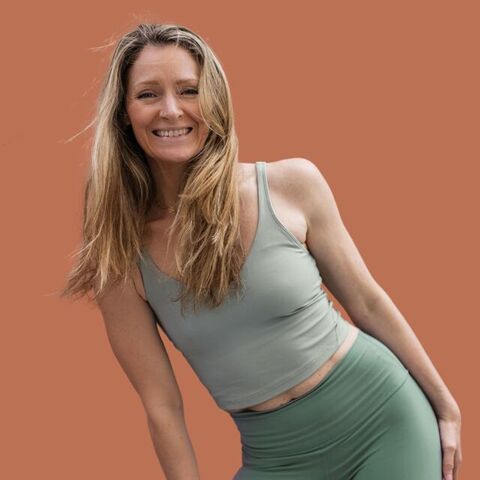
This is for describing how to find a comfortable seat for your breathing and meditation practices and following that to describe how to do square breathing.
So first of all,
We need to find a comfortable seat to do our breathing and meditation practices.
It's really important that you're sitting upright and tall.
So if you look at me from the side,
I'm trying to sit up nice and tall,
Not slouching.
You can sit on a chair with your feet down on the floor,
But make sure you're not slouching back into the chair because,
Again,
We want to have a nice tall straight spine.
It does make it easier to breathe with the diaphragm.
If you're slouched,
It's hard to breathe with your lower ribcage.
When you're sat up tall,
It's much easier to breathe with your diaphragm,
Which just sits right at the bottom of the ribcage.
So you can feel free to stick a pillow behind you if you want that extra spinal support.
Now,
Sitting cross-legged is optional.
You can sit on the floor on a pillow on your shins as well or sit a block underneath your sitting bones to raise your pelvis higher than your knees,
Which can be really comfortable if sitting directly on the floor makes your legs or your hips go numb or tingly.
Alright,
So moving into what the diaphragm is,
We need to be breathing with our diaphragm for most of the pranayama exercises that we're doing,
Which pranayama means breath control.
The diaphragm,
If you put your hands at the bottom of your ribcage,
You can identify where your diaphragm is.
You want to inhale into your hands and feel your fingers move away from each other in the center of your lower ribcage.
And the exhale,
Your fingers come back together,
Touching in the middle of your ribcage.
We try not to breathe from the neck and shoulders.
We try to breathe from the ribcage,
So inhale.
As you're going through the pranayama practices,
Try your hardest to breathe from here.
It has to do with engaging the parasympathetic nervous system and stimulating the vagus nerve and moving you into rest and digest mode so you can get a really restful sleep.
Now square breathing is the first practice that you'll learn.
It's also called box breathing or samavrti,
Which means in Sanskrit,
Same action breath.
You breathe through your nose and you breathe with your diaphragm.
Your inhale and exhale need to be extremely smooth,
Mindful,
And controlled.
So that means the beginning,
Middle,
And the end of each inhale and each exhale,
You want to feel like they're the same.
So there's no abrupt stop or taking too much breath or exhaling too much breath at the beginning and running out of steam towards the end.
So you inhale really,
Really smoothly to a comfortable peak,
Pause,
And then take a retention.
So you just hold your inhale breath.
If for any reason holding your breath in this breath practice causes you to feel panicked or your heart rate increases or your blood pressure increases,
Please skip the breath retentions and just inhale and exhale one after the next,
Again,
Even and smooth.
The breath retentions,
We want to feel like they're starting to become smooth and eventually with practice,
They become more comfortable.
After the holds,
You move into your exhale breath,
Again,
Even and smooth to the bottom,
A comfortable bottom.
Try not to squeeze out the entire breath.
Then there's another breath retention,
Smooth transition,
And then into the inhale breath.
Now,
For the technique that I'm teaching you in this first lesson of Pranayama,
We are going to be doing a count of four.
Your guided audio file,
They are completely separate and to be used when you want to use them with no further instructions so you're not distracted by all of this chit-chat right before you want to be breathing.
So just listen to this once,
Get the technique right,
And then use the other files to do the technique for your five-minute guided breathing exercise.
So you sit down.
You can rest your hands onto your knees,
Palms up or palms down,
Whichever is more comfortable for your shoulders.
Again,
Not slouching,
Chest up,
Chin parallel to the floor,
Eyes softly closed.
If you're feeling like it's hard to close your eyes,
Try to scrunch your eyes really tightly shut to engage the facial muscles around your eyes and then relax your face and see if that helps.
So feeling as tall and relaxed as possible,
Inhaling through the nose for one,
Two,
Three,
Four,
Hold,
One,
Two,
Three,
Four.
Exhale even and smooth,
One,
Two,
Three,
Four.
Hold the breath,
One,
Two,
Three,
Four.
So that's one round.
Second round,
Inhale smoothly,
One,
Two,
Three,
Four,
Hold,
One,
Two,
Three,
Four.
Exhale,
One,
Two,
Three,
Four,
Hold,
One,
Two,
Three,
Four.
Inhale,
One,
Two,
Three,
Four,
Hold,
One,
Two,
Three,
Four.
Exhale,
One,
Two,
Three,
Four,
Hold,
One,
Two,
Three,
Four.
Now that's two complete rounds.
That is the technique of square breathing.
I hope that explains it well and I hope you enjoy it.