Hi everyone.
I wanted to do something a little bit different today.
Although it's still a meditation,
What I wanted to do is help you to discover where in your body you hold stress through breathing.
So just breath work can really tell us a lot about where we hold stress in different points in our bodies.
Although it's simple,
It does take some practice to discover where we hold stress in our bodies.
Why it's important is so that we can learn which points in our bodies we need to relieve tension,
How we can prevent and respond to any pain points in the body that are occurring because of stress,
And release any energy blockages that may be occurring.
We can do all of this just through breathing,
Which is pretty great.
I wanted to take some time to do a few exercises with you all.
Hopefully you guys will come away from this meditation,
This breathing exercise,
With a new found understanding of how to relate to your body's physiological responses to stress so that in the future you can identify where you hold stress in the body and how to then mitigate that,
Whether it's through massage or through yoga,
Acupuncture,
Or just simply taking stock and breathing and relaxing in those areas.
I do this because I hold stress in my upper back,
But there are some parts of our bodies that we hold stress that we really wouldn't think of otherwise.
A lot of people hold stress in their chest,
And you may discover through this breathing exercise that you do hold stress there.
You can really find out through breathing if you're holding stress in your chest.
Hips are another place that people hold stress.
Lower back,
Of course.
The back is a big area of contention for people with pain and tension.
Whenever you're ready,
I would say if you don't have a yoga mat or a blanket or something comfortable to sit on,
Pause this video now,
Go grab it,
And then come back.
Also important when you're doing these exercises is to just be comfortable.
Today I'm just wearing something that's not very restricting.
It's loose,
It's flowy.
It allows me to take big,
Deep breaths in through the chest and through the abdomen without much restriction or pain or discomfort.
Take a minute to make sure that you're comfortable,
And we'll get started.
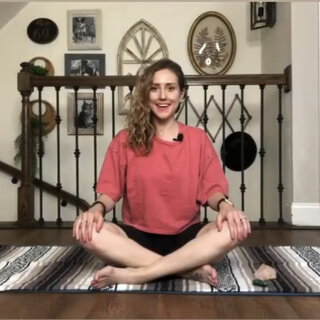
The first position that we will be in is just a traditional seated position.
Sit with your pelvis really rooted nicely into the ground.
You can either close your eyes or have a soft gaze at the floor for this exercise.
Really whichever is more comfortable for you.
What you really will be paying attention to is the breath work here and how it relates to the body.
Feel free to just listen to me guide you through these practices versus watching them,
But it's totally up to you.
What we're going to do is sit up straight with the crown of our head really lifted and our spines nice and straight,
And then really firm into the ground here.
You can rest your hands wherever you're comfortable.
You can either have them up,
You can have them in the knees,
Or you can just have them on your knees,
Wherever.
What you're going to do is you're going to take five deep breaths in through the nose and out through the nose.
In your last exhale,
What I want you to do is just start to settle into the breath and start to gain an increased awareness of your body.
It doesn't necessarily need to be body scanning,
But it can if that's something that you're used to and that works for you.
Next,
You're going to take five deep breaths in through the nose and out through the mouth.
You can try your best to focus on breathing through the abdomen,
But that can be challenging.
You can breathe in the chest if that works better for you right now.
But oftentimes when we do struggle to breathe through the abdomen,
That can be a sign that there is some energy blockages,
That there are some energy blockages in the abdomen area,
Or that that is an area that we hold stress.
What I want you to do is just start to focus on where you feel tightness when you're breathing.
What you'll identify is that a lot of times you'll feel the tension spots when you're breathing in,
When you're inhaling.
If you find yourself starting to sort of skip breath,
So that kind of breathing,
Start to try to recognize where you're feeling that.
Is it in the chest?
Is it in the back?
What pain points might you be having?
Where do you feel uncomfortable when you're breathing?
Let's start by taking five deep breaths in through the nose and out through the mouth in your seated position.
Take a second to stay comfortable.
Let your breath go back to its natural state.
Try to notice if anything came up for you in the body there.
You're starting to feel anything through breathing where it might be tight,
There might be tension.
You have difficulty breathing in.
Sometimes when you first get started doing deep breaths,
It can be difficult.
It could become a little easier for you over time through this video.
Now that we've started,
You have an idea of how we're breathing.
We're taking five deep inhales in through the nose and out through the nose.
Then the second set of breathing exercises is in through the nose five times and out through the mouth.
Exhaling out through the mouth allows us to let the heat out of our body,
Sort of a renewal.
Then when we start again,
We'll start to breathe in the nose and out through the nose again.
Now that you have an idea of how we're doing this,
We're actually going to shift positions.
This is when having a comfortable space in the knee view is really important.
When you're comfortable,
And if you're comfortable,
I'm going to actually have you come into a traditional child's pose.
When I say traditional child's pose,
It just means kind of what everybody thinks of.
But you can either have a wide legged child's pose here with your feet together and your legs apart.
You come down.
I encourage you to maybe do something with a little bit more ease.
So with your knees together,
Feet together,
And coming forward here.
Let your forehead touch the ground.
Or if you're really craving something nice and comfortable and delicious,
You can have your arms back here and forward.
Whatever is up,
It's up to you.
But what you're going to notice here is how your back might respond to your breathing.
Start to feel the points in your back,
And maybe even in the back of the neck,
And also in the shoulders and in the arms,
Where you might be feeling some stress and some tension.
So let's get started breathing into this pose.
So you're going to come down here,
And we're going to take five deep breaths in through the nose and out through the nose.
Let your final exhale.
Just take a second to make sure that you're comfortable,
Make sure you're not holding too much in any spots,
But that if you are holding in any spots,
It could be a stress response in your body.
So in your next five inhales in through the nose and five exhales out through the mouth,
Really start to take stock of how your body is feeling in certain points.
Inhale through the nose,
Exhale through the mouth.
Really let it go on those exhales through the mouth.
Do four more on your own time.
And then you finish your last inhale.
Just stay in this nice forward fold and just let your breath come back to normal and take stock of how you feel in your body.
Did any feelings come up in the back and hips and the neck and the shoulders,
Arms,
Anywhere?
Do you find that you're feeling tension in the eyes and the forehead and the jaw?
I don't know about you,
But I definitely felt some tension in my left shoulder,
Which is really something that I don't experience often and that's why it's so important to do these exercises to connect to our bodies and allow our bodies to tell us where there's pain,
Where there's tension.
Are we holding stress?
Are we more stressed out than we think we are?
Our bodies really allow us to become more educated on where our minds are at.
Okay,
So gently come out of your child's pose.
And this part is everyone's favorite.
So now what we're going to do for our final breathing posture is we're actually going to come to lie down on our backs.
If you have a blanket at this point,
What can be really nice?
If not,
It's totally okay.
You could use a pillow too,
Or towel.
Just something with a little bit of weight.
If not,
That's perfectly fine.
You'll still be able to get the benefits out of this.
And just drape it on your hips.
If you do have something.
We're going to come down and lay down on the ground.
And I'm going to lay on the ground for just a quick second and then I'm going to pop back up so you all can hear me.
But yes,
Just get comfortable and really allow your body to fully sink in.
Let the weight of your body to just drop into the earth.
Let your arms splay out nice and wide,
Whatever feels comfortable,
Or you can keep your hands on your hips above the towel or blanket if you have that to add some additional weight.
It can be really comforting.
And we're going to start that breathing exercise again.
Now that we're in,
As in yogi terms,
A traditional,
We're in our Shavasana pose,
We can become very relaxed.
This really allows us to not have to use any core strength,
Hold our bodies up,
Which some of you might have needed to do in the upright seated position.
It really allows us to not have to use any shoulder strength or stamina that you might have needed if you're tight in the shoulders during the child's pose.
The Shavasana is where you can really let your body relax.
So because of that,
This position is very powerful to be able to connect to where there might be stress,
Pain,
Tension in the body.
So let's start.
Five deep inhales through the nose and out through the nose.
And on your final exhale,
Just take a second to make sure that you're comfortable,
You're not gripping.
Your jaw is nice and loose,
Not clenched.
And just take a second to think if anything came up in the body.
We really want to be focusing on the feelings in our bodies while we're doing this exercise.
So we're going to jump into our final breathing for this meditation,
For this breathing exercise.
We're going to take our five deep breaths in through the nose and out through the mouth.
Take one final inhale through the nose and out through the mouth and really let the breath out through the mouth.
Now just start to let the breath come back to its normal rhythm.
Listen to your body.
What is it telling you?
Now that you've spent about 15 minutes or so just breathing into the body,
Different postures.
What came up?
What came up in the body there?
And if nothing came up,
Then that's perfectly fine.
I encourage you to do this exercise as often as possible to really strengthen the mind-body connection through something that we all have,
Which is the breath.
You can remove the blanket if you have that or the towel or anything that you have on top of you.
And you can just slowly come to a seated position back where we started.
You can keep the eyes closed,
Soft gaze.
Start to bring some movement back into the body.
Take stock of the room and just know that whenever you need to,
You can come back to the breath to connect the body.
I hope you enjoy it.
Namaste.