Welcome to the mindfulness meditation podcast presented by the Rubin Museum of Art.
We are a museum in Chelsea,
New York City that connects visitors to the art and ideas of the Himalayas and serves as a space for reflection and personal transformation.
I'm your host,
Dawn Eshelman.
Every Monday we present a meditation session inspired by a different artwork from the Rubin Museum's collection and led by a prominent meditation teacher from the New York area.
This podcast is a recording of our weekly practice currently held virtually.
In the description for each episode,
You will find information about the theme for that week's session,
Including an image of the related artwork.
Our mindfulness meditation podcast is presented in partnership with Sharon Salzberg and teachers from the New York Insight Meditation Center,
The Interdependence Project,
And Parabola Magazine.
And now,
Please enjoy your practice.
Hi everyone.
Welcome to mindfulness meditation online with the Rubin Museum of Art.
My name is Dawn Eshelman.
I'm head of programs at the Rubin Museum and we're a museum of Himalayan art and ideas in Chelsea,
New York City.
And we're so happy to have all of you joining us for our weekly program where we combine art and meditation online.
I hope you all are doing well,
Keeping warm,
Depending on where you are.
It is that time of year where so many cultures around the world,
Especially in the Northern Hemisphere are just celebrating this time with light of some kind,
Right?
Bringing the light into the darkness.
So happy Diwali,
Tihar,
Samhain,
All of those wonderful autumn holidays.
I hope that you're enjoying this time.
We will dive in to the art that we're looking at today.
We will do that with our wonderful teacher,
Lama Arya Droma,
In just a few minutes.
First,
I just want to invite you to the museum.
We're open and in operation and our new installation on the third floor,
The Mandala Lab,
Which is all about this idea of what mandalas represent,
Which is transforming afflictive emotions into wisdom.
And so that's what we're talking about this month.
So yeah,
Let's take a look together at our art for the day.
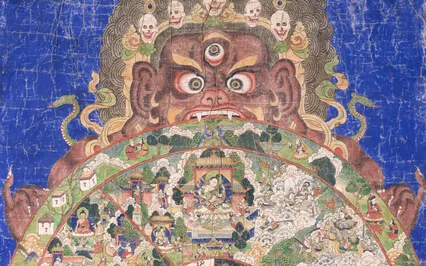
This,
As many of you will recognize,
Is the wheel of life or the wheel of existence as it is sometimes called.
This is from Tibet or Mongolia.
It's from the 19th century,
Pigments on cloth.
And this is a visualization from the Buddhist point of view of the human condition within the endless cycle of birth,
Death,
And rebirth,
Samsara,
This vivid reminder of the law of karma.
And there's so much to see here,
But we'll start with just this outermost figure that really pops out to us amidst this bright lapis blue background.
And this is Yama,
The Lord of Death,
Or possibly Yami,
Female demon of death,
Holding the circle that contains all six of these realms of existence.
And it looks like they could just swallow it at any moment,
Which reminds us about this precarious impermanence that exists in all of these realms.
And in the very center here,
We'll take a close look.
We see three mental poisons that are depicted or kleshas.
These are in relationship to that idea of the afflictive emotions.
And what we have here in the middle is a rooster that represents attachment,
A green snake that represents hatred,
And a black pig that represents ignorance.
And so these are the three kleshas,
The three mental poisons,
These afflictive emotions that through these practices,
We can transform into wisdom.
But for now,
I'll bring on our wonderful teacher,
Lama Aryadroma,
Who is an ordained Buddhist teacher and is trained in the karmakayu and shankh bhakayu traditions of Tibetan Buddhism with over a decade of monastic study and meditation training.
She was born in India and in her early years practiced Hindu traditions.
And later she studied under a renowned Tibetan Buddhist master and practiced Tibetan Buddhism.
Lama Aryadroma is a graduate of the traditional three years,
Three months Tibetan Buddhist retreat,
Which is an advanced cloistered meditation training program at the Palpantup Tincholing monastery in upstate New York.
And she's also studied and trained extensively in the Dharma path program of mindfulness contemplation.
She leads and teaches worldwide leading retreats and workshops and is really wonderful at conveying these kind of ancient Buddhist principles and making them relevant to our everyday life.
Lama Aryadroma,
So nice to have you here.
Hi.
Thank you.
Hello everyone.
And I'm so happy to be here with you all.
And thank you,
Dawn,
For that wonderful introduction.
And also thank you for talking about the theme,
The wonderful artwork that you introduced today.
So this artwork is,
As Dawn mentioned,
It's the wheel of life,
Which represents the infinite cycle of birth,
Death,
And rebirth.
This artwork is an absolute masterpiece.
The topic today is about the center of the painting.
And as Dawn mentioned in the very center,
There are three animals,
The snake,
The rooster,
And the pig.
And it's eating each other's tail in a circle.
You know,
And this represents the three poisons.
So it's greed,
Hatred,
And ignorance.
The rooster symbolizes greed,
The snake,
Hate,
The pig,
Ignorance.
It's in the form of a circle to represent our own life.
It's birth,
Death,
And rebirth.
And the cycle keeps continuing.
And these three poisons are the ones that keep us trapped in this life,
In this human life,
From the infinite cycle of rebirths.
These three poisons are really referring to the three mental states of the mind.
And these mental states is a cause of all the suffering,
Problems,
And pain to ourselves.
And then we create problems to the world.
So the theme of this month is transforming afflictive emotions.
So how do we transform these three poisons?
And what are the antidotes?
And what are the remedies for these three poisons?
We're very fortunate because the Buddhist path not only points out the causes of the suffering,
But gives us techniques and remedies to transform these mental states.
And all of the Buddhist teachings do this.
They transform our mental affliction.
They transform the constant loop of all these emotions,
Negative emotions coming up.
And what do we do?
We transform that into positive emotions.
And so this is why the Buddhist path is so wonderful because it gives you techniques and tools.
So to reduce the suffering in your life,
You must apply these remedies and antidotes as often as you can.
It may be easy to think that it's always the other person that's making you angry,
Hatred,
And ignorant,
But it's in the end of it,
When you come down to it,
It's your own mind that's causing all this.
Yes,
The other person may cause it,
But we have no control over the other person,
But we suddenly have how we react.
So let's take the mental state of hatred,
Which gives us rise to anger and aversion.
So these are really strong mental states that bring great suffering to our minds.
When you feel hate,
You suffer because the mental pain is really even more terrible than whom you hate.
So it's us that we have to get rid of these mental afflictions and transform them.
And the first thing we can do is if we are good practitioners,
And I believe all of you all seem to be very good practitioners,
We will start by calming the mind,
Putting attention on our breath.
And then another wonderful meditation is the loving kindness meditation.
And I think in today's world,
Loving kindness meditation is the key to all the mental afflictions.
Love on every breath,
That's what I try to practice.
So like yesterday,
Here in the monastery,
I'm in this beautiful monastery upstate,
We had something called the merit day.
And the Chinese community wanted to have this day.
And you know,
The day was going to be filled with merit,
Meritorious activities.
So what we did was we started chanting Lord Chenrezis practice,
And Mother Tara's practice.
And then we went and released a fish as such a wonderful day in the symbolic sign of releasing fish means a long life and healthy life for ourselves.
And then we lit butter lambs at dusk to signify,
May all the sentient beings have wisdom instead of ignorance.
May all the ignorance be removed from this universe and may there be light.
And talking about light,
Happy Diwali,
We all celebrated Diwali all over the world.
And this is also significant of bringing light to darkness.
And so coming back to the loving kindness meditation,
We can cultivate this attitude of loving kindness to ourselves and extend it to all the beings.
And in this meditation,
What you're doing is from a negative state of mind,
We are redirecting the focus to a positive state of mind,
You're transforming the negative mind.
And I shall be giving you a guided meditation on loving kindness.
So then let's take and with anger and things of that nature,
You know,
All this will subside when we start having loving kindness when we transform this.
So we basically,
What we want in our life is we want to hear pleasant things.
We want to taste wonderful things.
We hear our ears and our speech.
And we don't like anything basically,
Any kind of displeasure to our sensory faculties.
Like when there's loud music,
You can see,
You know,
When you,
How do you transform it instead of looking at it as someone,
Your neighbors,
You know,
Irritating you or bothering you,
You can look at it and analyze it and say,
These are like sound waves bothering,
You know,
These are sound affecting our auditory senses rather than personalizing it and thinking,
You know,
The neighbors out to get to you.
How many of us,
You know,
All of us,
We can't handle this very loud music and some can.
But kind of de-personalizing it.
So let's take greed and cravings or attachment.
The antidote or remedy is to again calm your mind,
You know,
Put your mind's attention on your breath and really calm your mind.
And then you look at the object that you're fixated upon bringing the mind,
The,
When you have strong desires,
You can look at it and say,
Think of the impermanence of that object.
You know,
We can bring to mind that it's just temporary,
You know,
Our desire,
You know,
Say it's a car that you desire or this extravagant designer outfit or whatever your desire is so strong and you can look at it and say,
This is just temporary.
How many times have you all bought something fabulous?
You know,
It could be a car or it could be even a house.
And you know,
Within a few days you've lost interest for your,
You know,
Your iPhone,
You know,
Every time you go and buy a new iPhone and the latest one,
You lose interest.
And so that's one of the things when you have great desire,
You can say,
These are just temporary.
And then the mental poison of ignorance.
So with ignorance,
It doesn't mean lack of knowledge.
All of y'all are so smart.
The antidote to ignorance is wisdom and wisdom can be obtained through spiritual cultivation.
The remedy is practicing mindfulness,
Meditation,
Insight,
Meditation,
To be spiritually centered.
So today's mindful meditation will be the practice of loving kindness and compassion meditation.
For many people,
This seems to be a little awkward to practice at first,
But it has great potential to transform our minds in terms of bringing about a sense of loving kindness for all beings and oneself.
So how do we practice this loving kindness meditation?
It's really,
Really very easy.
I'll give you a guided meditation.
It's quite easy and really simple.
But here are some important instructions.
So let's all straighten up.
We'll start the meditation and I'll give you guidelines.
And as we practice this loving kindness meditation,
You'll get better and better.
So we all at some point or the other have experienced unconditional love towards someone.
It could be a child,
It could be a sibling,
It could be a friend.
It could be your parents.
So right now let's all set up right and bring that person into mind who we feel unconditional and absolute love for.
And let's feel that feeling of unkindness,
Unconditional love and kindness.
So as you breathe in,
Just feel the suffering,
The mental suffering you're facing,
Which is either anger,
Hatred,
Desire,
Or even ignorance.
So just breathe all that out.
And as you breathe in,
Just feel other people suffering as well as they suffer with the hatred,
Anger,
And ignorance.
And bring into mind this beautiful white light filling you with all the joy,
Peace,
And happiness.
And then once it has filled you completely,
Just stay in that moment for a while,
Putting your attention on your breath.
Let's meditate for a while for a few moments.
We'll be right back.
As you breathe in,
Bring to mind the feeling of suffering of yourself and others.
And as you breathe out,
Bring to mind the tension,
The feeling of unconditional love,
Kindness and compassion into your mindstream.
And just imagine you're sending out pure loving kindness and compassion in a form of brilliant light which goes out in all direction and it permeates the universe with loving kindness.
And all beings are filled with happiness and joy and including yourself and just rest in that present moment of awareness.
As your mind wanders off,
Just notice and just say thinking and bring your attention back to your breath.
Putting all your mind's attention on your breath,
Just inhale and exhale.
Breathe normally.
Again,
Bring to your mindstream that unconditional love you feel for someone wishing that all the beings in the universe is also blessed with that loving kindness and compassion.
It permeates the whole universe and yourself.
And again,
Just rest in that present moment of awareness.
It's okay if your mind wanders off.
As soon as you notice,
Just say thinking,
Let go of that thought,
Bring your attention back to your breath.
Meditation is absolutely very simple.
That's mindful meditation and it's extremely profound.
So don't be fooled by the simplicity.
So again,
Inhale and exhale.
Breathe normally.
Breathe as to your space.
As you breathe in,
Bring to mind the feeling of unconditional love,
Loving kindness and compassion.
And just imagine you're sending out this pure loving kindness and compassion in a form of brilliant light,
Which goes out from your heart center in all direction.
It permeates the universe with loving kindness and all beings are filled with happiness and joy,
Including yourself.
So just rest in that present moment of awareness here and now.
Breathe as you breathe in and out.
It's okay to have thoughts.
That's the nature of your mind.
You don't push away your thoughts.
You don't stop your thoughts.
Just acknowledge them and then the minute you watch yourself thinking,
Just label it thinking and let go of that thought and bring your mind's attention.
Concentrate even harder on your breath,
But everything is gentle.
The thoughts will come and go,
And that's what thoughts do.
Do not follow the past.
The past is finished.
Do not think of the future that I must do this or I have to do a list of things that you want to do right now.
As you start thinking of these things,
Say thinking,
Let go of that thought and bring your mind to the present moment of awareness,
Which is putting your mind's attention on your breath,
Inhaling and exhaling.
As your mind wanders off,
It's all right.
Then as you breathe in,
Bring to mind the feeling of unconditional love,
Loving kindness and compassion you feel for someone.
Bring that emotion into your mind stream and just think of all the people who are going through hard times with hate,
Desire,
Strong attachments and ignorance,
And then wish them well and feel that loving kindness and compassion from your heart center in a form of a beautiful,
Brilliant light go out and permeate the whole universe with loving kindness and compassion.
And just rest in that present moment of awareness.
Lie truly.
So,
Now that you'll have practiced this wonderful meditation,
Loving kindness and compassion,
It's actually a very ancient Buddhist practice.
It's called tonglen and it's sending and receiving.
This is what tonglen means.
And now,
As you have these mental states of deep hatred,
Which leads to anger,
Or when you feel desire and attachment,
Or when you feel ignorant or spiritually not centered,
The moment you sense this,
The antidote is immediately feel compassion for yourself.
And then what you do from your heart center in a form of a white light,
Just think of all the people at that very moment who are feeling so terrible,
You know,
They're suffering from all these mental afflictions and you send out beautiful light from your mind stream,
The feeling of loving kindness and compassion to everyone on this universe.
And then just rest in that glory in that beautiful moment,
Beautiful,
Precious moments,
Just rest.
And this is how you use these remedies.
And at first,
You know,
We're not very familiar of loving yourselves or sending loving kindness and compassion to ourselves.
But then you will get more and more familiar,
It'll be such such a natural thing for you to do.
And I do this practice all the time.
When I started this practice,
It was I was going to one of the centers,
Meditation centers in the city.
And one of the practice was,
We would chant this Lord of compassion,
His the prayer text,
It's called a sadhana.
And we would bring to mind,
You know,
Loving kindness and compassion,
And,
You know,
Bring it,
Send it to ourselves and send it to the whole universe.
And this is what transformed my views.
I saw it working,
People gravitated more to me,
Because I was in a great positive energy,
Positive energy space.
And it became so natural.
And I just loved,
You know,
In the mornings,
When I would go walk to work,
I would say,
I have two choices.
One,
I can just judge,
Judge,
Judge hate,
You know,
As I walked,
Or I could do this meditation.
So I would sometimes have the silly grin on my face,
But I felt absolutely happy.
And that energy was contagious.
So I'm so happy that all of y'all did this meditation.
It's one of the most profound meditations.
You can look it up.
It's called Tonglen,
T-o-n-g-l-e-n.
And,
And Happy Diwali,
May your hearts be filled with light and love for everyone.
And so I just wanted to part with this little joke,
Jesus and Buddha are sitting in heaven.
And Buddha said,
I should have made one of these rules,
Where people aren't allowed to depict me.
And Jesus was,
Why?
Why Buddha,
Why do you say that?
And Buddha said,
They keep making me look fat.
And then Jesus said,
Tell me about it.
I have been a blonde white guy for thousands of years.
I thought that was such a hilarious Buddhist joke.
But then Buddha apparently was in this town and people rushed to him and they said,
Please,
Give us some solution.
We have so many mental problems.
Please,
Please help us,
Help us.
And Buddha,
You know,
With his compassion,
Loving kindness,
He said,
Of course I'll help you.
Please come tomorrow.
I'll be teaching and giving you antidotes.
And of course,
You know what they said?
They said,
Oh no,
Please send me,
Send all this by mail.
And then Buddha said,
I'm sorry,
No attachments,
No emails and no attachments and no mails.
So thank you all for being here.
I thought I'll share this funny joke that we were talking about.
Thank you so much.
Oh,
Thank you so much.
Lama Arya drama.
That was great.
That concludes this week's practice.
If you'd like to support the Rubin and this meditation series,
We invite you to become a member.
If you're looking for more inspiring content,
Please check out our new podcast,
Awaken hosted by Laurie Anderson.
The 10 part series features personal stories that explore the dynamic path to enlightenment and what it means to wake up now available wherever you listen to podcasts.
Thank you for listening and thank you for practicing with us.