Hi and thank you for joining me in this Nature at the Heart of Wellbeing meditation.
Hopefully you're able to take part in this meditation outside.
Please don't worry if you're in your house.
If you are in your house try to open your windows to let some of the outside in.
Take a few seconds to get comfortable and find a place to sit.
Cross your legs if you wish but most importantly you should feel comfortable sitting.
Keep your eyes open for a moment and find your breath.
Take control of it for three deep cycles of inhale and exhale.
As you allow your breath to take care of itself once again count each exhale up to the number 10 or whatever number is that you've reached again when I speak next.
Exhale.
Now as you allow your breath to disappear begin to listen to your environment starting with the sounds which are closest to you.
If you're outside they might be the sound of leaves in the wind,
The sound of birds or nearby water,
Maybe even insects.
No need to try to identify any of the sounds.
Just notice them.
The pitch,
The tone,
The softness,
The volume.
Now allow your mind to focus your ears,
Your hearing,
On sounds which are farther afield.
You might be able to hear machinery or aircraft,
Distant animals,
Livestock.
Or like me you might be able to hear the church bells.
As the ringers practice you might hear the traffic and the sound of a distant storm.
Once again there's no need to identify the noise,
The sounds that you hear.
Simply notice them.
The pitch,
The volume,
The tone,
How soft those sounds are,
How distant they are in your position.
Now you're listening back toward you,
Those leaves,
The birds that are in your immediate surroundings,
The insects.
Any water that's running nearby,
Maybe the rain outside your window.
If you're in your house you might hear sounds created by the heating systems in your house or the settling sounds of the structure of the property.
No need to identify those sounds.
Just notice them.
Now bringing your ears,
The sound,
The listening within your body,
Can you hear any sounds within yourself?
Can you hear your breath for instance?
You might be able to hear ringing in your ears that you've not noticed before,
Sounds within the silence that you originally perceived.
Notice those sounds.
You may even be able to just finally hear the sound of your pulse,
Your heartbeat.
As you allow the sensation of those sounds to pass,
Physical sensations begin to take prominence.
And I'd like you to notice the feeling of the air moving around your head,
Moving the individual strands of hair.
Notice the temperature of that air moving around your head.
Notice the weight of your head pressing down on your neck and shoulders.
Rise and fall of your chest as you breathe.
The touch of fabric on your skin around your neck and your shoulders.
Clothing around your tummy and your waist.
Trousers or skirts on your legs,
Feet.
And if you've any bare skin,
Notice the sensation of the air around that skin.
And feel your contact with the surface on which you're sitting.
Whether that's a rock,
A chair,
A patch of grass,
A wooden floor.
Is it dry?
Is it wet?
Is it warm or cold?
Is it soft or firm?
Smooth or rough?
It doesn't matter which it is,
Just take notice,
Give it your attention.
And a little time noticing what your contact with the surface on which you're sitting feels like.
And as we allow the sense of touch to fade away from our attention,
Turn now to your sense of smell.
Begin to notice how many individual scents you can discern in the air.
The air itself,
Does it have a smell?
Can you smell the nearby flowers?
Or woodland floor?
If it's safe to do so,
Run your fingers over the nearby vegetation.
Bring your fingers to your nose.
There's no need to identify the scent.
Just notice it and experience it.
Now do the same for the surface you're sitting on.
Grass,
The rock,
Carpet.
So far,
Your hand up to your nose,
Notice the smell.
Experience it.
If your eyes have closed during the past 8,
9 minutes or so,
Open them up once more.
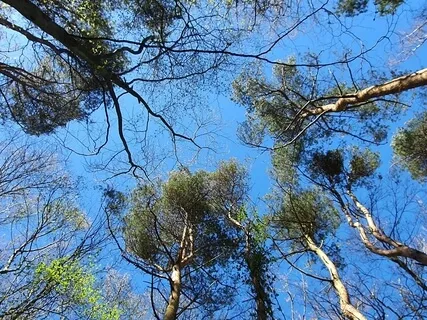
Look directly above your head and witness the light coming from above you.
If you're outside,
Coming from the sky,
If you're in your room,
There's light reflecting from the ceiling back at you.
Are there trees above you or any shapes in the ceiling?
Are there still or moving?
Notice the range of colours.
Notice the tones,
The brightness,
The darkness.
Actually move your gaze down,
Noticing how colours,
Brightness and tone has changed.
When you're looking straight ahead of you,
What can you see in your immediate surroundings?
Notice the trees,
The flowers,
The vegetation.
Any houseplants you might have in your room,
The surfaces,
The furnishings,
The ornaments.
In all of those objects,
Notice the tones and the shades.
In the air in between those objects,
Can you notice any particles?
Is the air clear?
If you're outside,
Are there any insects or birds in the air?
Are they being struck by the light?
Notice as they move around in the air.
How far can you see?
Move your eyes around your head if necessary and pick out the farthest object.
There's no need to try to identify it,
Just notice the colours,
The tones,
The shades and the shapes of that object.
Regard it for a moment or two.
Then slowly bring your vision back to your immediate surroundings and notice your breath once more.
Counting each exhale until you next hear my voice.
As we now have our attention fixed on the breath,
Take control of the breath and take three deep cycles.
Inhale and exhale.
Notice yourself being a part of nature and your surroundings once more.
End your meditation on the sound of the singing bowl of gong.
Thank you for sharing these moments with me.
My name is Karl and it has been a privilege to share the last 14 minutes with you.