Hello,
I'm Charlotte Watts.
Welcome to these podcasts that were first broadcast live in my Facebook group,
Charlotte Watts Calm.
Hope you enjoy them and if you want more,
Please look at my website,
Charlottewattshealth.
Com.
Hello,
Welcome to this evening's Facebook live here on Charlotte Watts Calm.
Getting down to get my notes.
And this evening we're going to be talking about how yoga relieves stress and it's quite a big reason to talk about often why many,
Many people are drawn to yoga practices.
And let's be clear here,
I am mainly referring here within the yoga canons,
A great big arena of yoga,
Which is all designed to move us towards meditation,
Towards connection.
But here I'm referring to what is often called modern postural yoga,
Which is what many people know as yoga,
Doing postures,
Asanas,
Which is the Sanskrit word for posture,
It means seat,
Which is the way many,
Many people,
Most people experience yoga in the modern world today.
So most of what I'm referring here today is modern postural yoga and stress is one of the main reasons that many people are drawn to yoga.
And often that is seen as an exercise alternative if you like that also has other dimensions and as one of the ways to come to yoga,
It's not a bad one,
But let's be clear from the offset that yoga is a meditative art.
So it is meditative in the sense that it is concerned with presence,
Being in the present moment,
Concerned with expanse and concerned with not actually having to get anywhere,
Letting go of goals and letting go of something,
Having a particular purpose yoga itself means union.
And that is translated,
Seen,
Viewed in many ways by different schools and different translations.
And as something philosophical as a way to view it in many ways to have lots of different flavours,
If you like.
And often it might be seen as mind body union.
And that's something that's particularly picked up on for that need for presence,
That need to live in the present moment that many of us have in the modern world.
And the reason we are often drawn to yoga and because we live in these States where we are often in quite hypervigilance.
So the stress response has us coming from a place of fear,
A place of survival,
Where ultimately we are looking around for where the danger may come from or stealing ourselves in an environment that might feel inherently unsafe.
Then that union where we become embodied,
We occupy our body and we consciously invite our mind to be in our body at the same time in the here and now,
That union is something that draws people to yoga.
And even if they come as a purely physical exercise,
Then often they stay because they start to find that presence and start to find through the physical practice that they are much more able to be present than they might do just with meditation or seated more still practices.
So from a wider yoga philosophy perspective,
Yoga as union is the end of what's called the eight limbed path in yoga from Patanjali sutras.
And Samadhi is the ultimate,
The end,
The eighth limb in the yoga path.
And Samadhi is a joining of our individual consciousness with the wider consciousness.
So an opening up of us as just ourselves,
Seeing ourselves as something removed from everything else and a sense that we can really open up into the universal and having presence that might seem kind of like quite a highfalutin or kind of esoteric,
But actually from a real point of view,
That's something that we might find that we do when we're walking in nature,
That we are connected,
That we're just feeling that we're being really true to ourselves.
And we get that sense of open and expanse because many,
Many cultures,
Philosophies that have meditation within their practice are ultimately concerned with this sense of expanse,
With liberation,
They're leaving behind this sense of attachment to identity,
To being something,
To desire or to desire things we want and we like and desire things that we don't want,
We want to push away from.
So aversion in that sense.
So talking in the context here of posture,
Of modern postural yoga,
The reason that many people find quite immediately,
Quite excessively that yoga allows us to relieve the stress response,
Relieve stress,
There's a focus on the breath and you find in much modern yoga teaching that the exhale is often mentioned more than the inhale and that is not because the inhale and the exhale,
So the exhale is more important than the inhale,
Of course the two,
The exchange of energy,
Oxygen,
Nutrients in then out is always within a balance,
It always has a complete relationship.
But the stress that we are prey to in modern life is psychosocial stress,
This kind of continual drip feed of potential emotional stressors and maybe feeling unsafe and having certain types of traumas,
Developmental trauma in the mix as well means that we can live in that slightly sympathetic dominant state which is something that doesn't even feel like massive agitation but just slightly on edge primed for danger,
Even at a low level that can be our kind of normal state and if that's the case then it's very usual for the inhale to dominate,
For us to gather in oxygen to be ready to fight or flight as the survival response demands.
So that leaves little room for that exhale,
The release of the exhale that is more in tone with the parasympathetic nervous system,
The calming tone of the nervous system.
So put kind of briefly,
The inhale is a more excitatory gathering in,
Drawing in breath and the exhale is a more releasing,
Letting go expansive breath.
So just the natural movement of breath has us constricting in to draw it in and expanding to let it out and there's a relief in that.
So why we go after we're stressed to let those things go.
So often this instruction of being able to be spacious in the exhale,
Even instruction in class to sigh out if things feel like they're gathering up and they're becoming constricted or stressed is quite a blessed relief for people and the stress response comes with us moving from our most efficient and easeful primary breathing which is breathing into the diaphragm and the belly and as soon as we go into the stress response we move into a heightened secondary breathing where things move up into the chest and the shoulders.
So that's when we're kind of dominating on the inhale as well and things start going like that and a lot of people,
Especially as we sit hunched over and desks as well or supporting ourselves,
Bringing ourselves around if we feel vulnerable or we need support,
Then this getting caught up here feeds back down as well to keep the stress response up.
So if we're in this and we're quite dominant on the inhalation then the whole of us,
Our body is getting the message that we must be stressed,
There must be danger and we must keep it up.
So we can get quite locked up here,
Which continually sends the signals back down again.
So if we are able to do practices where there is an emphasis on noticing the exhalation,
Not even manipulating in yoga breath consciousness is called pranayama and sometimes that's seen as specific exercises but actually really does mean the consciousness of breath.
Noticing,
In the noticing of something it changes,
You know if there is an observer or participant something of its nature changes so that it means you have an immediate relationship with the breath anyway.
But this consciousness of breath means that we can start to notice where we hold,
Where we have those patterns and where then is the potential to start to let them go.
And many practices and hopefully you know this is why fascial work and more kind of fluid moving work is really brought more and more into the yoga world.
We're not just doing kind of like large virtual oso postures and big muscular stuff but we are really recognizing that our tissues get locked in by stress and we need that fluidity through the whole of the connective web,
The whole of our tissues need to start that sense of coming from the constriction of stress into the fluidity of being able to let that go and find different patterns.
Because many of those stress responses that come up from the bottom they gather us in a drawer that's up to steal against the things that we might see as challenge or danger.
Also have us clenching around the jaw,
Have our eyes moving around.
They create a lot of tension rigidity around this area and around the base of the skull.
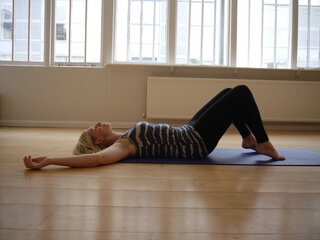
So often you see when people lay down in postures and they for instance like Shavasana and they have they're quite hunched in their day-to-day life that when they lay down the chin is lifted and the head is tipped back and that's one of the things where we might need something under the head for instance if that's something that your teacher is helping you with or you find in your practice.
And lifting just letting the chin drop very lightly into the throat opens up this area at the base of the skull where the bundle of our vagus nerves and our old brain is housed.
We can get quite compressed there and in yoga this area is equated with the moon.
It's a yin cooling place,
Lunar female energy.
So the more that we can just allow that to start to make space and release the jaw and start to let everything drop down again we have that natural dropping down into the exhalation.
And if we can do practices that help that to help to open us out in the chest without going into suddenly big opening back arches that can feel quite even stressful for the system if we're particularly if we need that support around the heart the more we can open up here release the jaw release the back of the neck feel expanse on the exhalation and that's when we get these new patterns where the body really starts to drop into the sense that it feels safe.
And one of the things that a yoga practice and a physical yoga practice really cultivates and this is still moving towards meditation but it also has a very palpable help to still the mind which is the aim of yoga not to do anything in particular but to still the mind and that's one of the reasons that coming to yoga to help relieve stress really has some validity as a you know a purpose.
Stilling the mind is what allows us to have a sense of expanse and presence and one of the things that yoga has shown within research to help is release levels of a neurotransmitter called gamma amiobutyric acid which is our natural brain's natural breaking system.
It does shut off chatter of the brain our tendency to go around in loops and get attached to language the stories that we conjure up the commentary the interpretation of what's going on the judgment of whether we think something is good or bad and just drop beneath all this stuff and start to be able to experience the present moment as it truthfully is not what we bring to the present from the past what we're living now as if it were happening nor some kind of projection of what this means for the future or what we want out of the practice but to actually feel what is our experience right now and that helps to cultivate what is called embodied awareness and when this left brain chatter this constant mind monkey mind going is continuing on it's difficult to feel neck down but when we start to allow the mind to drop then we can start to feel below the neck and the same is true bottom up if not more so the more we can feel our body and the more we can feel our body where it is on the earth grounded that is a sense of our physicality the size of us in the here and now the more we're aware of that the more our body feels safe the more we feel safe and being aware of what our body is doing starts to allow the brain to settle because it doesn't have that hyper-vigilance of slight panic of not knowing what's going on neck down and this disjoint where we might see mind up above the neck and body down below the neck is fracturing and something that is not actually real it's not true we are not separated out mind body you are not disjointed head and neck but if we tend to live up in our heads as is you know very usual in these times then the amount of time we actually spend noticing what is going on neck down means that we're not used to feeling that we can be quite cut off even numb and often when the things that we feel deep down are quite buried down there maybe we don't want to feel them in particular maybe the stuff that we've buried deep down in the belly in the pelvis in our root in terms of chakras is difficult for us then we might keep clenching our jaw to stop us feeling below and it's also kind of posited that often people will get a habitual clenching of their jaw when they can't feel just to feel something to have some sense of connection and in tantra which is a philosophy that feeds into yoga the jaw in particular is seen as a particular lock wall and in yoga these locks where we hold intention refers to as granti which means not and this not this grunty that gets formed across the jaw is seen as shutting us off from our belly and our heart so if we can practice and it's two of the most important instructions in yoga in physical yoga practice i don't think there's any more important structures than softening the eyes and the jaw once we can do that then we can really start to feel that there's an ease possible to our practice so softening the eyes and the jaw allows this wall is grunty to melt away and allows us to have a practice where all that energy that we're creating up in the head has a chance to ripple down and drop into into our heart and our belly so it's not that feeling that we're just locked up there and it's all going round with that energy that we are just holding in one place has the potential to go down and be felt here and we have a potential in our practice to really start to notice on all of these levels and particularly get away from any sense that getting somewhere in our practice you're doing the advanced i really do use that with air quotes advanced practice is not about how far we go it's not about being acrobatic but it is about presence and so often actually that's doing less because if we take our samskaras our tendencies the habits that we've created into our practice and those might be habits of doing those might be habits of believing that getting doing more is better getting somewhere to an end point is better if we take that into our practice then we start to run the risk of just roughshodding over a real sense of what our body needs so the kind of aphorism the breath leads the body follows the mind observes is one of the most useful and instructional phrases to hold i say it very often in class it's just very clear it gets to the point the breath leads pay attention to how our breath is it will let you know if you need to find ease releasing the eyes and the jaw then the body can follow and the mind simply observes so that in our practice we are led by listening and responding what do we need not what do we want sort of bug made of mind where you might say if you want to do this in a practice it's not really that relevant what we want what is actually appropriate for the time just because we can do something does it mean we should these you know big discussions and then the mind can observe so we're not having to call on it to make decisions and we can notice when our we might impose our will upon a posture and playing with them things like forward bends where actually they have an essence of surrender within them but they also can tend to bring up our how far can i go tendencies if we can watch that balance going on it's very natural for us to want to get further of course and you know in many aspects of our lives that really really serves us but if we live on that one note then that wears us out and it has us just led into areas where we don't have the potential for expanse and the potential for that liberation that comes from really truly listening to your body and all this leads to another one of one of the sutras which is a sthira sukha asanam which is ease and steadiness within posture within seats and really that means you know within meditation essentially in that context but it really applies for us when we are practicing postures wherein we're in any yoga posture as in life to have steadiness to hold something in strength if you like or power or dynamism and i don't mean those words in terms of force or push but is in energy gathering if we just do it that one direction that kind of fiery direction without a sense of ease then that becomes tight and rigid and we lose yoga we lose connection you lose the state of union and expanse but if we can hold something a whole our strong posture can be held if we can look for a sense of ease where we can soften so if we're holding something gritting our teeth then we've probably lost the sense of ease but if we can notice our breath notice when we soften how we can release the jaw then yoga really becomes what many people are seeking which is that stress relief and then it does all the things that you know the research is showing it lowers cortisol it lowers inflammatory cytokines which are part of the inflammation cascade which is part of the stress response it increases our ability to be with difficult experiences to have emotional resilience to be adaptable whole host of things that are rippled through the whole of our system a whole of our psycho neuro immunological systems and ultimately really gives us a sense of peace and a relationship with our body that means our mind can settle and that deepens our practice so even if someone comes to the practice for just stress or just exercise ultimately that's where those things will lead and it's a very very beautiful practice in that way so I hope that's helped you explore and just be able to notice what is going on for you in your practice what is going on for you at any given time so that our practice becomes creative we're not just going through the same old thing again and again and again and going through those same grooves without paying attention but having a sense of creativity and play that really allows us to listen to and respond to our needs so do send me any questions also if you do want more information about the research around yoga and stress the minded institute facebook page is incredibly useful the work heather mason does bringing all that together is really really useful a really really valuable library of information so yes do send me any questions and I will see you soon.