Hello,
My name is Chantelle Walker,
Registered psychologist in Alberta and Saskatchewan,
And I'm pleased to offer you the Six Anchors Meditation by Willoughby Britain.
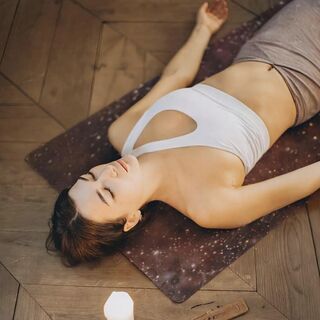
This practice can be done sitting up or lying down.
So just taking a few moments and getting yourself into a comfortable posture.
Letting your body settle.
Allowing the mind to settle as well to the extent that it will.
Perhaps taking a few deep breaths to bring some ease into the body.
Letting go of any unconscious stress that you can.
Letting go of any thoughts and concerns of what's not here.
Thoughts or concerns of the past.
Thoughts or concerns of the future.
Settling in as best you can to this moment.
Allowing yourself to sink into the mat or the chair.
Just letting go.
Settling.
And when you feel ready,
Begin by bringing your attention to the sensations of the feet as you lie or sit here.
Both feet,
Tops and bottoms.
Arches,
Toes,
Tops and bottoms.
Each body part has its own unique kind of flavor or signature.
So really getting to know what it's like to be with the foot.
Sensations of moisture or tingling.
Cold or heat.
Weight.
Contact with the floor or perhaps noticing the sensations of your foot against a sock.
Or the air against your bare skin.
Paying attention to anything that reveals itself.
Bringing gentle curiosity and awareness to your experience,
Whatever it may be.
And if there's no sensations,
Keeping the mind there anyway.
Registering,
But no sensations feel like.
Letting your attention bathe and saturate the sensations of the feet.
Feeling the feet fully.
Settling in.
Resting,
Letting go and noticing the feet.
At some point you may notice that your attention isn't fully in the feet.
Perhaps it's wandered into thinking or caught by emotion or sensations elsewhere in the body.
Seeing if it's possible to simply acknowledge that this has happened.
And then gently and kindly bringing your attention back to the feet.
And continuing with this resting attention.
Noticing and investigating feet sensations.
There is no need to try to achieve any special state or feeling anything in particular.
We're learning to be present.
Present with a direct attention to our feet.
With any and all sensations that are appearing in this moment.
Seeing if it's possible to stay with sensations from moment to moment.
You're not needing to move in any way.
That might generate sensations.
Seeing if you can embrace the sensations that are already present.
Including in this the possibility that there may be no sensations at all.
And just knowing that that is okay.
It may feel like nothing is happening.
But each time you redirect your attention back to your feet.
You are strengthening neural networks.
Both for paying attention and also being able to be with your feet.
So each time you return your attention there it will gradually get easier.
Noticing where the mind is right now.
That's wandering away from this chosen object of your feet.
Gently but firmly return your attention to the sensations in the feet.
Good.
Now moving attention to the sensations of breathing that you feel in the belly.
Just below the belly button.
The rise and the fall of the abdomen.
Allowing these movements to become center stage in the field of awareness.
Sometimes it can be helpful to place a hand on your belly.
Feeling the rise and the fall.
Focusing as best you can on the experience of breathing in the belly.
The expansion of the belly with the in-breath.
The slight pause.
The release of the belly on the exhalation.
The slight pause.
Over and over.
Breathing in.
And breathing out.
Not needing to change or control the breath in any way.
Just letting the breath breathe itself.
In and out.
Like laying on the raft in the ocean.
On the in-breath the wave lifts you up.
On the out-breath the wave sets you down.
You don't have to do anything but rest and feel the movement.
Not trying to do anything.
Not trying to achieve anything.
Just being with the breath fully.
The in-breath naturally following the out-breath.
The out-breath naturally following the in-breath.
The breath is always a reliable place you can return to for support and stability.
Allowing yourself to further let go of what is not here.
And becoming more content with and more drawn towards the sensations of your belly.
This is your anchor.
Your attention will be drawn to other things like thoughts and sounds and other body sensations.
And if you notice that this has happened.
Relaxing again and inviting your attention back to your anchor.
Let simplicity and ease be the support for resting your attention in one place.
Breathing in.
Feeling it in the belly.
The space at the top of the inhalation.
Breathing out.
Feeling in the belly.
The space at the bottom of the exhalation.
Resting the mind right here in those sensations of expansion and release.
Again with an attitude of simplicity and ease.
Sustaining your attention into one place.
So this takes some commitment or loyalty.
Being loyal to your anchor.
And being dedicated to your anchor.
Committed to your anchor.
Not becoming tight or making a struggle out of this.
But from simplicity and ease.
Staying committed to whatever you're focusing on with your attention.
Which in this case is your breathing.
And when you notice that your mind has wandered away from your anchor.
Gently bringing it back.
If it wanders a hundred times.
Bringing it back.
Starting again back a hundred times.
This naturally cultivates the qualities of patience.
Compassion.
Steadfastness.
Learning to begin again.
To start fresh in a new moment.
And when you're ready.
Letting go of sensations in the belly for now.
And moving attention up to the body.
To the sensations of breathing in the chest.
The rib cage expanding and releasing with each out breath.
Taking a moment to settle into this new anchor.
And in the same way.
Throughout this practice.
Whenever you notice that your attention has wandered from your intended focus.
Simply registering that this has happened.
Gently.
Kindly.
Patiently.
Bringing your attention back to the present anchor.
Which in this case is the sensations of breathing in the chest.
And as best you can.
Becoming curious about these sensations.
Remaining with them in their entirety.
As they move and change.
Sensations lifting you up as you breathe in.
And then relaxing back.
And releasing as you breathe out.
And each time the mind wanders away from the anchor.
Relaxing.
Letting go.
And being present with the breath in the chest again.
Breathing in and breathing out.
Noticing the expansion.
And the depletion.
So when you're ready.
Letting go of the breath in the chest.
And moving attention to the breath in the nose.
The movement of the air at the tip of the nostrils.
Perhaps noticing the very subtle difference in temperature.
Slightly cooler on the in breath.
And slightly warmer on the out breath.
Just noticing the subtle sensations in the nostril of the upper lip.
These are very subtle.
And sometimes hard to notice.
So sometimes you want to breathe bigger breaths.
So it's easier to notice.
But as best you can.
Just try to breathe normally.
And let your attention settle.
Becoming curious and interested about your breathing.
As the anchor becomes more subtle.
It's important to not strain or try.
Allowing ease and simplicity to be your supports.
You're not trying to achieve anything.
Just befriending your anchors.
Noticing the air as you breathe in and out.
At the level of your nostrils.
In and out.
Now letting go of the breath for a moment.
And moving attention to the hands.
Feeling the thumbs.
The pointer fingers.
The middle fingers.
The ring fingers.
The pinkies.
Feeling the tips of the fingers.
You may notice tingling.
Numbness.
Or again you may notice the lack of sensations in the fingers.
And again we're just curious about whatever is happening in this moment.
Perhaps feeling warmth or tingling.
Perhaps noticing what fingers are touching each other.
You're wearing a ring.
Perhaps noticing how that feels.
And now expanding the attention to include your entire hand.
The backs.
The palms.
Perhaps sensing the creases and folds in the skin of the palms.
And letting your hands be your new anchor.
Resting awareness there.
Letting your attention saturate your hands.
And when you notice your attention has wandered away from hands.
Gently and kindly bringing it back.
And getting curious once again about this anchor of your hands.
Recognizing that this anchor is here for you no matter what else is going on.
Totally reliable.
Totally safe.
Just like a best friend.
And developing some loyalty to that friend by staying with the hands.
And just hanging out here.
No need to do anything special.
No need to manipulate your hands.
Just a sense of devotion and presence.
Getting curious about sensations as they arise and pass away.
Coming back to the hands again and again whenever you notice that your attention has wandered.
And when you're ready.
Letting attention go from the hands.
And for a moment.
Getting to know and be with a different anchor.
The anchor of sound.
Taking a moment now to notice what sounds are present.
Perhaps noticing sounds in the room that you're in.
Perhaps noticing sounds from afar.
Getting curious about sound.
The timbre.
The pitch.
The volume.
Whether sound is continuous.
Or intermittent.
And as best you can.
Become curious about sound without naming sound.
Instead getting very curious about the qualities of the sound.
Again it could be the pitch.
The volume.
Whether or not the sound is continuous or discreet.
As best you can.
Letting the mind be totally present.
Totally absorbed by sound.
Relaxing into it.
Letting go of everything else.
Now when you're ready.
Letting go of sounds.
And like visiting old friends.
We're going to go back and visit the anchors you've met today one at a time.
The feet.
The breath in the belly.
The breath in the chest.
The breath in the nose.
The hands.
And sounds.
Reminding yourself that the anchors you have met and connected with today in this meditation are always available to you.
And as you move through your day.
If you find yourself lost or off balance.
You can seek refuge in them.
They are stable and reliable and always here for you.
To help steady you and give you an anchor in the chaos of life.
Now just taking a few moments to appreciate the intention and effort that you did with these practices.
Giving yourself some compassion.
And when you're ready I'll invite you to bring your awareness back to this moment.
I thank you for joining me.
And I wish you a wonderful rest of your day.