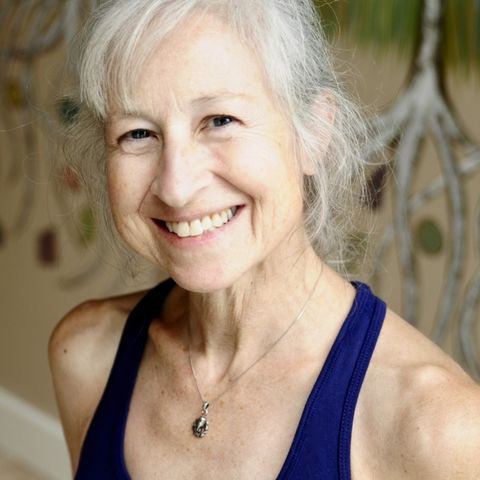
My name is Pamela and this practice is a Yin practice,
A deep stretch.
This practice is going to be a focus in the hips and sometimes we hold a lot of tension,
Emotion,
Tightness in the hips.
And so this practice will be great for releasing,
Maybe focusing on something consciously you want to let go of or just allowing the breath to help release tension and tightness in the body.
Just releasing that maybe your body's inner wisdom whatever you're ready to let go of.
So create a comfortable space maybe coming on to a blanket on your mat,
Maybe with a couple blocks if you have a bolster that's fine to use it can be quite nice in a yin practice but it's not necessary.
So come into our first position here in butterfly pose.
Sitting maybe on an additional blanket and bringing your feet,
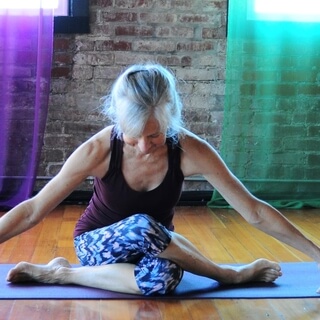
Soles of the feet together sometimes called cobbler pose in yin it's called butterfly pose.
So you're making a diamond shape with your legs and take a nice inhale here find length through the spine and as you exhale keep the spine long and begin to hinge forward and as you come forward you can bring your hands maybe onto your feet or ankles wherever they're comfortable.
You can also use blocks under your arms sort of like arm rests or you could turn a bolster on its side and maybe rest your forearms on the bolster or maybe resting your head on a block or your hands whatever feels comfortable to you.
So if you're new to a yin practice it's a more passive style of yoga we come to our edge of sensation.
So you should feel some sensation in the outer hips but it might not be as deep into a pose as you might come in a traditional yang or hatha practice.
So we're going to hold for time most of the poses tonight will be holding for four to five minutes and as we hold the poses we have a chance to go inward.
Sometimes we call it going inward.
So you might tune into your breath focusing on how your breath feels and where you feel it in the body.
Maybe take a nice full inhale and maybe an open mouth sigh of an exhale let it go.
So sometimes we might have some resistance in our mind when we come into sometimes discomfort in a yin pose or anywhere else in our lives.
Sometimes the reaction of the mind is to run away that flight of the fight-or-flight or maybe we try to change something trying to force something to be different.
Another possible reaction is to sort of come into that victim mentality that sort of suffering mentality just suffering through the discomfort and of course the wisest response is just to be present and aware.
Notice sensation with a sense of detachment and curiosity and of course if you have gone too far and if there's any discomfort in knees or anywhere else that is just like a sharp sensation do come out or back off of the pose.
It should just feel like a deep stretch.
It might not be comfortable but it shouldn't be painful.
Maybe notice the mind's reaction.
If you noticed one of those four qualities of responses if it wasn't the wisest response that's okay.
Just notice that.
Notice whatever thought or reaction came into the mind and then just see if you can soften it.
Just begin to focus on the breath and invite a sense of detachment and curiosity.
We'll be here for a few more breaths.
Begin to gently deepen your breath.
Nice full inhale.
Soft open mouth sigh of an exhale.
Let it go.
And then thoughtfully and slowly begin to press yourself back up onto your hands.
Lean back on your hands and slowly straighten those legs out.
Pause for a moment.
Notice that sensation in the outer hips.
That momentary and temporary feeling of vulnerability and fragility is what we actually want in yin after the poses.
It means we got into the joints the way we wanted.
So bend the knees,
Feet about as wide as your mat.
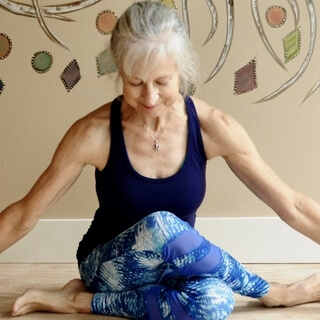
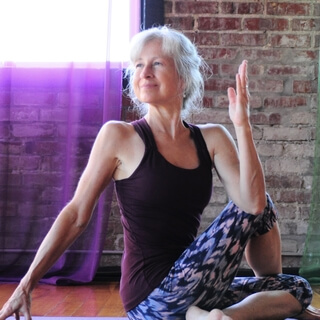
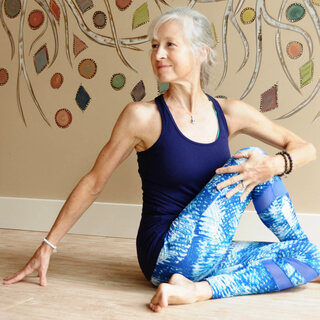
Knees are bent and take a couple windshield wipers.
Letting the knees fall over to one side as you twist gently into the opposite direction.
And then as you inhale bring the knees back up,
Feet stay wide and drop the knees in the opposite direction twisting in the opposite way.
So sometimes we come into counter pose as to just sort of even the body out a little bit and sometimes the counter pose is just the other side.
So we're going to come into square for our next pose.
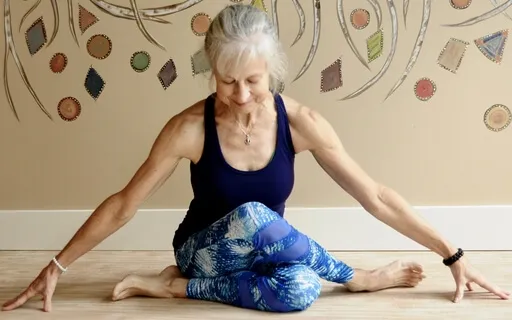
It's sort of like sitting cross-legged except your front shin is going to be in line with your yoga mat or blanket and the feet are going to push out towards the knees.
So instead of having the feet close to the hips they're in line or under the knees.
And again you might sit up on a blanket if you need to if it's more comfortable.
Take a nice inhale,
Exhale hinging forward.
So you can feel this more in probably the outer right hip.
We're going to start with,
Well just notice which leg is in front.
I have my right leg in front.
Just notice which leg is in front for you.
Sometimes we start with the one that's most comfortable.
And as you come forward maybe explore a support for your arms or your head.
You might use a bolster or a block.
Gradually coming forward,
Finding your edge.
Make sure the shoulders feel comfortable here.
Closing the eyes as really nice as we hold the poses.
Breathe normally here.
Maybe a soft breath.
And anytime you want to have those open mouth sighs of an exhale helping to release,
Please do so.
So if you would like to come a little deeper for the last minute or so,
Feel free to maybe adjust your feet out wider towards the knees or maybe some of you even go past the knees.
Maybe hinging forward a little bit deeper but you might be fine right where you are.
So listen to your body.
Yin can be very calming to the central nervous system and is sometimes really great to do before bed especially getting into the hips.
Begin to deepen your breath.
Take a nice full inhale,
Open mouth sigh of an exhale.
Let it go.
And then slowly use your hands and arms and slowly start to press yourself back upright.
Lean back on your hands,
Slowly move your feet wide and maybe a couple windshield wipers if that would feel good.
And then we're going to come right into the other side.
So change which leg you had in front.
Again making that sort of triangular shape in between the legs,
Feet going out towards the knees or past the knees,
Front shin parallel to your blanket or mat.
Take a nice inhale and then exhale hinging forward from the hip crease.
And if you started with your more comfortable side you're probably going to feel this side a little bit more.
I know I do.
You might even feel it in both hips.
So coming into your edge again maybe supporting your arms with blocks or a bolster and maybe supporting your head with your hands or a block or two.
Breathe here.
Notice your breath.
And maybe notice any reaction or response in the mind.
Be the observer.
Being present and aware.
And as you notice sensation that might get intense or deep depending on how far forward you've gone,
Use your breath.
Sending the breath to the areas of most sensation and maybe with an open mouth sigh of an exhale letting go.
Encouraging that release of whatever no longer serves you.
Clearing out the energetic clutter of tightness and tension.
Just letting it go.
Notice if the side is more challenging.
Or maybe some of you now want to go deeper and find a second edge.
But many of you might be fine right where you are so really listen to your body.
Listen to your breath and always find variations that suit you.
Each day your body might want a different variation.
So really pay attention to what the body needs and what the body wants rather than what the ego wants.
And what the ego wants.
Being present and aware.
Focus on your breath.
Observe the mind.
And encourage that release with the breath.
Begin to deepen your breath.
Take a nice full inhale.
Open mouth sigh of an exhale.
Let it go.
Let's take one more breath like this.
Let's take one more breath like that.
Nice full inhale.
Open mouth sigh of an exhale.
Let it go.
Slowly on your next inhale begin to press yourself back up with your hands.
Lean back onto your hands.
Slowly move your feet back into that windshield wiper position.
Notice that sensation in the hips.
Noticing that echo from that pose.
So our next pose,
We're just going to be doing three poses today,
Is called straddle.
So again you might benefit from sitting up on a blanket and just spread your legs into a v-shape.
And you might have a bolster or cushion in front of you or some blocks.
We're going to take a nice inhale lengthening the spine.
And when you're ready start to walk your hands forward,
Hinging forward from the hips.
So you're taking your upper body towards the floor in between your legs.
You might use blocks to rest your forearms on,
Maybe elbows.
And then maybe have your hands in a prayer position and rest your head on your hands.
Or some of you might be able to go a little deeper and rest your head on a block or the bolster.
Or maybe have your arms on the bolster or cushion and rest your head on your hands.
So find your position that feels comfortable for you.
And after a few minutes here we might feel inclined to go deeper.
But remember,
Listen to your body,
Listen to your breath.
Relax the legs and feet.
In a yin pose the muscles are more relaxed than in a typical yang position or posture.
By relaxing the muscles we're getting safely into the joints and the connective tissue,
The fascia.
Each inhale maybe think of lengthening the spine and each exhale an opportunity to let go,
To release.
Use your breath.
Open mouth sigh of an exhale,
Letting go.
Many of us have many things we want to release and let go of.
Actually this year.
And sometimes during stressful times we accumulate more tension and tightness in our bodies.
So we need to take that extra time and care and allow our bodies to release that tension and tightness.
You should feel the sensation in the inner thighs,
Maybe even into the groin area.
Notice where you feel it.
Notice if you feel it in the hips,
Deep into the joints.
You can also think of relaxing the muscles hold of the bones,
Letting the hip and leg bones be heavy.
And the muscles soft,
Sort of relaxing the body towards the earth.
If you would like to go deeper or change your arm or hand position at any time,
Feel free to do so.
Listen to your body.
Notice your breath.
Begin to deepen your breath.
Take a nice full inhale,
Soft sigh of an exhale,
Letting go.
Let's take two more breaths like that.
Nice full inhale,
Soft sigh of an exhale,
Let it go.
One more nice full inhale and let it go with the sigh.
Slowly start to use your hands and arms and press yourself back up.
Pause for a moment,
Notice sensation.
Maybe take your hands under your legs,
Bending the knees and bringing your feet back in.
And if you would like,
Maybe transition into a table pose,
Hands and knees.
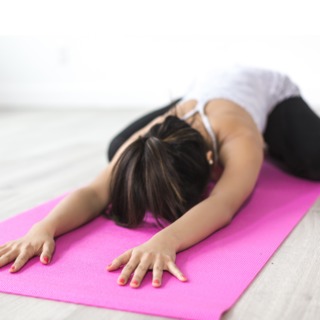
Maybe just moving a little bit in a side to side motion or kapow or some of you might want to find a child's pose and rest.
Or maybe come into a Shavasana.
I encourage you to take some time,
Maybe child's pose or Shavasana,
Or maybe a seated meditation for at least five minutes so that you can integrate this practice into your body.
I wish you well.
Thank you for joining me today.
Namaste.
Namaste.
Namaste.
Namaste.
Namaste.
Namaste.
Namaste.
Namaste.
Namaste.
Namaste.
Namaste.
Namaste.
Namaste.
Namaste.