Welcome,
I'll be talking about kanki-isoku,
Which is a Japanese term that means exhausting a final breath.
I'll describe the practice and gradually draw us into the sublime silence of just sitting.
In shikantaza practice,
Just sitting,
We practice with both the body and the mind.
This is because they are one.
The body is the more obvious aspect of the body-mind,
And the mind is the more subtle aspect of the body-mind.
It is only our natural tendency to conceptualize and categorize everything.
That results in viewing them as separate and distinct.
Since the body is the more obvious,
It is with the body that we enter shikantaza.
We begin with the breath in order to draw attention into reality.
By reality,
I simply mean something that is going on,
Something that you can verify through your direct experience.
So we start with something that is very simple and completely true.
You are breathing,
And that is totally true,
And the breath is the gate to which we enter more of what is true of our experiencing.
We are breathing,
But we're also experiencing the sensations of the whole body-mind sitting.
These sensations are not something we make happen because they are already happening.
All that we need to do is let go of continuously distracting ourselves from the expansive quality of awareness and release attention into the breath and the sensations of the body.
And we start with kankyusoku,
Which,
As I mentioned,
Means exhausting a final breath.
Final breath here means that we let go of control of the breathing.
Here is how we practice kankyusoku.
After the next exhalation,
Slowly take in a deep breath,
Filling the tummy,
The ribcage,
And the chest fully and deeply,
But without straining.
Then let the air out slowly,
Quietly,
And fully through the mouth until the tummy contracts,
As if squeezing out that last bit of air and letting go so that the next inhalation comes in by itself.
Then close the mouth and continue to breathe through the nostrils.
Now just leave the breath alone.
The breath operates perfectly fine by itself and doesn't need your control,
So there's no need to count or specifically concentrate on following the breath.
Sometimes you'll notice a short breath,
And at other times you'll notice a long breath.
Still,
At other times you won't even notice the breath at all because your awareness will be on other experiences,
Like sounds,
Sensations,
Thoughts,
Or feelings.
Be aware of the whole body just sitting.
If you find yourself getting lost,
Simply come back to the present moment,
To the natural flow of the breath and the sense of the whole body just sitting.
That's all.
This is important because it sets in place how we will relate to the mind,
Or any other sense gates for that matter.
You simply apply the same relationship to the thoughts,
Just noticing,
Without judgment,
Grasping or pushing away of your thoughts,
Feelings,
Memories,
Fantasies,
Or concerns.
Just watch them rise and fall.
Just as the breath breathes air,
The mind breathes thoughts.
Sit with the awareness to the arising and dissolving of thoughts,
The coming and going of sounds,
The nuisance of a pain of the knee,
A twitch in the eye.
We sit open to all of these experiences because they are all part of the larger scope of our lives.
This is our life,
Being as it is.
When we begin to face our life just being as it is,
We begin to open to it.
We find that it's not a problem.
Life has subtlety,
A depth,
A vastness,
And a fullness that is beyond thinking or not thinking,
Beyond description.
We find that our life is not just our thoughts and feelings,
Not just our cycles of grasping and pushing away.
Our life is something beyond description.
The body breathes itself,
The heart beats itself,
The mind thinks itself.
The body-mind knows how to see,
How to hear,
How to taste.
As we practice,
We harmonize body,
Breath,
And mind,
And we open to the totality of our experience.
Sikhantasa is the complete engagement of the whole body-mind in this very moment of experiencing.
When we sit,
We feel the knees,
We feel the back and the tummy,
The neck and the head.
We feel the ears,
We feel the whole body.
The breath is rising and falling.
The body is attending to the coming and going of the thoughts,
Feelings,
Memories,
Fantasies,
And relaxed feelings,
Tense feelings,
All of it without judgment.
We notice how the many different mind moments rise within the states of the body and how the states of the body reflect states of the mind.
Now I'm going to ring a bell three times.
Say a bit more as we enter sublime silence.
A single bell will signal the end of the silent period.
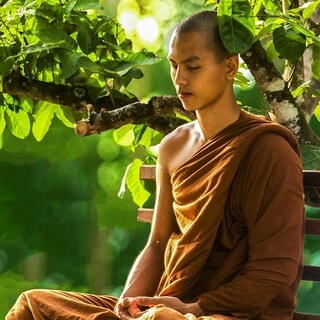
Sikhantasa posture is simple,
Elegant,
Straightforward.
The head is up,
Chin tucked in a bit,
Ears in line with the shoulders,
Nose in line with the navel,
The chest centered over the hips,
The spine rising to the base of the skull,
The legs providing solid support.
If you were sitting on a cushion,
The triangle formed by the knees and the buttocks creates the foundation for the weight of the whole body.
Feel that.
The upper part of the body will rest lightly and openly.
The lower part of the body sits in the still,
Still solid as a mountain state.
If you're sitting in a chair,
Sit toward the front of the chair.
Avoid resting on the back of the chair.
Have your feet firmly planted on the floor about shoulder width apart.
Just as we need to firmly settle the upper part of the body and the lower part of the body,
So we need to settle our thoughts and feelings within the wholeness of the whole body just sitting.
In Sikhantasa,
We experience the lived here and now from head to toe.
If we tense up,
We draw in muscles of the upper part of the body and we create a sort of protective skin around us.
The tightness of this protective skin can affect your posture,
Pulling you forward or off center.
However,
Sikhantasa allows the body to re-establish its center,
Rooted in the present moment,
Harmonizing body,
Breath,
And mind.
So keep practicing with the body in the basic fact of sitting.
If you find yourself lost in thought,
Just return to the basic fact of sitting.
Apply Kankiyusoku and begin again.
When you become bored or because you're expecting something special to happen,
Notice how the posture has shifted from when you started.
Reset yourself again with Kankiyusoku and feel the wholeness of the body.
Settle your thoughts and feelings in the experience of the body.
Feel the interconnectedness of whole being beyond the confines of the little me.
Know that this life is realized and revealed in all of the senses,
Seeing,
Hearing,
Touching,
Tasting,
Smelling,
And thinking.
Thoughts,
Concerns,
Memories,
Fantasies,
And feelings quickly flow through the mind's eye.
The sounds of the world rise and fall,
Surrounded by the vast ocean of silence.
Feel the dignity of being human,
Being alive at this very moment.
There is an integrity in the richness,
The subtlety,
And the vitality that is intrinsic to our being.
Be embraced by the wholeness of the moment.
Be this moment and just sit.
Thank you for your presence and for your practice.
And just keep practicing no matter what.
It's very important,
Not only for you as an individual,
But for all beings on the planet.
Thank you.