Hi there,
Welcome to Serenity Wellness Podcast,
Episode 64,
Where Can I Land?
My name is Nicole White,
And I'm an integrative mental health and energy therapist,
And happy to be here to help you build your wellness toolbox for mental,
Emotional,
Physical,
And spiritual health.
Thank you everyone for coming by,
And thank you so much for those of you who have followed me from the beginning for your patience with me getting back into this.
Just to quickly give you a little update on kind of where I vanished to,
I pretty much was reorganizing my life.
I moved my wellness center,
Serenity Wellness Center,
Over to a virtual wellness center and developed some wellness courses.
You can pop over there and check that out if you're interested,
And there's a free course there for you.
But that required that I had to step back a bit from the podcast.
I am though happy to be back into this,
And I do assure you now that the time has opened up for me as I've gotten all of that organized,
I have a dedication to get back into this for you.
I've also flipped the podcast over to YouTube,
So you're welcome to pop over there and check this out if you'd like.
Serenity Wellness Podcast is where that's at over there,
And I started another YouTube channel,
Serenity Wellness Tools,
And that just kind of gets straight to the point with the tools,
Short and sweet.
I am happy to share these wellness tools with you and the information so that we can continue to ripple out wellness to others.
So let's get into today.
Where can I land?
I wanted to cover some information today that might help us see,
Notice,
But also move through our day a bit differently.
I think many of us can relate to the fast-forward way that we move through our day and sometimes how we move through life.
A lot of people are even talking about how quickly they feel life is going.
We can get to the end of our day and remember waking up and realize we're at the end of the day and the in-between is quite cloudy.
Like,
What did I do?
Where did my day go?
Did I talk to people?
Did I just talk to myself?
Like,
We'll almost kind of feel fuzzy and uncertain of how we even move through the day when we get to the other end.
With today's information,
I'm going to share some insight or ways that you might be able to notice where you've gone so that you can decide where you're going to land.
As I start with the beginning information,
Just take note.
Take note of where you might notice that you get wrapped up the most or that you start to tap away from the now because that's where we get lost when we're not fully present,
But also when we start doing these other things to just kind of numb ourselves out or disconnect from a lot of different stuff.
So I'm going to start with the mind.
Our mind itself is very busy.
We have over 60,
000 thoughts a day.
But how engaged are you in your mind?
Sometimes when we have a very high engagement in the mind,
We might notice that we are wrapped up into a thought cycle.
That could be something like you might have heard of it as ruminating.
But with this thought cycle,
We're in a loop.
It's like the hamster wheel,
And it's a repeat topic or repeat message,
Even just a repeat word that we're saying that might be emotionally elevating for us.
We might get more into worry cycle,
Catastrophic thinking,
Perfectionist mindset.
But when you think of a thought loop,
Think of it as the repetitive topic.
It's like the broken record.
We're just repeating and repeating.
It's not often new information.
We might have a few sentences of variety in there,
But it's all about the same umbrella topic that we're in.
Or we might find that our participation in our mind through the day is a bit scattered and bouncy.
That's where we're like,
Oh,
I'm going to think about this.
And then over here,
There's that shiny thing.
Let me look over there and think about that.
And I just smelled something.
And now my thoughts went there,
And then I'm back here thinking about something that happened three years ago,
And now I'm up here thinking about what I'm going to do next week.
And you can notice that maybe when you're in conversation,
Either one of those really,
When you're in conversation or when you're watching something or listening to something or maybe like in a meeting of some sort for work,
And how tapped in are you to the information gathering that's in the moment in front of you?
Or are you up here?
Are you kind of back and forth,
Like half listening,
Half over here?
And that's not really active listening and engagement in the present moment.
So where's your mind?
Are you on the thought loop,
The repetitive cycle,
Kind of broken record?
Are you bouncing around a bit scattered in the mind itself?
Or are you foggy?
Sometimes we might experience like a haze,
Like,
What am I thinking?
How do I think?
I don't know how to make a decision.
I feel really lost in maybe something that we could really kind of move through relatively easily,
Something maybe we do on a routine even.
We could still feel sometimes like the mind is a fog,
Like,
Where am I and how do I get through this?
It's kind of cloudy and a bit of disorientation.
So we have the wheel,
Repetitive cycle,
The scattered,
Jumpy,
Bouncy,
Foggy,
Tapped out would be examples of different ways that we might move away from what we're experiencing.
So the over mind engagement,
We'll kind of have that under.
And again,
As I move through these,
I'm going to be talking about mind,
Body,
Emotion,
And spirit.
And just notice kind of what pops out for you,
Keeping in mind that these are all combined.
As you'll hear and understand as I move through these,
They're all together.
It's not like,
Oh,
There's just this.
Even as you've heard me talk about the mind and some of those things,
You can see how they're tapped in maybe to emotion.
You might notice that a little bit,
But you're going to also hear and understand too,
If not already,
Just adding maybe some more clarity there of how it's also tapped into physical body and spiritual body.
So let's move on to the physical body.
With the physical body,
Some ways that we might have this notation or noticing of our engagement there can be about tension holding.
How do we move through our day in terms of tension?
And this can even imply to how we're sleeping.
Sometimes people will fall asleep clenching their blanket or with fists or muscle tension in their legs,
Gripping their toes,
Shortness of breath,
Maybe chest breathing.
So it's not even necessarily in physical body,
Just how we're moving in our waking state,
Even as we're trying to relax and even as we're sleeping,
We may be in such a pattern there of gripping up,
Jaw clenching,
Big one.
A lot of times people fall asleep clenching their jaw.
So notice body hold and tension hold.
Are you a tension grabber,
Gripper,
Some common areas to check in with.
Starting even just up at your forehead and scalp,
The pulling together of the eyebrows.
Are you ripping tension here?
Can you feel it on your scalp?
We can even feel it on the back of our head when we release.
So if you notice that you're holding any tension,
For example,
Right now on your face,
Maybe in your forehead area or your jaw or the base shoulder area,
But right now I'm talking more about upper body with head,
With your head,
Your jaw and the back of your neck.
If you notice for a moment there that you're holding any tension there and you just release for a moment and know that that might be a little tricky to release it,
But you can feel the tension then start to trickle off.
You can start to notice,
Oh wow,
I've got some stuff going on here in my shoulders as well.
So notice if you're a physical gripper,
Are you gripping tension in the physical body,
Facial,
Jaw,
Neck,
Shoulders,
Even our abdomen and digestive system?
Sometimes people hold breath or not move breath down.
So it's another physical body engagement.
Are you holding your breath?
Are you resisting moving your breath cycle all the way down?
And sometimes we hold those things.
We hold tension because letting go of it will actually increase a little of anxiety because we think we must hold onto it as a force of protection.
Think about it as you're walking around with a wall of armor,
The heaviness that that can bring,
The lack of breath cycle and how we can even hold our breath,
Especially when it comes to emotion.
We might notice when we have,
I don't want to jump to emotion yet,
I'm getting there,
But again,
It's all tied together.
We might have certain emotion that causes us to tense up the body,
But now it's also elevating the emotion.
And with it,
We might find certain emotions.
We hold our breath.
I noticed for myself when I get into maybe some sadness and I am crying,
I'll hold my breath.
I'm aware of it now.
So I feel like,
Hey,
Let's breathe here.
It's going to be helpful.
But it took the slowing down and awareness to notice I was doing it before I noticed I was doing it.
Sometimes people do it for anger,
Like hold their breath.
You could see it in small children.
I remember my good friend,
When her daughter was younger,
She,
And I think I've even talked about this in a previous podcast,
She would hold her breath to the point that she was like two at the time.
If my friend told her no,
She would hold her breath to the point that she got really,
Really red as,
You know,
I want to prove my point.
So we can even do that as adults.
And just it's such a pattern that we don't notice how we're taking care of our physical body.
How are we holding tension?
Are we even breathing?
And how are we taking care of the physical body and what we're putting into it?
And I'm going to try not to splinter off too far here.
So this part I'll talk about right here is like,
How are we taking care of the physical body through the day?
Are we moving through our day and not even eating?
Not even having a sip of water?
I'm moving on,
Proving in that myself,
But water is like one of the things for me that I'm like,
Oh my goodness,
Yes,
Let's drink some more water,
Nicole,
Because it's so interchanged with our whole physical body.
But sometimes we might even deplete ourselves that way.
Couple of things of human survival,
Air and water.
I mean,
We kind of need those things,
Food as well.
So are we taking care of our physical body or are we depleting it?
Are we gripping?
And if we're gripping that tension hold,
That impacts our whole body because we're elevating the adrenals,
Our cortisol,
Which affects our serotonin and dopamine.
That has to do with emotion regulation,
Which goes into the amygdala part.
There's so much interchange here just by being a chronic gripper of tension and what that can do for release.
If you notice the gripping of tension and if you ever then massage the area that maybe you're holding tension,
And I'll talk about that when I get to the tools,
Then you can really notice how it impacts the body.
Or if you're feeling really tense and you try to eat some food,
You might notice how it creates some digestion challenges there.
So the mind and the physical body,
You can see the combination there and how are you moving through those things through your day?
You heard how the mind can impact emotion,
But the physical body,
If we are gripping tension or moving through our body in certain ways like that,
Our body remembers a whole lot.
So it knows all this entanglement that's going on,
Whether we cognitively want to recognize or acknowledge.
So if we're holding body tension,
For example,
And we have a past history of trauma or high anxiety cycles,
Then us gripping tension is keeping our baseline through the day in an anxious body cycle.
So it's actually also at times activating previous things that maybe we haven't quite healed.
And that's why sometimes people will notice folders opening up of past memories of things that are similar to the emotion maybe that they're experiencing suddenly,
Because it's all combined.
The mind,
The racing,
Regurgitation of things,
The physical body,
The gripping,
The holding,
And in the physical body,
This emotion interchange here.
Sometimes it can lead to us really numbing out and avoiding.
It's in my experience in therapy,
One of the things that is interchange,
Entangled,
And leads to addiction.
I know that's not the model or method that all therapists follow.
So I'm just speaking from my experience as a therapist and my own addiction history,
Honestly,
I had addiction history in my 20s and have lots of addiction that runs throughout my family.
But in my professional and personal experience and working with people with co-occurring disorders of mental health and addiction,
The leading whatever you want to call it trickle down into addiction,
And addiction is many things.
It is not just substances.
It's think about phone addiction,
Food addiction,
Gambling addiction,
Shopping addiction.
I mean,
It's about numbing out.
So you can see how many categories can fit into there.
And the numbing out is this interchange of physical body,
Emotion experience.
We have emotion,
Our physical body is responding,
And sometimes people can feel so uncomfortable or have fear around that exchange there that they just want to numb out.
They want to numb out from physical body,
And they want to numb out from emotion body.
So they don't want to have the physical experience of the emotion.
So therefore,
Let me tap out,
Avoid,
And just jump over or not even see the emotion.
So let me talk a little bit about emotion now.
Our engagement,
Our interchange with our emotional body,
How do we treat our emotional experiences?
Do we move into them with some of that numbing,
Tapping out that I just mentioned and talked about?
But also,
We can move into that emotional detective,
Where we put on the hat,
We put on the glasses,
And we are on the search for all the things that will elevate the emotion we're experiencing.
So if we're experiencing sadness,
We will go on the lookout for all the things that will make us remember why we should feel sad or what causes our anxiety,
Even if it's illusionary thought.
Oftentimes,
These thought cycles,
For example,
Aren't even based off truth,
But we're so wrapped up into them,
They still create the emotional experience.
So we'll go on this detective search and we will seek out identifying things to help elevate the emotion,
Or we'll be our own agitator.
So we'll have emotion and then we'll put ourselves down for having the emotion,
Or we'll judge ourselves for having the emotion,
Or even become the bully against ourselves,
Really.
Like,
You're too sensitive,
Get over this.
There's people out there with bigger problems than you.
How dare you feel these emotions?
So this relationship with our emotions,
It has a direct impact on how we're moving through life.
Are we feeling and experiencing what is real for us?
Because if we are elevating or we are avoiding,
Then we will also continue to repeat cycles that might be hurtful or harmful to us.
We continue to get opportunities to learn about ourselves,
To learn about our inner workings and repeat cycles and patterns through the repeat cycles and patterns.
But if we just keep repeating and we are half in and we're half out and we're numbed out and we're tapped out of our body and we're tapped out of our emotions and then our mind is over here,
Well,
We're going to just keep moving through life on repeat.
So the gift,
Really,
Of giving yourself the opportunity to kind of see these things I'm talking about,
But in this emotion part,
Experiencing our emotion,
That's how we move out of cycles.
That's how we break free from these chains that make us feel like we are anchored to the bottom of the depths of the ocean and that we can't move from it.
And I'll talk more about tools with emotion there in just a moment.
But I also want to talk a little about the spirit part of ourselves.
This is non-religion.
If it fits into an organized religion category for you,
Awesome.
Put it there.
If it fits into a spiritual category for you,
Beautiful.
But it might just fit into nature or soul self,
Our internal being and who we are.
So place it,
Put it,
Lie it,
Wherever this language best resonates for you.
I'm just talking about our full being.
So when we're thinking about spiritual body and how are we moving through our day there,
We can notice sometimes that we might feel really disconnected or disengaged there.
This is where we might get into feelings of separation and isolation,
Where we might get into a feeling of what's my point purpose,
Kind of feeling lost on our trail of life,
Journey through life,
However you want to work it.
But we might feel this sense of disconnection.
A lot of times people will talk with me when I'm working one-on-one with them about how does this experience fill in the body,
This kind of spiritual body part of things and disconnection.
They will often talk about it as a feeling of depletion,
Heaviness,
A bit of kind of how I was talking about in the mind,
The cloud,
Kind of like that,
But an internal cloudiness.
Sometimes things are hard to put in words when we're talking about it.
So conceptualize that in whatever way kind of fits there.
It's like an internal cloudiness.
What's my point and purpose?
What am I doing here on this earthly plane kind of thing?
This bigger picture,
But a bigger picture where we move out of trust and surrender,
Where we move more into it has to look this way,
Expectation,
Attachment.
And because expectation and attachment are also illusion,
Then we can feel a disconnect here.
And you can kind of,
Again,
Think about it in whatever language works for you.
And how we see or notice where we go in these areas,
In the mind,
In the physical body,
In the emotional body and spiritual body,
As you're moving through our day,
As you're moving through our life,
You might hear and see and feel how those things impact that,
How they move into how we perceive,
How we digest,
How we repeat.
We might just repeat some of these things because that's just what we know,
Or just what we learned.
It's what we're familiar with.
And we might think,
I have a desire to move out of that and move back into now,
Because any of those things,
If we're over-engaged in them,
We are not fully tapped in to now in this experience we're in.
And so maybe we have a desire,
Like,
I want to move back into just my everyday experience of what I'm experiencing the best that I can,
Because it's going to create regulation,
It's going to create understanding,
It's going to create healing,
Compassion towards my emotion and my experience.
But if we don't have a willingness to do that,
We will still stay repeating.
Desire and willingness are a little different.
So we can have the desire and then the inner willingness is like,
Oh,
What's that really mean?
If I really move through these in a different way,
What story do I have to give up that I've been telling about my life or myself,
For example?
I want to now move into the tools before I start digressing too much and splintering out into too many side topics,
Because I just noticed I was about to do that.
So let's talk a little bit about tools.
When you're thinking about these tools,
You can notice those areas and notice if there's one particular that you might slide into a little more than others.
And with the tools itself,
You might implement the tool in that very category,
Or you might choose a tool that's in another.
So if you're really in mind,
For example,
The mind tools I give,
You might want to instead choose one that's in the physical body category or the spiritual body category.
Because for some people,
If they go into mind,
Well,
It's going to make them really wrapped up more in the mind,
And that's going to be too much.
Or if physical body is where you go and you notice,
Wow,
This idea of releasing and letting go of tension is way too much for me.
I notice my anxiety going up.
I notice I'm holding more tension.
Suddenly I'm really chest breathing.
Well,
Then you might want to move into one of the mind categories or the emotion categories.
There's no right or wrong here.
Personalize it for what fits for you.
I'm going to just give two or so ideas or examples of tools for each part.
So for the mind,
If you notice any of those categories that you're on the hamster wheel,
You're the broken record,
And again,
Sometimes,
A lot of times it's based off illusion,
Not even truth,
Or you're jumping around,
Skitter scattered,
Chitter chatter all over the place in your mind that you don't even know what you're thinking about because you're just bouncing all over the place,
Or that foggy,
Where am I at?
How do I clear the way?
Some tools that you can use here,
If you're doing the mind looping,
Racing,
Or the bouncing around scattered,
You can slow it down for just a moment.
Whenever you notice,
It doesn't matter if you're five minutes in,
10 minutes in,
Just whenever you notice that that's where I'm at,
You can pause and ask yourself,
What is happening in this moment?
So what is happening right in front of me in this moment,
And what do I think about that?
And the in front of you moment might be nothing.
You might be sitting in a quiet,
Empty room.
What do I think about that?
I might think it's quiet.
For some people,
They might be like,
This is kind of boring.
Silence can be uncomfortable.
We'll be working on that in the future on another situation,
Episode,
Or something like that.
But what is happening in the moment,
And what do I think about that?
You can also ask yourself,
Is that thought real?
Is that thought true?
If you find that you're trying to battle with yourself,
They're like,
Yeah,
It's true.
But parties like,
Mm-mm,
Ask yourself for the facts.
What do I factually know that shows me that this is true?
And if you're in the foggy mind,
You might just try to start writing a brief list.
What are three things that I am trying to work through processing today or thinking through today?
And it might be the simplest of things.
It doesn't have to be that we have to think of something elaborate when we're in foggy minds.
Start low.
Start with something small.
Start to activate your mind and the reality that you have some connection there.
When we're fogged out,
Like,
I don't even know where my brain's at.
So start small,
Just write down a few things of things that you're trying to think about.
So maybe it's breakfast or lunch,
And you're like,
I have no idea.
I'm not feeling hungry.
The thought of food is like,
No.
Well,
What are my top three things that,
Like,
Whenever I am not hungry,
I know that I will still eat?
Try to keep them healthy if you can,
But write them down and then choose one to start.
Or maybe you're like,
How do I even want to start my day?
And I keep feeling so foggy.
I don't know where to start because I'm feeling overwhelmed.
My list is too long.
Just start with writing down two things.
What are two things I would like to do today?
And that will start to clear out some of that fog and start to get a little bit more clarity there.
There's no right or wrong,
And there's no 100%.
So it's not about punishment cycle.
Start well and give yourself a little build up because once you get to cross something off,
That can feel kind of nice as well.
If physical body is your thing,
Then some tools there you can consider.
Or again,
You can consider using these tools if you're in a different category and those tools might not be the best fit.
Physical body,
You can start with that notice of tension and tap it into maybe three things you're already doing in your day that you notice are pretty big tension holds.
These might sound like silly ones,
But they're pretty common.
So one might be when you're driving your car.
A lot of times people will grip their steering wheel or they will clench their jaw.
Having muscle tension in the shoulders,
Then it's very rare that you're going to have tension up in your face with the jaw,
The scalp,
Even behind her ears and it not go through the neck and the shoulders.
You might notice that you're gripping your hands during a conversation or when you're thinking about something that you know you're overwhelmed or stressed about.
So conversation or thought cycle,
Notice where your body's at or when you're sleeping.
That's another big one.
If you're trying to fall asleep,
You're laying down to fall asleep,
How's your body tension?
And if you notice that there's a lot of tension there,
You can just do a very gentle,
It doesn't have to be like strong release because again,
For some people,
Initially releasing body tension can feel a little intense because they've just been living in that baseline of anxiety.
So give yourself some gentle ease here.
And it might just be starting at the crown of the head and let me notice the tension and let me notice it gently easing and trickling away.
Let me just think of adding some softness in there,
A little cushiony cloud of some sort.
So just kind of offering some space in the tension and then doing same as you move down the body to the neck,
To the shoulders,
The shoulders if you're sitting up,
You can just really physically drop them down,
Breathe out and you could feel it just releasing the tension and it goes down the arms and the hands.
So you can just give yourself a gentle,
Let me just move this muscle tension down a little bit.
You might also physically push your palms up to the air.
If you notice that you grip your hands a lot,
Feel the difference when you push your palms up to the air,
How it feels in the upper arms,
In the neck.
So if you're gripping,
You can feel that and then release and you can feel the difference in the change.
So if you're a gripper in your hands,
Let yourself maybe do that.
If you're holding tension a lot in your jaw,
You might practice just giving your jaw like some openness,
Just opening it a little bit.
You might want to wear a mouth guard at night.
If you are gripping down a lot when you're sleeping,
It will cause damage in your back molars if you are grinding,
Gritting teeth when you're sleeping.
Over time,
It creates hairline fractures in your back molars.
So just keep that in mind.
If you know that you're doing these things,
There are some great tools out there to help you.
Those other parts of physical body,
What are such a big one,
Set a timer on your phone if you need to.
There's apps that you can get.
I don't know the names of the apps,
But there are apps that you can get that will remind you to drink water.
There's certain mugs and travel thing,
Muggy things that you can get that will highlight,
Show you.
I think even you can link it to your phone.
I'm not a technology person,
But there's all kind of technology out there,
But I don't have enough mindset around it to explain it exactly to you.
But I did know or see and I do know that there's some kind of like water tumbler and you can link it to your phone and it sets something off to like,
Hey,
Drink water.
So if it's something like that,
That you're like depleting body and food and water,
Set a time,
Put it on your calendar,
Set an alarm on your phone kind of thing until you get yourself into a rhythm.
Hydration of self is super important in a million different ways that I won't sidetrack and get off into,
But just keep in mind liver is our emotion control center in the body.
If you're familiar with acupuncture and things like that,
Then you would be familiar with that.
But the liver is really important to be hydrated.
When it's dehydrated,
We can actually feel that fuzzy mind and body,
But high elevation of sandpapery emotions.
So we might have low frustration tolerance,
For example.
So how are we in our physical body?
Do I need to release some tension?
Do I need to maybe drink some water,
Eat some food?
Or am I tapping out?
Am I tapping out of my body and numbing out?
And if that is the case,
What's that about?
So maybe go down some exploration with yourself.
What would make me want to tap out?
What is it about my emotions or the experience in front of me that I am fearing experiencing?
A lot of times when I talk with people about this emotional part and the tapping,
Numbing out in physical body and emotion body,
And we slow it down and it's like,
Well,
What am I fearing here?
What is so scary about this emotion?
We can see that the bigger fear,
The bigger part,
The bigger stress is actually the avoidance and numbing out and what we create in our life then.
But we have to ask ourselves,
We have to notice that we're numbing out first off,
Then we have to own it.
Like,
Yep,
I'm numbing out.
And then we have to have the desire,
So want to figure it out,
And the willingness to move through it.
But we all have the capacity to get there.
It's about this compassion,
Empathy,
And understanding to ourself that can lead us there,
Which takes me to the emotion part.
If you are the investigator,
The detective,
The instigator of yourself with emotion,
Oftentimes it comes with judgment.
And so what do we do here?
We move into compassion.
We move into empathy for ourselves as beings,
As humans that we have had a life experience.
And for many of us,
It has been a rocky slope.
We are not just like,
Woo,
Let's shoot to the moon type thing.
It's all over the place and it's up and down,
And that's the same for healing.
But emotions are impermanent.
There is no permanence in an emotion.
We ebb and flow,
Even if we feel like we are stuck in a deep cycle of depression.
If you look at it,
You do step out and slide out of it at times.
Maybe it's into frustration,
Maybe it's into anger,
Maybe it's into anxiety,
Maybe you're not stepping into joy,
But you're not permanently stuck in an emotion,
But we fear it or we judge ourselves as though we are.
Moving into compassion,
Moving into empathy,
And practicing having the dialogue and language towards yourself that highlights that,
That highlights compassion and empathy.
It's like,
What would my child self want to hear if I was experiencing this emotion pain?
Let me give that to myself,
Because maybe it's something I never had as a child,
And that's why I keep repeating cycles,
Because I'm just giving myself the same emotion message of pain,
Of you're,
You know,
Too this or too that,
You're too sensitive,
Or my problems aren't big enough,
Other people have bigger problems,
You're just a complainer,
All the things,
Right?
How is that helpful?
Will we tell our friend that if we're showing up in a loving kind way?
We might tell a friend that,
But we're not showing up in a loving kind way if that's the language we have.
So how do we support our emotions?
How do we give ourselves loving kindness and compassion?
And it will take some practice to give yourself the trust in self,
That it's okay that you can work through these emotions and that you don't have to judge yourself to tap out to numb out,
Because those very things are what create storms in our life in a lot of different ways.
With the spiritual body,
That can mean many things if you notice that you're tapping out or you're feeling fuzzy or you're feeling what's my point and purpose.
And one of the most beautiful things is just trying to move into the now experience and allowing yourself kind of back to that compassion and empathy,
Recognizing that,
Again,
Life is like this.
We're all over the place.
And we don't have to always have this spot on ID of our purpose,
Passion,
And point in being here on the earth.
And sometimes we'll put such pressure on ourselves.
It's where we feel this spiritual body disconnection or disconnection from our soul self.
Spirit and body,
Soul and spirit are two different things,
But that's a whole different situation of discussion that I will not be covering here.
But in case any of you are energy therapists or watching this,
Yes,
I'm aware that soul and spirit are not the same thing,
Even though they're entangled and all that kind of stuff.
But for this purpose and clarity,
Just know this spirit,
Soul,
Self,
And we don't have to know our purpose in every moment.
We can move through life with some grace towards ourselves.
And some ways to do that if you're feeling disconnected in the spiritual body,
You might just have a mantra of sort that you can say,
Or if you're one who practices prayer,
You can pray.
A mantra that I go to sometimes here is,
I am whole.
And I'll just repeat that maybe for a minute,
Maybe even longer.
If you think about the mind part,
The mind racing,
The loops,
Et cetera,
The bouncy bouncy,
If we're repeating mantra,
It's giving us like a physical gym in the mind of connection awareness and not,
Ooh,
I'm just all over here,
All over the place is one of many things it does.
But again,
Not going to digress here.
So you can have a mantra of some sort that you just repeat for a bit of time to pull you back to awareness of your full spirit self,
Soul self,
You might pray.
You can pull in nature.
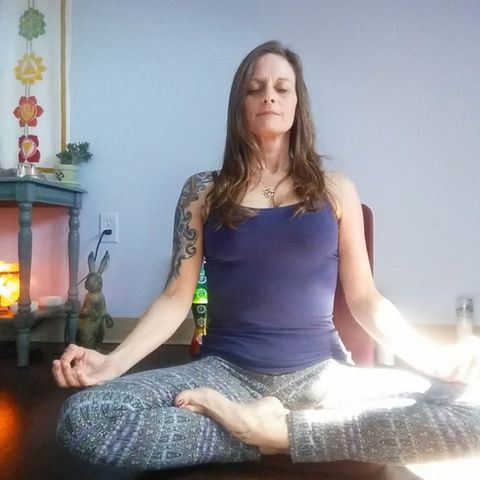
This is just a little snapshot of one area of my home.
But most of my home is like,
As you see here behind me,
There are plants all over the place.
I love nature.
It's such a grounder,
But I also live in Pennsylvania.
So sometimes it's kind of chilly.
Like now I'm in winter period here.
And the green isn't as green out there.
My backyard,
The trees are dead.
My pollinator gardens aren't so pollinated right now.
But in my home,
I have green everywhere.
I have plants everywhere because it's just a connector to me.
I love the exchange there and I can make sure that I have it at all times because it's here in my house.
It doesn't have to be outside my door.
But what is it that helps you feel connected?
Because nature,
You know,
Even when we're out in the forest,
For example,
There's forest bathing,
There's earthing.
So that's when our feet are directly connected barefoot to the earth and the exchange there of earth energy.
But in the forest,
For example,
There's a situation going on there in the forest that helps us to feel that sense of bliss.
So there are terrapins that actually are present in the forest that are put out from the beautiful trees there and specific ones within that.
So lemmonine is I think one and pionine,
Trying to remember the pronunciation off the top of my head,
But would be two examples of these terrapins that are present in the forest.
And those two,
So the pionine and the lemmonine,
For example,
Directly impact emotional regulation,
Inflammation in the body,
Like it's beautiful,
The exchange there.
And if you follow me on social media,
You might remember a post that I did rather recently on inflammation.
I've talked about it in many episodes through here.
But I also just recently posted something about that because Time magazine finally had on their cover like this secret that's not a secret,
That inflammation is directly correlated with disease in the body.
And the many ways that we can support ourselves with bringing it down,
Anti-inflammatory situations.
So just like that,
Being in the forest is one of those things that supports our body through the terrapins that are in the air.
And the rhythm of mantra,
Meditation,
Or prayer that we can connect to also creates a rhythm in our body that brings balance and ease.
So think about where you're at.
Kind of that beginning part,
Like are you,
I wake up,
And then I'm at the end of the day,
And where did the day go?
I'm not really sure what I do,
Where do I spend my time?
And perhaps when you notice where it goes,
You might think of mind,
Physical body,
Emotion body,
Spiritual body,
And how do I get back to me?
How do I kind of reconnect to the full system that's here?
Because that's what's going to give me the full array of tools,
Like we're a full body system.
So use your full system,
And you're going to notice how much ease and tranquility maybe you can start to land on in your day as well.
So you choose where you can land.
They're all great options.
There's no right or wrong.
Just make it fit for you.
Thanks so much for sharing this space with me.
I greatly appreciate you,
And I look forward to spending some more time with you and sharing your deep passion for wellness.