Hi everybody and welcome to Two Eyes Women Talking.
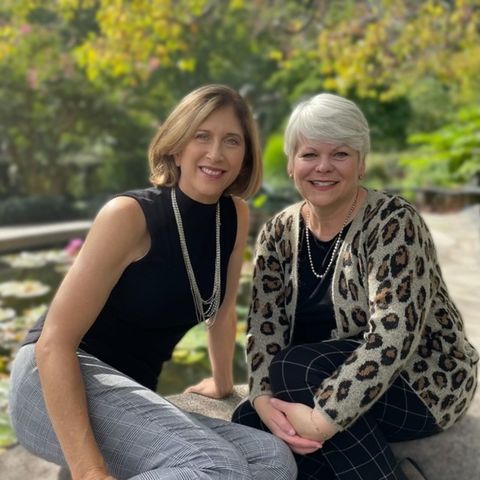
My name is Shira Khan.
Hi everyone.
This is Diana Zahir.
I'm so happy to be here with you and with Shira.
We've been together for 30 years as friends and students and teachers.
We're so excited to talk about the mystery and the path and this present moment.
So let's get started.
I would like to invite you back to the teaching zone about safety.
Shira and I are so grateful to be returning into this space with you today.
And to begin our time together,
I'd like us to all breathe and find a comfortable place to sit or lie down.
And for a safe moment or two,
Touch into this holding field together.
The body is such a helpful companion when we're working with the healing of safety.
Doesn't mean anything in particular needs to happen in our bodies,
But that we get to make a little visit.
So I invite you to get comfortable and to drop in however you can to this incredible gift of a body-mind container.
You might be aware of the furniture being in contact with you,
Or it might feel like you're in contact with the furniture,
However those words land for you.
Maybe there's contact with your back or your legs or your head or your neck or your shoulders.
You need to feel the support of that contact.
Or you might be wearing shoes or socks.
I want you to see what it's like to feel the texture of the contact with your feet.
And notice where your hands are right now.
If you want to change the location of your hands,
Maybe they're resting on your legs.
You can feel the weight of your hands there.
Such a natural way.
Maybe you'd like to put your left hand on your heart center,
Your right hand on your belly.
Just feel the hands as you breathe,
Rising and falling.
So simple.
So natural.
There's a kind of ease,
Kind of easiness of having a body when we feel safe and there's a holding field and we have companionship.
So that's what I would like you to have as we come into our conversation today.
Thank you for that meditation.
I'm appreciating when you said put your hands the way you want to get comfortable.
I like that you set us up to let our body speak to us.
We're usually the one commanding our body to do this or do that or sometimes to ignore things that it's saying about what it wants or what it's feeling.
And the meditation was an invitation to get into a partnership with the body and cooperation with it.
And with that as the foundation for the next hour,
There's already a friendship there.
The meditation to me was a way of making friends with your body.
A little simple visit.
We're not used to simple.
I don't think we're not used to easy or gentle or momentary.
We think it needs to be something very long and often serious,
But the body has so much innocence and directness.
When we just get to pop in and pop out,
It's a great way of developing that friendship,
That trust.
Yeah,
I'm appreciating you bringing in that popping in idea.
Sometimes the idea of going into the body can feel overwhelming.
If people have a trauma history,
The body remembers as well known.
So the idea of having to go in and stay too long and experience things that are bad memories is daunting.
But to think about,
You can pop in and visit and have cooperation,
Then it doesn't sound intimidating.
It doesn't sound like too much.
Exactly.
I think especially with trauma memories,
We're not choosing to pop in or out.
Things just happen to our bodies.
This is intentional and we have a choice.
It's so different.
I also have seen,
I feel a little playful part of me,
I think I'm speaking as the body right now.
If the body could talk,
That it would say,
I like when you visit me.
I like when you stop by.
I like when you don't ignore me all day.
Please get to know me.
I'm this patient companion waiting for your attention.
I know there's pain in there from our history.
But I'm also here right now.
I'd love to get to know you.
Right.
Right.
And in a way,
Like,
Please don't blame me for the pain.
Don't blame me.
A whole episode just on that.
I think we must.
I'm gonna write that down.
Yeah.
But anyway,
The meeting that you just facilitated with the body has left me with a happy feeling.
So thank you.
I'm glad.
Thinking of so many things we could say right here,
But I think the word that's coming up is reunion.
If I can have a moment with my body and I'm safe,
And maybe there's playfulness or lightness or excited,
I'm back.
That excitement.
It opens up all these possibilities for how we could be allies together,
Not only in excellent things like exercise and nutrition and sleep,
But that I could feel safe in here.
Because I actually am the boss of my body.
Trauma takes us very far away from that.
But if I know my feet are here and feet are so great because they tend not to be very emotional.
They just tend to be in shoes and socks.
And if I can remember that,
That's a good point.
That's a great point.
Our hearts have a lot of emotional memory,
And we love them for that.
And they have empathy and they can engage in the world in a certain way.
And our minds have a lot to say and connect and conclude.
But feet are just great.
And our bellies.
Our bellies are holding so much of history for us.
And we need episodes just on every center,
Don't we?
But the feet are just there.
They're these steadfast,
Steady companions and they're helping us truck around,
Do all these cool things.
But they're also just these friends that are like,
Yeah,
Hi,
I'm here.
I'm holding you up and I'm giving you structure.
And if you just need to come in and feel me in the shoes,
I'm here for you.
I love this so much.
I want to call this the feet episode.
Well,
There's so much in feet.
I love to teach about feet.
And I love Dr.
Seuss.
I read so many Dr.
Seuss books over and over again to my kids.
But the foot book is a genius book.
I mean,
Dr.
Seuss was a genius.
He was teaching children how to go into their bodies and their feet safely.
Because it's all about the feet.
Sick feet,
Well feet,
Feet,
Feet,
Feet.
He just kept bringing us down,
Bringing us down,
Visit the feet.
All right.
Yeah,
Well,
My feet are very happy to be part of the podcast.
And of course,
The other centers are very helpful to especially the pelvis and the belly.
Would you speak to us more about how the pelvis and belly are helpful?
Yes,
That's a good idea.
Let's talk more about the lower centers of the body and how incredible they are for our lives and for our healing journey.
And maybe as we're focusing there for a moment,
I'll invite everyone to place your hands on your thighs or on the center of your belly,
Maybe on your solar plexus,
This whole area that we can feel or sitting in the chair.
This is often the least visited of our experience because there's trauma memory in there often.
Or if we feel unsafe right now,
We don't want to go in there.
Probably in our heads,
Maybe we're over our heads.
We can actually function on this planet quite well and not be in our bodies at all.
Just amazing.
But when we learn to visit the lower centers,
Just kind of feel the body against the chair,
Feel the hand on the belly,
We're accessing a kind of direct feedback.
We can feel things that are simple and direct and that kind of connection with ourselves and with the ground.
It's very stabilizing.
We can feel more of our own existence.
It might feel like we've arrived in a certain way that we can spread out and take up space.
We can hear guidance from ourselves that can feel quite wise and ancient about simple things.
Am I hungry?
The body can tell us about its own hunger when we go in.
I want to also say that we don't have to go in for very long.
It takes a lot of courage to go in.
It might be a little visit of contact with this very powerful and strong part of me.
I like to use the visual of dipping a toe in the pond.
It might be the baby toe,
Might be the toenail of the baby toe,
Just popping in to the pelvis,
To the belly,
To a solar plexus,
A little visit.
See how it feels in there.
Then exiting out,
That builds courage.
I can do that.
It builds confidence that it's safe in there.
I keep getting more and more information about what's true for me,
But it feels different than the kind of feedback I can get from my heart or my mind.
Obviously,
Each center is so precious.
Ultimately,
They can all become a team.
The particular way of dropping in and feeling,
Oh,
I'm safe,
Getting this feedback,
There's something I can know more about myself,
And I can feel held in this certain way that almost feels like a mountain or a redwood tree,
Something very calm,
Quiet,
Fast.
That belongs to the realm of these lower centers.
I want to add one more thing.
Sometimes when we begin visiting the pelvis and the belly and the solar plexus,
It might feel numb.
It might feel like I don't feel anything.
That can be disheartening,
But I always encourage people to understand feeling nothing is something.
If I notice I'm not in this part of my body,
Or it's difficult to go in there,
Or I wish something was going on,
That's part of the registration.
That's the beginning.
It's actually very positive to notice when I feel a kind of dissociated experience,
Or I feel a kind of blankness,
An emptiness,
A numbness.
That's a very good thing for us to notice,
And we can keep hanging out with it and see what arises next.
I really thank you for explaining that.
I felt myself fully drop in right about when you were saying you can have an experience of just being here.
My mind is quiet.
I feel like there's a continuity between my mind and the rest of my body.
There's a clarity about it when you're talking about nothing.
It's just a nothingness.
It's actually for me showing up not as a numbness,
But as a nothingness.
Since you're speaking about that,
And I'm feeling that as we record,
I wonder what the listeners are feeling.
I invite the folks at home to jot down what might be arising for you,
Whatever it is.
I noticed,
Listen,
I've dropped in my body many a time,
And I lead people in how to do it.
But with you taking the lead,
I noticed a younger part of myself in the back of my mind going,
Oh,
Are you sure it's going to be safe in there?
I so appreciate you explaining piece by piece why it's safe and how it's safe.
I found myself relaxed.
This was right before I fully dropped in when you mentioned that touching into the pelvis is a place of where you're connected to the Earth in a certain way from having that body part and a certain strength that goes from generation to generation.
And I said this little idea that that made my traumatic memories look a little smaller,
Just in comparison to this much larger picture.
And then I just wanted to share a little friendship moment.
We've mentioned earlier in the podcast,
I think it was earlier that after Diamond Heart,
I remember we went back to my apartment and you said,
Let's lie down and sense ourselves.
And if memory serves,
I was like,
Are you sure it's I didn't say that loud,
But I was thinking like,
Well,
If you think it's safe,
And like,
Seem to think it's fine to go do that at home when we're not with the group,
Let's go try it.
And I just was reminded of that with you explaining this so clearly.
And then my being was like,
All right.
Okay,
It seems like a good idea.
Like,
Let's really drop it.
I feel so sweet to me.
I think it's the unknown friend.
Obviously,
We have many parts to get to know about ourselves in all different formations.
But if we think about these three basic centers,
Or these three energy centers,
Or chakras of the body of the head and the heart and the belly,
For most people,
The belly is the lesser known.
Most people hang out in the head.
And we have these beautiful hearts full of empathy.
So we might also spend time in the heart.
We were doing a conversation earlier today,
Before we were recording,
We were talking about an event.
And we were saying,
Okay,
What if we look at that event from the head?
What's the experience?
What if we look at that event from the heart?
What's the experience?
And what if we look at it from the belly?
Most people are going to want to look at it from the head,
Because it's the safest if we're talking about safety,
Right?
I had the most experience there.
It's the least emotional,
I can kind of figure it out.
And that's beautiful.
We want this gorgeous head.
It's got so much capacity and open mind and all the brilliancy and even the distortions,
We want to help those heal.
I want to add in the head is where our defenses are.
Yeah,
It's the battle station.
You know,
We're really grateful.
We inherited all this stuff about how to be here.
So the heads like you can depend on me,
I'm there for you.
But what if we look at it from the heart,
Then we have all this emotion.
And again,
Maybe history comes in through the heart.
We also have huge gifts of the heart.
It doesn't mean if we go in the belly,
We're not going to experience something historical too.
But like the head and the heart,
The belly has huge gifts.
And it has the ability to ground us and help us be here and really land in our lives in a certain way.
So we're not suggesting everybody should effort into the belly.
Absolutely not.
But if there are ways you can visit your lower centers,
Especially during the podcast,
When we're all here together kind of visiting and sensing in there.
Or there are practices that you like to do in your life,
Maybe you like to hike,
Maybe you like to dance,
Maybe you like to chant.
There's so many activities we can do in our daily life,
Where we become embodied in this part of us.
There are beautiful meditations,
We used to do the cough meditation quite a bit.
So we are inviting ourselves into the remembering of that part.
Because this is an amazing safety tool.
If I can learn to tap in and feel the energetic resource there,
I can feel a kind of safety that won't be accessible just with my mind or with my heart.
I'm so relaxed hearing this that I don't really have very much to say.
I want to ask you to add a tool because this had,
We had a vision for this conversation today about helping people take tools away.
And when you don't feel safe,
You can have a little safety toolkit.
And I think having the feet in that toolkit is amazing.
Having a visit to your lower centers,
However,
You can do that even if it's just sitting in the chair and feeling your body against the chair.
But we were also talking about breath,
That there's a certain way of breathing that can bring in an additional experience of safety for us.
So I'd love to add that in.
A lot of times just with getting through the day,
Or for those of us who didn't feel safe growing up,
We do more shallow breathing.
There are two lobes to the lungs,
And we usually just work with the upper lobe if we're in go mode or if we're in survival mode.
So a breathing tool is to gently and consciously think of breathing into the lower lobe of the lungs.
So the way I'm experiencing that lately is that I let the breath come in,
I'm not forcing it.
I invite you to do this.
So let the breath come in and let it expand your rib cage.
Think about expanding from the inside out.
So you're not making yourself expand,
You're letting the breath expand your diaphragm with air.
So this type of breathing touches upon the vagus nerve,
Which is related to giving us a sense of well-being.
So there's a very physical component to breathing into the lower lobe of the lungs.
It only takes a minute,
Or less than a minute.
It can take 10 seconds.
You can do it wherever you are.
And it brings a different openness and calmness in that's less available when we're doing the more shallow breathing.
And I invite you,
If you are interested in reading about the vagus nerve and breath,
There's a lot of stuff about it on the internet now.
Thank you for putting that in words.
So I want to take all of these ways we're inviting you into your body to hang out there,
Maybe a little bit differently than you normally do.
And we're together and there's this companionship.
I want to talk a little bit about trust,
The development of trust,
And also about guidance.
And then we were going to give a little bit of a teaser of where we're going next with the podcast,
Taking all of this great understanding about how I can be in a relationship with myself in a friendship with myself.
And we're talking about the friendship with these body experiences.
Now,
We're going to move more into our relationships with other humans specifically,
And how we can know ourselves and have this closeness with ourselves while we relate to those people.
But before that coming attraction,
I want to say something about trust.
And I want to share that as I'm doing this,
I am feeling my body in the chair,
Feeling my back against the back of the chair,
And I'm especially aware of my tailbone.
I'm really hanging out in there.
And that sounds really goofy.
I don't know.
But it's as if I can feel an intimacy or a deep contact with the bones in my pelvis.
Almost like I'm feeling energy or temperature or a kind of embodied depth in the bone marrow or in the bone.
If that sounds like imagination,
No problem.
Just let that hover for you.
If it doesn't resonate for you,
That's fine.
But I actually have a direct experience of that.
And it helps me really feel like I'm here.
It holds my experience.
It's very grounding.
And I feel very much in an existing state as I allow myself to connect with my bones and my body and my muscles.
So what I want to share about trust,
And I talk about this a lot with people.
We have a concept of trust.
And it's from a time when we were young and very innocent.
And there may have been many times when that trust was broken.
So that is very sensitive and tender.
And I want to honor that and give all kinds of respect and care for whatever might come up for each of us about trust.
And in addition to being really kind to that part of us,
As we grow and develop and have different adult experiences,
Trust may feel very foreign.
We may not know how to allow trust to be a healthy part of our life.
So one of the things I like to remind myself and other people about is that trust develops slowly.
Trust is a gradual experience of being in an environment or with people and seeing what happens.
We don't have to have one positive experience and jump right in and say,
Okay,
I trust this.
We want to keep going back if it feels comfortable,
Watching,
Discerning,
Do words and actions match in someone?
And again,
Bring it back to my body.
How does it feel in my body,
Especially in my legs or my pelvis,
When I'm in that situation,
When I'm in relationship with someone,
When I'm in an environment,
What feedback do I get from my body?
Does this feel trustworthy?
And does it continue to feel trustworthy?
This is a kind of maturing experience of trust that we didn't have or we didn't know about as children.
I so appreciate you speaking about trust right now.
I'm reminded of the theme of visiting from the first part of the podcast.
To me,
The word visit has safety in it.
Because it's a visit,
It's friendly.
There are so many actual actually positive associations with that word.
Trust and visiting go together.
Because when you when you're visiting and you're observing and you're gathering information,
That then trust can be built.
And then that's when you decide if you're going to hang out longer with an experience or with a person.
By the way,
I think what you just said is a really good foundation for anyone who's thinking about dating.
And I appreciate it.
Because we're visiting that possibility with that person.
How do I know?
I have no idea.
I'm taking myself somewhere.
I love the idea that I'm taking my relationship with myself out in the world.
Like,
Yeah,
We're going out in the world.
We're gonna check out this job or this restaurant or this date.
But I'm here with me.
Yeah,
We're going on all these visits.
And then we get feedback from our bodies or our minds or our hearts.
But there is an exploration.
I'm kind of a scientist.
I'm going to check things out.
You have just described what it's like to go about your life,
Go out in your daily world when you're not just going from your difficult memories.
And as someone who really struggled with that in my early 20s,
Because I had a very rough time growing up,
When someone comes along and spells it out,
Like,
This is how you do it.
I really appreciate that.
Oh,
So,
Okay,
I see.
So you have sort of this,
I'm looking out for you kind of attitude.
And you have an attitude of experimentation.
And you have an attitude of we were going to go together like,
Oh,
Okay,
That's what it looks like and feels like to conduct yourself in a kind and friendly way.
And I actually think what you just said is quite profound.
We haven't brought up the word survival mode in this episode,
But that's kind of in the background here of what we're proposing an alternative to.
What does it look like when you're not in survival mode?
You just described it.
Well,
And this connects us back to what we were saying in Episode Three about feeling so alone.
A huge part of feeling unsafe is remembering these overwhelming moments,
But I was alone in them.
And even if I'm so young,
I don't even know I'm alone.
I feel that aloneness.
And if I still have that operating system,
That survival operating system running in me today,
If I go to the market,
It'll feel very different.
I'll still feel alone and I won't feel like it's okay to be here.
And I won't be in my body.
I might be over my head as I'm buying food or I might feel some tenderness as I'm buying food.
And we can work with that.
We can help those parts feel safer.
But if I do have this kind of inner companionship and grounding,
And I am taking myself out in the world,
It's very different to be in the market buying food.
We're not comparing them or judging that tender state,
But we're just showing the possibility of having an experience of the ground,
Learning to visit and feeling that expansion and that inner support that's available,
That inner holding that's available.
This is actually what we're designed to feel when history begins to melt,
When it begins to soften and loosen and let go.
And that's a gradual process,
We're supposed to feel connected to all these parts of us.
We're designed to feel that if we want to grow that.
So I'm going to work backwards here.
I think that what I'm feeling energetically and what I'm hearing in your words and our words and in this point in the podcast is that it's an invitation to have a new attitude,
Have a beginning,
Have an intention of even if I didn't know how to do this before,
Even if I couldn't do it before,
Even if I haven't experienced this before,
I'm now gaining the tools and the understanding where I can set an intention of friendliness going forward.
It's a declaration that I'm making self,
Body,
Inner child,
Inner adult.
I want us to be friendly and working together and I'm going to set an environment of calmness to do that in.
It seems so simple.
It almost seems too simple.
That was the other thing I was going to say.
I think this is profound.
I think it's radical.
I think it's revolutionary.
And it's like a life hack because it is so simple.
Simple but not easy.
So that's where we need the friendship.
That's where we need the patience.
That's where we need the tools.
That's where we need the podcast.
It's like,
Okay,
We're together.
It's like a huddle.
Being friendly in all these different ways is simple and it keeps unwinding the way we are misunderstanding about right now.
So if right now is actually okay for two breaths,
Letting my lungs fully feel all this breath going down into the lower lobes,
Letting my body be in the chair,
Feeling myself in my shoes,
As silly as that sounds,
As simple as that sounds,
What if I actually drop in in a way I'm not used to and I experienced that as me and I feel this sense of inner support,
It seems trustworthy and maybe even something arises that feels like wisdom or guidance.
This is spectacular.
Nobody else gave that to me.
And I don't have to stay there.
So we start growing intimacy with ourselves.
Apparently,
This is what it's like to be me right now.
So we expand,
We start knowing ourselves as more than our history,
As more than the belief that I took from history,
More than what this other person is saying is true.
I start to have this allegiance,
This curiosity.
Well,
What's true for me?
What's going on in here right now?
And that we can have that when we're alone in our house or in the market or when we're hanging out with people we love.
This is something we want to keep working with and growing as we move forward in the podcast to practice and demonstrate and invite.
Yep,
Exactly.
As you said earlier,
Even if it's only two seconds,
I think that's really important to emphasize.
It can start just from these brief visits.
Actually two seconds is ideal for the reasons we said before.
If my history was so bad,
I'm not going to trust going in my body and I shouldn't have to.
And it's kind not to.
So to be as bold as we're being,
Where we're talking about this and we're inviting this huddle,
How great just to have two seconds.
Along those lines.
So to have,
For some people listening,
The experience of aloneness was a big part of the trauma and a big part of what happened in the history.
And it's,
I want to speak for a minute about what that experience is like.
It shows up to me visually as being in a dark place.
It could either be a well where there are walls right there,
Or it can be an open cave where there's utter aloneness,
But then there's nothingness surrounding.
And this type of metaphor arises in my mind when I hear clients speak about their childhood experience that there was nowhere they could turn.
There were people who were troubled and they were acting out and being scary and sometimes being abusive.
And there was no one in the person's life who could bring in the alternative,
Who could bring in the calmness and the friendliness.
So that feeling of no body to help me and no one to help me,
Even if other people are there physically.
So I just want to say how sad that is for people when that happens and how scary it is for a child.
A child can also feel that way from if the natural emanations of the child,
Like anger,
Sadness or fear is rejected by the parent because the parent is getting triggered being with the child,
That the parent's nervous system being triggered can also make the child feel rejected and alone.
So it could be like actual acts of violence or it could be rejection through the relationship.
So it's so compassionate.
I think to talk about two seconds,
Because for the child,
It was the reality and it was long term and there was a lot of evidence that that was life and that was the way things were.
So we're coming in and we're saying,
We're saying there's another way to be in your body.
There's another way to experience life.
There's another way to experience yourself.
Let's just try it.
We're not and there's no forcing and there's no saying your true experience of aloneness that was long term isn't true.
This is actually true.
We're not saying that.
We're saying there's another way.
Just try it and start from there.
Start from wherever you are.
And that's so it's very sweet because it takes into account what the person might be going through.
And it says,
Hey,
There's there is another way that could feel really good.
There was a thing you said on an earlier podcast about when we go inside and it's good.
There was a way you said the word good that I could feel in my body and a part of me that had a hold over a it's not really good to be in the body.
A part of me melted when I heard and felt your conviction that it's it's good.
Not I think what this moment in the podcast is about.
This can be good in this moment.
And you're invited and it's friendly and it's a visit and we're all together.
Exactly.
Exactly.
And I like how you were really painting the picture of the memory that we can have from childhood.
And that it was sad.
And even though it's not happening right now,
It may still feel sad and scary.
And we're not fighting with it.
We're saying,
Please come in the space right now.
And we're all together and everything that's in your memory or your nervous system or your body or your beliefs.
It's here taking the two breaths.
And you can lean into our voices.
You can lean into our energy.
We're having the two breaths together.
And then you can saddle up.
You can suit up.
You can armor up and go back to your life.
That's fine.
And then maybe you'll listen to the podcast again and we'll have another visit and we can take two more breaths together.
And then you can armor back up like that is so friendly and so realistic.
This is how change happens.
It's gradual.
It's friendly.
You can lean into the holding field.
You can come back to yourself.
It's natural.
Yeah.
Yeah.
And I hope it's okay to say this,
But for the listeners to know that Diana and I have had our fair share of trauma.
And we're here and we're dropping into calmness,
Having had a lot of trauma also.
So we're sitting with you as two people who've had both.
We've had the calmness and the expansion and the safety.
And we've also had the experience of aloneness and tragedy.
So if that's you,
We get you.
It's the human journey.
It's all of us.
And we can all be here right now and appreciate the vulnerability and the possibility of being a human.
There's extraordinary potential.
That's the mystery of the two breaths.
More to come on this topic and many others.
I'm so glad we got to do this today.
Yes.
And I want to thank all of the listeners for engaging with us and with this material.
Have a beautiful day and a beautiful night,
Everybody.
And be sure to enjoy your closeness with yourself and with everything you love.
Bye for now.
See you next time.