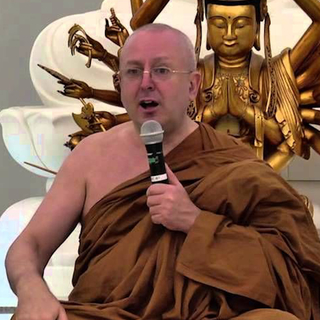
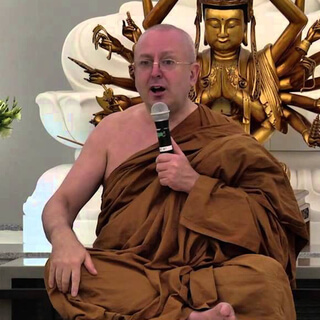
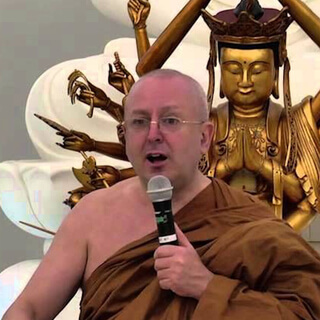
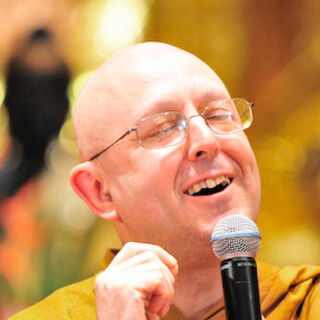
Welcome once again to the ongoing meditation class.
For those of you who know the basics of meditation,
Here on Saturday afternoon,
I have myself,
Sister Ajahn Vayama,
One of the other monks,
Leads us in guided meditation for 45 minutes and that's preceded by 15 minutes of just focusing on one aspect of the meditation practice.
But again,
The announcement you always have to make.
This is the ongoing class.
Anyone who's coming here for the introduction to meditation class,
That class is held in the room on my right.
The room you pass on the way to the reception area.
So that's for those who are learning the basics of meditation first off.
This is the ongoing class.
Last week we had Ajahn Pasanno here,
Visiting monk from United States,
My little friend and some of the teachings he was focusing on,
Wonderful,
Especially the awareness of the body as he was talking to our monks about serpentine.
In the way that I've been leading the meditation here over the last few years,
You see that we begin by sitting down and spending a few minutes just getting in contact with our body.
That has two main purposes.
Both are really very important.
The last purpose is the practical one of just having a comfortable posture so you can sit long enough in meditation without having to worry about ache here or pain there.
It is true,
The longer you meditate,
If you know what you're doing,
The deeper you can go.
That's why as monks we like sometimes sitting for many hours because you get really,
Really deep in your meditation that way.
It's just like if you're walking,
The longer you walk,
The further you go.
Time is important also.
But here we only have the 45 minutes available to meditate and we want to make sure our body is comfortable for that period.
The whole idea of the physical posture of the body has to be a personal quest for the best posture for you.
I know that sometimes you look in books and sometimes you have teachers who say you should sit this way and that particular way has more power than other ways.
In my long experience of meditating,
There is no perfect posture.
There is no sort of magical way you can put your body which makes meditation easier,
Which applies to all people.
Everyone has got their own posture which works for them.
Understanding that means you have to be aware of your body to find what that posture is.
Whether you're sitting on a chair or sitting on one of these stools which you see here,
You see some very high tech stools there with padding on the outside,
There's all sorts of stools which you can make for yourselves or having cushions.
You have to try and feel what is the best for you.
That takes awareness,
That takes mindfulness focused on your body.
With that mindfulness focused on the body,
You do learn about the aches and the pains in the body and how sometimes those aches and those pains are generated just because of wrong posture.
Physiotherapists sometimes look at the way a person sits or walks and identify that as a cause of some physical problems.
Sometimes instead of having a physiotherapist to tell us,
We can sometimes feel at ourselves,
We feel in the body,
That it's not in the right position,
We try and wiggle it about to try and make it more comfortable.
So the first part of the meditation is very much getting in contact with the physical feelings in the body,
Putting your mindfulness there just for the sake of comfort and health.
The second part of why we put mindfulness on the body at the beginning is because it is a very useful way of developing the first stage of meditation of present moment awareness.
It gives us something to focus on and the sensations on the body are only that which happens now.
Of course,
Sometimes we do remember aches and pains in the past but only if they are very,
Very strong,
Acute pains.
But most of the time when we say we are going to be aware of the body,
Just all the time,
Just about 99% of the time at least,
We are just focusing in the moment,
Focusing on the sensations of the body as they are happening.
And with that,
It's sometimes really hard to give those sensations a name.
As an object lesson to understand what we mean by an awareness in the moment without giving things a name,
I often use the exercise of asking you meditators,
Once they close their eyes,
To please now be aware of the feeling in your bottom pressed against the chair or the stool or the cushion.
And that bottom feeling,
Which you can probably be aware of right now,
Not only does it happen in this present moment,
But our English language has not given that a word.
So that when you actually start to be aware of the bottom feeling,
You can't say anything about it.
And that gives an indication that you can know something without giving it a name.
So the whole conversation that in a speech what most people identify as thinking,
But thinking can be even more subtle than the verbal thinking,
But that verbal inner speech sometimes gets stopped when we come to feelings which haven't got a name.
And many of the feelings in the body are like that,
They haven't got names,
Unless you are some sort of doctor or something.
But because of that,
Becoming aware of the feelings in the body is a great introduction to present moment awareness and to silence.
You just can't have much of a conversation with many of those ordinary feelings in the body,
Those sensations,
Even when you become aware of them.
Sometimes when I ask people,
Now become aware of that sensation,
Say in your thighs,
The prickly sensation or the itchy or the ants crawling up your leg sort of sensation,
This is so hard to give those feelings a name,
But they are real.
So one of the advantages of this first part of the meditation when you become aware of the body is also giving you a head start in present moment awareness and silence.
And you can use those bodily sensations at other times in the day as a focus for your meditation to get you into the present moment and to get you into silence very quickly.
Sometimes even if you are just stuck in the traffic or the red traffic light or you are waiting for a bus or waiting for an aircraft or waiting for an appointment at your doctor or wherever you are waiting for something,
Every time you are waiting is a great opportunity to make peace by bringing up this mindfulness into the moment and being silent.
And the way you do that,
You can just become aware of your body,
The bodily feelings.
You scan your body and find out just what's going on in there.
Now of course,
Those of you who have great aches and pains in the body,
There will be some aches and pains or some physical feelings which will be so dominant,
It's not sometimes you want to be aware of your body anymore.
But even then,
I found that because of the practice of meditation I've been doing for such a long time and because you have built up that mindfulness over many years meditating,
You can actually take physical feelings in the body as an object of meditation,
Even painful ones,
Focus on them and sometimes it happens just with the focusing on them.
Now gently,
Sometimes you notice those aches,
Those pains,
They start to disappear.
It does seem to be that just kind attention is therapeutic.
Sometimes,
I wonder about things like reflexology,
Foot massages,
Why do they work?
Sometimes it could be some physical reason.
I think sometimes when a person is pressing on your foot,
Sometimes that feeling of touch means you become aware of that part of your body.
You have to be aware in this moment,
It's silent and just becoming aware of a part of your body for some people is a wonderful advance in their meditation.
Instead of thinking about it,
They're aware of something,
They're getting to the physical feelings.
I think that just that kindness,
That gentleness,
That care which is associated with that feeling sometimes is therapeutic.
I still remember as a kid playing in the streets of London,
Playing soccer with my mates,
Sometimes the park was too far away,
So you'd be playing soccer with your mates in the street and sometimes you'd fall over or do a tackle and you'd scrape the skin off your knees and straight away you'd run to your mother.
What my mother used to do was to kiss it better and so she put all these germs from her mouth on this open wound and it never got infected,
It always healed up.
Obviously it was a belief in a kid and the power of his mother's love but sometimes there must be some truth in that.
Just kind attention to a part of the body can be quite therapeutic,
It can actually ease your pain if you know how to do it.
Sometimes that awareness of the body can also relax areas just by kind attention.
The mindfulness of the body that we do at the beginning of meditation is by itself a wonderful meditation tool and again it gives you present moment awareness and silence and secondly it is therapeutic.
You can by kind attention on the body,
Gives some relaxation,
Gives some peace there.
So that's why the beginning of the meditation is not just the summon to get through quickly but an important integral part which is useful in its own right.
Okay,
So I just want to make that point this morning about the beginning mindfulness of the body.
Okay,
So we can now start our meditation,
So those of you who aren't in the best posture yet,
Please adjust your posture and position to begin today's meditation period of 45 minutes.
And obviously just as a reminder,
Those people who do have mobile phones,
Please make sure they are always turned off before you come in here so they don't disturb the meditation.
So as usual,
Begin by closing the eyes which releases more mindfulness to go onto the body instead of being distracted by the world of sight.
Closing your eyes gives more freedom to see the body.
We begin by becoming really aware of this body as best we can.
Sometimes there is a sweeping exercise which we can do.
So today because I want to focus on this we're going to start with the sweeping exercise.
You can join me if you wish,
If you want to follow your normal pattern of meditation,
Just please ignore what I'm saying.
But you can,
If you wish,
Begin by noticing any feelings in your toes.
If you can't feel any sensations,
Then wiggle them around so at least you know where they are.
You do become sensitive to any physical feeling without needing to give it a name in the area around your toes.
The longer you look,
The more you see.
Whatever type of feeling that is,
Warm,
Fuzzy,
Tingly or whatever.
As soon as you know it,
Relax it.
Give it peace.
Bring it softness.
As you move the feelings up from your toes into your feet,
Especially in the soles of your feet,
Feel any sensations which are happening there,
To know them,
Stay with them awhile,
And just as an act of will,
Of kindness,
Just relax them.
As if you are just making sure very carefully,
Lingeringly carefully that everything is alright and a part of your body you take for granted.
As you move the attention past the feet to the ankles,
Sometimes people just think the ankles have no aches or pains.
Sometimes they do that.
Sometimes it's because we got them in a wrong posture,
A wrong position.
So we pay attention to any sensations you can pick up around your ankles.
Just opening your mindfulness to that area,
Focusing down there,
Until you can pick up something.
When you feel the sensations there,
You can grant them peace,
Grant them comfort.
See what you need to do to create a more peaceful feeling.
As you move your attention,
Just gradually up your calves.
Usually a person just becomes aware of the sensations in the skin on the outside of their calves.
But if you have been exercising you may be aware of some tiredness or tension in the muscles.
Sweep that attention slowly up,
Like a scanner moving millimetre by millimetre closer to the knees.
As you go through your calves,
You notice,
You recognise,
Bring peace,
Relax and notice the feeling of comfort and warmth as you move to your knees.
Sometimes people are so insensitive they just never notice what's happening in their knees unless they're banged or cut or otherwise injured.
With mindfulness you can always notice some sensation there,
Around your knees.
Become aware of that sensation,
Notice it as fully as you can and purposely relax that feeling.
Tingly warm feeling around your knees.
As you move the attention past the knees to your thighs,
Deliberately being aware of any sensation in the muscles of your upper legs.
Noticing,
Calming and moving on.
Sometimes just paying attention is enough to make sure everything is in its right position.
As you eventually meet your buttocks,
Pressed against the hard chair or even the cushion or the stool,
Just notice that sensation and relax into it.
See what's needed to make the sensation of pressure in your buttocks against whatever is supporting them,
To move into a more comfortable mode.
Sometimes just letting go of the tension,
Not resisting the feeling but sinking into the feeling.
As you sweep the attention up further,
Up to your waist.
And again the waist can be a seat of tightness and tension.
So you can just move the back,
Stretch backwards and forwards to notice that feeling in the waist,
To relax,
To calm,
To free.
Inch by inch go up the body,
As you go up the back.
Often we just go up the spine.
As you're going up the spine,
Feeling any sensations,
Pausing where there's a problem,
Putting attention there.
In any place with a problem,
Put your mindfulness there for a while.
Just deliberately thinking,
Relax,
Peace,
Calm,
Whatever words,
Even just like love and kindness.
The same sort of attitude when my mother kissed the wound better.
As you go up if there's any intestinal problems you pass on the way.
Again to know,
To relax,
To make as much peace as you can with those gastric sensations.
If you notice those feelings,
Those balls of pain and you expand them instead of trying to shrink them and make them tighter and more intense.
Go the opposite direction,
A counterintuitive expanding them to make them less dense.
Until they expand so much,
They get so thin they hardly exist.
As you move up the body,
Even as you get to such places like the lungs,
Even though you may not know what they look like,
Just imagine them and wish them peace.
Just noticing any sensations,
Even imaginary sensations in the lungs which bring in oxygen,
Push out the carbon dioxide.
Pay attention.
And as if you're settling a baby in bed at night,
Your child kindly settle the movement of your lungs.
For those of you who like breath meditation,
Just go on into breath meditation now.
You want to carry on with your body,
Just move the attention higher,
Maybe even imagining your heart now.
Many people have heart disease.
Just visualize that heart and give it your kindness as you put all of your attention on it.
If you can imagine any feelings there,
Any sensations associated with the area around your heart,
Just relax those sensations.
Just imagine like the heart just sinking in to like a soft mattress,
Letting go of all of its tension as it relaxes,
Relaxes,
Relaxes.
Moving the attention past the heart and up into the shoulder areas.
As you experience any sensations in that area of your body,
Then try and relax those sensations as best you can.
Sometimes I've found that if you really scrunch up with the shoulders as tight as I can,
Then release them.
They get released to a greater sense of openness,
Comfort than when I began.
So moving attention down from the shoulders,
Picking up any sensations as I move down my arms,
Slowly,
Because I'm also building up mindfulness of the present moment in silence at the same time.
Past the elbows,
To the wrists,
And eventually the hands.
It's not that hard to pick up sensations in the hands and the fingers.
Without opening your eyes,
Just notice those sensations.
And just see how much you can relax that area of your body.
Just making your hands and your fingers as relaxed and comfortable as you possibly can.
Bringing a maximum peace.
Move the attention back up to your shoulders,
Making sure they're still relaxed.
As you go up your neck,
So many people have neck problems.
Just notice any sensations there.
Those of you who have an itchy larynx,
Which is why we cough,
Sometimes you just be aware of that sensation.
Go right into it.
Open it out.
Peacefully,
Kindly,
Softly,
Soothing any sensations of irritation in your body as you go past.
As you go up further,
Up through the back of the head.
Sometimes headaches are just formed around the back and the front of the skull.
Just get into those sensations.
Just be one with them for a moment.
Give them kindness.
Open them out.
They tend to relax.
When you do this,
You get an automatic feedback.
The attitude of your mind changes that feeling sometimes.
You know what I mean of how to relax.
Whatever works to soften that feeling,
To ease the ache,
Because of mindfulness you see.
You know the cause and effect.
And you continue applying those soothing,
Relaxing intentions to release the pain more and more.
You go to the very top of your head.
A very helpful imaginary exercise is to imagine as if like a hole opens in the top of your head.
And any disease,
Any negativity,
Any fear,
Anything which is negative in the body or the mind has a chance to float out like smoke through the chimney in the top of your head.
Getting rid of anything which is toxic,
Mental or physical.
The mind has power and using imagination as a way of harnessing that power.
And then imagine that hole closing again.
You come to the last part of the body sweeping your face.
Just relaxing the muscles around your eyes.
And also bringing a small smile on the front of your face.
If you can't manage a smile,
Fake one.
It does work.
A little smile makes the mind brighten up.
You feel the whole sensations in the front of your face.
And become your object of mindfulness for these few seconds.
As you relax everything and smile.
And finally I like to imagine myself sitting inside a shell which is my body.
Sitting in the very middle and feeling the whole body,
Feeling as one with me in the middle.
Like a tingling shell of a body which I very careingly and carefully relaxed.
So that little exercise has already brought you some peace and plenty of present moment awareness and silence.
Now notice that present moment and notice that silence.
And make the present moment awareness and silence your main focus now.
Now notice that present moment awareness and silence your main focus now.
Whenever you want to go into your breathing please do so.
Just to know the breath as it goes in and know as it goes out.
Making sure that present moment awareness and silence surround that breath.
Now notice that present moment awareness and silence surround that breath.
Now notice that present moment awareness and silence surround that breath.
Now notice that present moment awareness and silence surround that breath.
Now notice that present moment awareness and silence surround that breath.
Now notice that present moment awareness and silence surround that breath.
Now notice that present moment awareness and silence surround that breath.
Now notice that present moment awareness and silence surround that breath.
Now notice that present moment awareness and silence surround that breath.
Now notice that present moment awareness and silence surround that breath.
Now notice that present moment awareness and silence surround that breath.
Now notice that present moment awareness and silence surround that breath.
Now notice that present moment awareness and silence surround that breath.
Now notice that present moment awareness and silence surround that breath.
Now notice that present moment awareness and silence surround that breath.
Now notice that present moment awareness and silence surround that breath.
Now notice that present moment awareness and silence surround that breath.
Now notice that present moment awareness and silence surround that breath.
Now notice that present moment awareness and silence surround that breath.
Now notice that present moment awareness and silence surround that breath.
Now notice that present moment awareness and silence surround that breath.
Now notice that present moment awareness and silence surround that breath.
Now notice that present moment awareness and silence surround that breath.
Now notice that present moment awareness and silence surround that breath.
Now notice that present moment awareness and silence surround that breath.
Now notice that present moment awareness and silence surround that breath.
Now notice that present moment awareness and silence surround that breath.
Now notice that present moment awareness and silence surround that breath.
Now notice that present moment awareness and silence surround that breath.
Now notice that present moment awareness and silence surround that breath.
Now notice that present moment awareness and silence surround that breath.
Now notice that present moment awareness and silence surround that breath.
Now notice that present moment awareness and silence surround that breath.
Now notice that present moment awareness and silence surround that breath.
Now notice that present moment awareness and silence surround that breath.
Now notice that present moment awareness and silence surround that breath.
Now notice that present moment awareness and silence surround that breath.
Now notice that present moment awareness and silence surround that breath.
Now notice that present moment awareness and silence surround that breath.
Now notice that present moment awareness and silence surround that breath.
Now notice that present moment awareness and silence surround that breath.
Now notice that present moment awareness and silence surround that breath.
Now notice that present moment awareness and silence surround that breath.
Now notice that present moment awareness and silence surround that breath.
Now notice that present moment awareness and silence surround that breath.
Now notice that present moment awareness and silence surround that breath.
Now notice that present moment awareness and silence surround that breath.
Now notice that present moment awareness and silence surround that breath.
Now notice that present moment awareness and silence surround that breath.
Now notice that present moment awareness and silence surround that breath.
Now notice that present moment awareness and silence surround that breath.
Now notice that present moment awareness and silence surround that breath.
Now notice that present moment awareness and silence surround that breath.
Now notice that present moment awareness and silence surround that breath.
Now notice that present moment awareness and silence surround that breath.
Now notice that present moment awareness and silence surround that breath.
Now notice that present moment awareness and silence surround that breath.
Now notice that present moment awareness and silence surround that breath.
Now notice that present moment awareness and silence surround that breath.
Now notice that present moment awareness and silence surround that breath.
Now notice that present moment awareness and silence surround that breath.
Now notice that present moment awareness and silence surround that breath.
Now notice that present moment awareness and silence surround that breath.
Now notice that present moment awareness and silence surround that breath.
Now notice that present moment awareness and silence surround that breath.
Now notice that present moment awareness and silence surround that breath.
Now notice that present moment awareness and silence surround that breath.
Now notice that present moment awareness and silence surround that breath.
Now notice that present moment awareness and silence surround that breath.
Now notice that present moment awareness and silence surround that breath.
So now very close to the end of the meditation period.
As usual I ask you now to notice how you feel inside.
To pay attention to not the body but the state of your mind,
How relaxed it is,
How peaceful,
How clear.
And to notice the sheer joy of a peaceful mind.
But also to notice how this came about,
To review the meditation you just performed.
So you learn from your own experience what works and what doesn't.
Which means you might make mistakes but you don't make them so often.
You make mistakes as you learn from successes.
Now notice how you feel inside.
Now notice how you feel inside.
So I'm now going to ring the gong three times.
Please attend to the sound of the gong.
It's another way of focusing on present moment awareness and silence.
Only when the last sound of the gong fades away,
Only then open your eyes to end the meditation.
Gong.
So today we started off with the body sweeping.
Sometimes if you only do the same type of meditation every time,
Sometimes the lack of novelty gives rise to a sense of lack of attention.
Sometimes doing something new often works.
However if you did that meditation every Saturday,
Again you just dull out.
So sometimes it's very nice to be able to have a few different approaches to the beginning part of the meditation.
Whether it's doing a body meditation or doing a loving kindness or doing what we usually do,
Present moment awareness or whatever.
Because that does give that little bit of variety which engages the mind,
Which gives rise to more interest,
More powerful mindfulness just to get you going.
Very often those different types of meditation,
They may start from different places.
But it's the same purpose of engaging the mind,
Bringing up the mindfulness to be strong and then stilling the mind.
Sometimes if you still the mind too quickly without having enough strength of mindfulness,
You go into dullness.
So you have to create a strong awareness first of all and then still it,
Rather than stilling first and hoping that mindfulness will go afterwards.
That's some of the reasons why people go into sleepiness and dullness.
They still the mind before they've got enough awareness to know what's happening,
When the mind goes still.
They often say that people are peaceful but they're not there to enjoy it.
But by developing a stronger mindfulness,
A more intent awareness,
A more radiance of the mind in the sense of a more radiance of the bulbs in your house,
Then you can see more.
You can still things down.
It can get very,
Very beautiful.
It's the same way that when you do get onto the breath,
It's a big mistake in meditation when sometimes people have awareness of the breath but they still it too fast,
Which means that when the breath disappears,
They've got nothing really to watch and they don't know what's going on and they lose it in their meditation.
So sometimes when people do get to that stage when they're watching the breath going in and out,
Going in and out and it gets very,
Very peaceful but then they sort of don't know what's really going on.
So often I say,
Well don't go so fast into studying the breath.
Stay with the breath a bit longer.
You get to that stage sometimes you think you've stopped breathing.
I remember Ajahn Chah once gave the advice,
When that happens,
They just force the breath to,
Actually he said to hold the breath,
Stop breathing for a few,
For a minute.
Then afterwards you really feel the breath.
In other words,
To do a little bit of controlled breathing,
Just to make sure you can actually see the breath.
Because when the breath stills and gets very,
Very calm,
If your mindfulness is not strong enough,
If it calms down too quickly before the mindfulness is really powerful,
Then you can't really make any more progress.
You get sort of off into a cul-de-sac in a one-way street,
Which doesn't need anywhere.
So it's great to be able to build up the mindfulness.
So it's so strong that you can watch the breath very,
Very clearly and when it disappears,
You can see it disappearing.
If it disappears too fast,
Hold back and keep the breath very clear so when it does still,
You know what's happening afterwards.
So is there any comments or questions about the meditation,
Especially the one we did today?
Yes.
Yes.
Correct.
Well actually the way that I was teaching that mindfulness,
It is a focus,
Focusing in,
But a gradual focusing in,
Which is why the ordinary mindfulness,
The broad mindfulness you have now,
Is just very broad,
But also spreads over into time,
Spreads over into speech.
So the different levels and stages of meditation which I usually teach,
Present moment awareness is the first act of focusing,
Of narrowing the mindfulness just onto what's happening now and thereby just giving up,
Not even paying attention to the past and the future.
Then you focus even further on the experience before the words.
You're actually narrowing mindfulness down and then you go further into the breath.
It's that old simile of the thousand petal lotus.
You're going inside the lotus,
Focusing in its centre all the time.
So it is always a narrowing down of mindfulness,
But if you go too quickly,
The mindfulness is strong enough to take up those very subtle objects.
Another way of describing meditation is using a simile just like going to school.
Every year,
Every grade you have a harder test,
Which you have to pass before you go into the next grade.
The test is to be able to hold those states of mind without them disappearing,
To be able to know what the present moment is,
To be there without being bored.
Then when you can find interest in the present moment,
Then you go into the silence without being bored.
You can watch the breath,
You're passed through the first grade 1 and grade 2 and go into grade 3.
I'm not saying these are like primary school,
But these are like just a metaphor.
When you go into that grade 3,
You have the breath there.
The wonderful thing about the breath,
Test with the breath,
To be able to hold it without being bored,
To make it go pleasant,
You have to notice it,
Have mindfulness without interfering with it,
Which is like a fascinating angle on what the meditation is,
To be able to hold something but let it go at the same time.
By which I mean to be able to notice something,
Be aware of it,
Without in any way interfering with it.
The great simile which we often use is,
Be aware of your saliva right now.
As soon as you become aware of your saliva,
You tend to control it,
It's a problem.
You can't just leave it alone.
But be able to be aware of your saliva and just allow it to be,
Without wanting to swallow,
Without wanting not to swallow,
Just allow it to go naturally as it did before you paid attention to it.
Because what happens,
It happens to me as well,
The first time I watch my breath,
It becomes unnatural.
Simply because you pay attention to it,
So subconsciously you interfere with it.
But then you have to watch the breath and then just let go of that interference and it soon calms down.
Which is why when you watch the breath,
You're not interfering with it,
Then it calms down,
It becomes delightful then.
But if you're interfering with it,
It becomes unnatural,
It becomes rough,
It's not going the right way,
It's a problem.
Which is why a lot of times people,
They say they can't watch the breath,
It's just unpleasant.
It's because they don't know how to watch it and let go at the same time,
To not interfere with it.
So when you're watching,
You don't interfere with it.
Then you get this beautiful peaceful breath,
You know the beautiful breath.
That's very hard not to interfere with.
Sometimes it's so beautiful you want to get it more beautiful.
You notice that you've been meditating a long time,
The more you interfere,
The worse it gets.
But when you learn to watch something very subtle like that,
It's a harder test to be able to watch that beautiful breath.
If you don't interfere with it,
It stays and nothing disturbs it.
And then when you go the next stage,
Very nice at university level when you get to nimittas,
To be able to hold a nimitta there,
To watch it without interfering with it,
It's very very subtle.
When these lights come up,
Just people get into it,
Wow,
At last,
And they try and own it,
Which means they interfere with it.
That's very very very subtle to be able to watch something as powerful as that nimitta,
With complete equanimity,
Not interfering with it.
It's to hold something without doing anything.
There's much more subtle levels of non-interference.
And that's actually,
We need incredible mindfulness to be able to notice how subtle our interfering,
Our meddling with the meditation process can be.
So we learn that at the very beginning,
Not to meddle with the present moment.
Whatever happens now,
Suppose my door,
My heart is open to this moment,
No matter what it is.
It's an expression of loving kindness but it's also an expression of non-meddling,
Non-interfering.
Sometimes we call that unconditional mindfulness.
Usually that word was always unconditional loving kindness.
I sort of melded those two words,
Kindness and mindfulness,
And having unconditional mindfulness,
Which means you're aware of something but you're not interfering with it.
You're not meddling,
You're accepting it 100% as it is.
This is actually a strange thing which happens when you do this.
When you get the hang of this,
The present moment becomes actually quite nice.
But when you first watch the present moment,
Because you're not accepting it fully,
You're meddling with it,
It's not good enough,
The person is making a noise,
The fans,
They're too noisy or they're too windy,
Or my body,
Could we meddle with it?
It's unpleasant,
Because it's unpleasant,
We get agitated.
And therefore we never find peace,
We never develop the meditation to the next level.
Unconditional mindfulness is the present moment,
We fully accept it.
It's unpleasant at first but because we're accepting it,
It becomes present.
We understand much of the unpleasantness of life,
It's nothing to do with life,
It's what we add on to it,
Our reaction to it.
So it's also you're learning a heck of a lot of Dhamma,
And what suffering is and what the end of suffering is.
You don't interfere,
Things don't need to be interfered with.
So I think that's giving you something to contemplate,
A nice deep aspect of Dhamma.
Okay,
It's 4.
15,
So it's time to call it a day,
So now pay respects to the Buddha Dham Sangha.
And then if you've got any personal questions to ask,
Please come up afterwards.